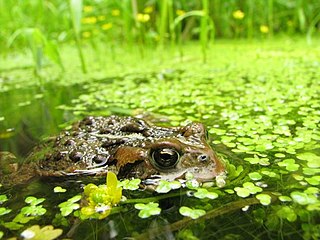
Ecology is the natural science of the relationships among living organisms and their environment. Ecology considers organisms at the individual, population, community, ecosystem, and biosphere levels. Ecology overlaps with the closely related sciences of biogeography, evolutionary biology, genetics, ethology, and natural history.

Theoretical ecology is the scientific discipline devoted to the study of ecological systems using theoretical methods such as simple conceptual models, mathematical models, computational simulations, and advanced data analysis. Effective models improve understanding of the natural world by revealing how the dynamics of species populations are often based on fundamental biological conditions and processes. Further, the field aims to unify a diverse range of empirical observations by assuming that common, mechanistic processes generate observable phenomena across species and ecological environments. Based on biologically realistic assumptions, theoretical ecologists are able to uncover novel, non-intuitive insights about natural processes. Theoretical results are often verified by empirical and observational studies, revealing the power of theoretical methods in both predicting and understanding the noisy, diverse biological world.
Ecology is a new science and considered as an important branch of biological science, having only become prominent during the second half of the 20th century. Ecological thought is derivative of established currents in philosophy, particularly from ethics and politics.
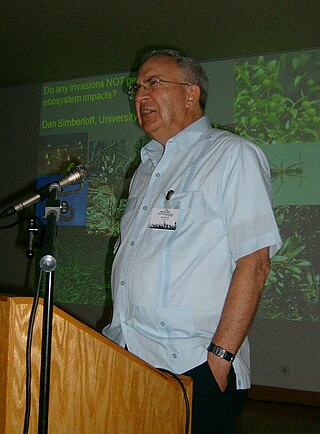
Daniel Simberloff is an American biologist and ecologist. He earned his Ph.D. from Harvard University in 1969. He is currently Gore Hunger Professor of Environmental Science at the University of Tennessee, editor-in-chief of the journal Biological Invasions, and a member of the National Academy of Sciences.
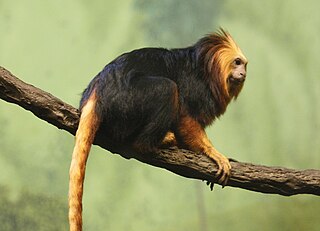
The golden-headed lion tamarin, also the golden-headed tamarin, is a lion tamarin endemic to Brazil. It is found only in the lowland and premontane tropical forest fragments in the state of Bahia, and therefore is considered to be an endangered species. It lives at heights of 3–10 metres (9.8–32.8 ft). Its preferred habitat is within mature forest, but with habitat destruction this is not always the case. Several sources seem to have different information on the number of individuals within a group, and the type of social system that may be apparent. The golden-headed lion tamarin lives within group sizes ranging from 2 to 11 individuals, with the average size ranging from 4 to 7. According to various sources, the group may consist of two adult males, one adult female, and any immature individuals, one male and one female and any immature individuals, or there may be one producing pair and a varying number of other group members, usually offspring from previous generations. There is not much known on its mating system, but according to different sources, and information on the possible social groups, it can be assumed that some may practice monogamous mating systems, and some may practice polyandrous mating systems. Both males and females invest energy in caring for the young, and all members of the group also help with juvenile care.
In landscape ecology, landscape connectivity is, broadly, "the degree to which the landscape facilitates or impedes movement among resource patches". Alternatively, connectivity may be a continuous property of the landscape and independent of patches and paths. Connectivity includes both structural connectivity and functional connectivity. Functional connectivity includes actual connectivity and potential connectivity in which movement paths are estimated using the life-history data.
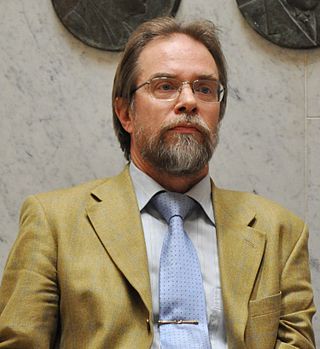
Ilkka Aulis Hanski was a Finnish ecologist at the University of Helsinki, Finland. The Metapopulation Research Center led by Hanski, until his death, has been nominated as a Center of Excellence by the Academy of Finland. The group studies species living in fragmented landscapes and attempts to advance metapopulation ecology research. Hanski proposed the core-satellite hypothesis of species distributions. Metapopulation ecology itself studies populations of plants and animals which are separated in space by occupying patches.

Steven J. Cooke is a Canadian biologist specializing in ecology and conservation physiology of fish. He is best known for his integrative work on fish physiology, behaviour, ecology, and human-dimensions to understand and solve complex environmental problems. He currently is a Canada Research Professor in Environmental Science and Biology at Carleton University and the Editor-in-Chief of the American Fisheries Society magazine Fisheries, Co-Editor-in-Chief of the Collaboration for Environmental Evidence journal Environmental Evidence, and Emeritus Editor and Strategic Advisor for the journal Conservation Physiology.
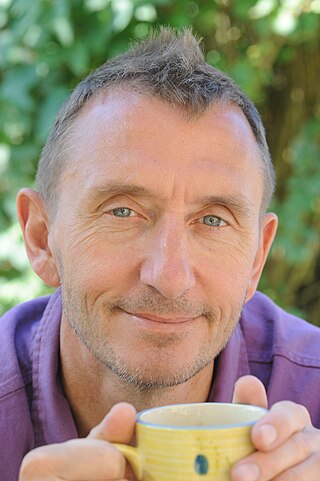
Dave Goulson is Professor of Biology at the University of Sussex. Specializing in the ecology and conservation of insects, particularly bumblebees, Goulson is the author of several books, including Bumblebees: Their Behaviour and Ecology (2003), Silent Earth: Averting the Insect Apocalypse (2021), and more than 200 academic articles. In 2006 he founded the Bumblebee Conservation Trust, a charity that aims to reverse the decline in the bumblebee population.
Sonia M. Altizer is the Georgia Athletic Association Professor of Ecology in the University of Georgia, Odum School of Ecology.

William James Sutherland is the Director of Research at the University of Cambridge Department of Zoology, and was previously the Miriam Rothschild Professor of Conservation Biology. He has been the president of the British Ecological Society. He has been a Fellow of St Catharine's College, Cambridge since 2008.
Colin A. Chapman is a professor at the Vancouver Island University in British Columbia, Canada. In addition, he is a Fellow of the Royal Society of Canada, an Honorary Lecturer at Makerere University in Uganda, a Member of the Committee of Research and Exploration at National Geographic, and an Associate Scientists of the Wildlife Conservation Society in New York. Prior to taking on his position at McGill University, he was at the University of Florida in the Department of Zoology from 1993 to 2004. He is internationally recognized for his 30+ years of research into primate ecology, population regulation, nutrition, and disease dynamics and for his contribution to conservation globally.
Rodolfo Dirzo is a professor, conservationist, and tropical ecologist. He is a Bing Professor in environmental science at Stanford and a senior fellow at the Stanford Woods Institute for the Environment. His research interests mainly focus on plant-animal interactions, evolutionary ecology, and defaunation in the tropics of Latin America, Africa, and the Central Pacific. He was a member of the Committee on A Conceptual Framework for New K-12 Science Education Standards, co-authoring the framework in 2012, and continues to educate local communities and young people about science and environmental issues.

Pedro Diego Jordano Barbudo is an ecologist, conservationist, researcher, focused on evolutionary ecology and ecological interactions. He is an honorary professor and associate professor at University of Sevilla, Spain. Most of his fieldwork is done in Parque Natural de las Sierras de Cazorla, Segura y Las Villas, in the eastern side of Andalucia, and in Doñana National Park, where he holds the title of Research Professor for the Estación Biológica Doñana, Spanish Council for Scientific Research (CSIC). Since 2000 he has been actively doing research in Brazil, with fieldwork in the SE Atlantic rainforest.
Jean-Dominique Lebreton is a biomathematician and a member of the French Academy of Sciences.

Anna Traveset is a Spanish ecologist, particularly known for her work on ecological interactions between plants and animals, especially on islands.

Douglas J. McCauley is a professor of ocean science at the University of California Santa Barbara, and serves as the Director of the Benioff Ocean Science Laboratory - an applied ocean research center based at UC Santa Barbara's Marine Science Institute. His research focuses on using tools from ecology, data science, and marine policy for ocean conservation.
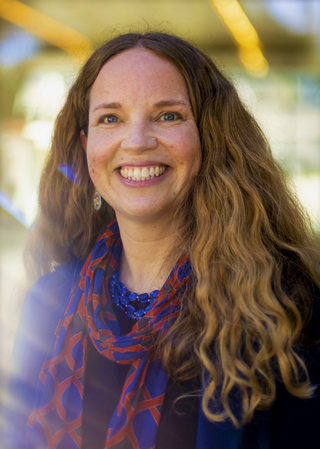
Jennifer Elaine Smith is a behavioral ecologist and evolutionary biologist. She is an associate professor of Biology at University of Wisconsin, Eau Claire. Previously, she was an associate professor and chair of biology at Mills College, in Oakland, California, prior to its merger with Northeastern University. Her research focuses primarily on the social lives of mammals based on insights gained from long-term studies on marked individuals and comparative approaches.

Lenore Fahrig is a Chancellor's Professor in the biology department at Carleton University, Canada and a Fellow of the Royal Society of Canada. Fahrig studies effects of landscape structure—the arrangement of forests, wetlands, roads, cities, and farmland—on wildlife populations and biodiversity, and is best known for her work on habitat fragmentation. In 2023, she was elected to the National Academy of Sciences.

Robert Mitchell Pringle is an American biologist and conservationist.


