Related Research Articles

Criticism is the construction of a judgement about the negative or positive qualities of someone or something. Criticism can range from impromptu comments to a written detailed response. Criticism falls into several overlapping types including "theoretical, practical, impressionistic, affective, prescriptive, or descriptive".
Critical legal studies (CLS) is a school of critical theory that developed in the United States during the 1970s. CLS adherents claim that laws are devised to maintain the status quo of society and thereby codify its biases against marginalized groups.
Feminist legal theory, also known as feminist jurisprudence, is based on the belief that the law has been fundamental in women's historical subordination. Feminist jurisprudence the philosophy of law is based on the political, economic, and social inequality of the sexes and feminist legal theory is the encompassment of law and theory connected.The project of feminist legal theory is twofold. First, feminist jurisprudence seeks to explain ways in which the law played a role in women's former subordinate status. Feminist legal theory was directly created to recognize and combat the legal system built primarily by the and for male intentions, often forgetting important components and experiences women and marginalized communities face. The law perpetuates a male valued system at the expense of female values. Through making sure all people have access to participate in legal systems as professionals to combating cases in constitutional and discriminatory law, feminist legal theory is utilized for it all.

Intersectionality is a sociological analytical framework for understanding how groups' and individuals' social and political identities result in unique combinations of discrimination and privilege. Examples of these factors include gender, caste, sex, race, ethnicity, class, sexuality, religion, disability, height, age, and weight. These intersecting and overlapping social identities may be both empowering and oppressing. However, little good-quality quantitative research has been done to support or undermine the practical uses of intersectionality.
Critical race theory (CRT) is an academic field focused on the relationships between social conceptions of race and ethnicity, social and political laws, and media. CRT also considers racism to be systemic in various laws and rules, not based only on individuals' prejudices. The word critical in the name is an academic reference to critical theory rather than criticizing or blaming individuals.

Derrick Albert Bell Jr. was an American lawyer, legal scholar, and civil rights activist. Bell first worked for the U.S. Justice Department, then the NAACP Legal Defense Fund, where he supervised over 300 school desegregation cases in Mississippi.
Peggy Ann Pascoe was an American historian. She was the Beekman Professor of Northwest and Pacific History and Professor of Ethnic Studies at the University of Oregon. She was a member of the University of Oregon History Department from 1996 until her death on July 23, 2010. Prior to her work at UO, Pascoe worked as an assistant professor and then associate professor at the University of Utah, where she taught courses on women’s history, race, and sexuality. Pascoe’s work centers on the history of race, gender, and sexuality, with a particular investment in law and the U.S. West. Together with George Lipsitz, Earl Lewis, George Sanchez, and Dana Takagi, Pascoe edited the influential American Crossroads book series in Ethnic Studies, published by the University of California Press. Pascoe held this position for fifteen years.

Kimberlé Williams Crenshaw is an American civil rights advocate and a scholar of critical race theory. She is a professor at the UCLA School of Law and Columbia Law School, where she specializes in race and gender issues.
Angela P. Harris is an American legal scholar at UC Davis School of Law, in the fields of critical race theory, feminist legal scholarship, and criminal law. She held the position of professor of law at UC Berkeley School of Law, joining the faculty in 1988. In 2009, Harris joined the faculty of the State University of New York at Buffalo Law School as a visiting professor. In 2010, she also assumed the role of acting vice dean for research and faculty development. In 2011, she accepted an offer to join the faculty at the UC Davis School of Law, and began teaching as a professor of law in the 2011–12 academic year.
Martha Albertson Fineman is an American jurist, legal theorist and political philosopher. She is Robert W. Woodruff Professor of Law at Emory University School of Law. Fineman was previously the first holder of the Dorothea S. Clarke Professor of Feminist Jurisprudence at Cornell Law School. She held the Maurice T. Moore Professorship at Columbia Law School.
The Michigan Journal of Race & Law is a student-run civil rights journal published at the University of Michigan Law School. The Journal began publication in 1996 and publishes semiannually. The editors and staff of the journal hold film series, critical race theory events, and symposia on issues related to the intersection of race and law. Anita Hill is one of the journal's contributors.
William A. Jacobson is an American lawyer, Cornell Law School clinical professor, and conservative blogger.

Sally Haslanger is an American philosopher and the Ford Professor of Philosophy in the Department of Linguistics and Philosophy at the Massachusetts Institute of Technology.
Rose Rosengard Subotnik is a leading American musicologist, generally credited with introducing the writing of Theodor Adorno to English-speaking musicologists in the late 1970s.
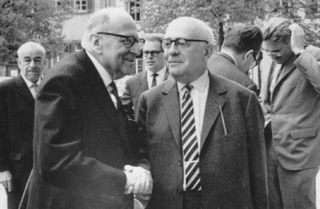
A critical theory is any approach to humanities and social philosophy that focuses on society and culture to attempt to reveal, critique, and challenge power structures. With roots in sociology and literary criticism, it argues that social problems stem more from social structures and cultural assumptions than from individuals. Some hold it to be an ideology, others argue that ideology is the principal obstacle to human liberation. Critical theory finds applications in various fields of study, including psychoanalysis, film theory, literary theory, cultural studies, history, communication theory, philosophy, and feminist theory.
The Law and Political Economy (LPE) Project is a collaborative project that examines the relationship between the law and capitalism. In addition to a blog, the Project regularly hosts speaking events, debates, and lectures. It also circulates printed materials, hosts a summer academy and runs mentoring programs.
In critical race theory, the black–white binary is a paradigm through which racial history is presented as a linear story between White and Black Americans. This binary has largely defined how civil rights legislation is approached in the United States, as African Americans led most of the major racial justice movements that informed civil rights era reformation. The paradigm conceptualizes Black and White people as the two predominant racial groups, viewing all racism accordant to anti-blackness, and the Black–White relation as central to racial analysis. According to critical race scholars, the binary acts to govern racial classifications and describe how race is understood and approached politically and socially throughout American history. The black-white binary is a product of white socialization and reduces race relations to an oppressor/oppressed dichotomy.

Since 2020, efforts have been made by conservatives and others to challenge critical race theory (CRT) being taught in schools in the United States.
The Foundation Against Intolerance and Racism (FAIR) is an American nonprofit organization, founded in 2021, that campaigns against diversity and inclusion programs, ethnic studies curricula, and antiracism initiatives that it refers to as "critical race theory" (CRT).
The Legal Insurrection Foundation, sometimes abbreviated LIF, is an American not-for-profit organization founded in 2008 and based in Rhode Island. The foundation is a conservative advocacy organization which focuses on free-speech and academic freedom issues. It has been tax-exempt since March 2018, and as of 2023 its president is William A. Jacobson. The foundation has participated in 2020s controversies around critical race theory and has criticized diversity initiatives which it alleges have discriminated against white people.
References
- ↑ "Toxic Diversity". NYU Press.
- ↑ Jamerson. "Critical Race Theory: What it Means for America and Why It Has Sparked Debate". Wall Street Journal.
- ↑ Subotnik, Daniel. "What's Wrong with Critical Race Theory: Reopening the Case for Middle Class Values". 7 (3). Cornell Journal of Law and Public Policy: 1.
{{cite journal}}: Cite journal requires|journal=(help) - ↑ Subotnik, Daniel (April 1998). "What's Wrong With Critical Race Theory". Cornell Journal of Law and Public Policy. 7 (3): 681–756.
- ↑ Subotnik, Subotnik (2021). "Maybe Law Schools Do Not Oppress Minority Faculty Women: A Critique of Meera E. Deo's "Unequal Profession: Race and Gender in Legal Academia""". 37. Touro Law School: 2.
{{cite journal}}: Cite journal requires|journal=(help) - ↑ Subotnik, Dan (July 2005). Toxic Diversity. ISBN 0814740006.
- ↑ Subotnik, Daniel. "Are Law Schools Racist?: A "Talk" with Richard Delgado". 43 (4). University of San Francisco Law Review: 1.
{{cite journal}}: Cite journal requires|journal=(help) - ↑ Delgado, Richard. "Getting Real: A Reply to Dan Subotnik". 43 (4). University of San Francisco Law Review: 2.
{{cite journal}}: Cite journal requires|journal=(help)
