
Harvard Medical School (HMS) is the medical school of Harvard University and is located in the Longwood Medical Area in Boston, Massachusetts. Founded in 1782, HMS is one of the oldest medical schools in the United States. Harvard Medical School (HMS) provides patient care, medical education, and research training through its 15 clinical affiliates and research institutes such as Massachusetts General Hospital (MGH), Dana–Farber Cancer Institute, Brigham and Women's Hospital, Beth Israel Deaconess Medical Center, Boston Children's Hospital, Mount Auburn Hospital, McLean Hospital, Cambridge Health Alliance, The Baker Center for Children and Families, and Spaulding Rehabilitation Hospital. Harvard Medical School also partners with newer entities such as Harvard Catalyst, Broad Institute of MIT and Harvard, Harvard Stem Cell Institute, the Center for Primary Care, and Wyss Institute for Biologically Inspired Engineering.

The Ether Dome is a surgical operating amphitheater in the Bulfinch Building at Massachusetts General Hospital in Boston, United States. It served as the hospital's operating room from its opening in 1821 until 1867. It was the site of the first public demonstration of the use of inhaled ether as a surgical anesthetic on October 16, 1846, otherwise known as Ether Day. Crawford Long, a surgeon in Georgia, had previously administered sulfuric ether in 1842, but this went unpublished until 1849. The Ether Dome event occurred when William Thomas Green Morton, a local dentist, used ether to anesthetize Edward Gilbert Abbott. John Collins Warren, the first dean of Harvard Medical School, then painlessly removed part of a tumor from Abbott's neck. After Warren had finished, and Abbott regained consciousness, Warren asked the patient how he felt. Reportedly, Abbott said, "Feels as if my neck's been scratched". Warren then turned to his medical audience and uttered "Gentlemen, this is no Humbug". This was presumably a reference to the unsuccessful demonstration of nitrous oxide anesthesia by Horace Wells in the same theater the previous year, which was ended by cries of "Humbug!" after the patient groaned with pain.

Massachusetts General Hospital is a teaching hospital located in the West End neighborhood of Boston, Massachusetts. It is the original and largest clinical education and research facility of Harvard Medical School/Harvard University, and houses the world's largest hospital-based research program with an annual research budget of more than $1.2 billion in 2021. It is the third-oldest general hospital in the United States with a patient capacity of 999 beds. Along with Brigham and Women's Hospital, Mass General is a founding member of Mass General Brigham, formerly known as Partners HealthCare, the largest healthcare provider in Massachusetts.

Mass General Brigham (MGB) is a not-for-profit, integrated health care system that engages in medical research, teaching, and patient care. It is the largest hospital-based research enterprise in the United States, with annual funding of more than $2 billion. The system's annual revenue was nearly $18 billion in 2022. It is also an educational institution, founded by Brigham and Women's Hospital and Massachusetts General Hospital. The system provides clinical care through two academic hospitals, three specialty hospitals, seven community hospitals, home care services, a health insurance plan, and a robust network of specialty practices, urgent care facilities, and outpatient clinics/surgical centers. It is the largest private employer in Massachusetts. In 2023, the system reported that from 2017–2021 its overall economic impact was $53.4 billion – more than the annual state budget.

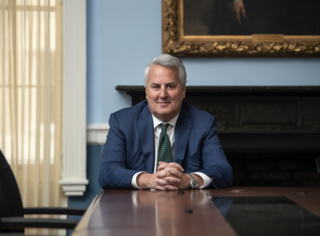
Brigham and Women's Hospital is the second largest teaching hospital of Harvard Medical School and the largest hospital in the Longwood Medical Area in Boston, Massachusetts. Along with Massachusetts General Hospital, it is one of the two founding members of Mass General Brigham, the largest healthcare provider in Massachusetts. Robert Higgins, MD, MSHA serves as the hospital's current president.

Massachusetts Eye and Ear is a specialty hospital located in Boston, Massachusetts, United States, which focuses on ophthalmology (eye), otolaryngology (ear/nose/throat), and related medicine and research. Founded in 1824 as the Boston Eye Infirmary (BEI), it has also been known as the Massachusetts Charitable Eye and Ear Infirmary (MCEEI), and Massachusetts Eye and Ear Infirmary (MEEI). It is a teaching partner of Harvard Medical School.
Dennis Brown is a renal physiologist. He is Professor of Medicine at Harvard Medical School, director of the Program in Membrane Biology at the Massachusetts General Hospital (MGH), and Associate Director of the MGH Center for Systems Biology. He is a member of the MGH Executive Committee on Research (ECOR), the central body for research governance at MGH.

Kurt Julius Isselbacher was a German-born American physician and held the position of Mallinckrodt Distinguished Professor of Medicine at Harvard Medical School and director emeritus of the Massachusetts General Hospital Cancer Center.

Alessio Fasano is an Italian-born medical doctor, pediatric gastroenterologist and researcher. He currently holds many roles, including professor of pediatrics at Harvard Medical School and professor of nutrition at Harvard T.H. Chan School of Public Health, both in Boston. He serves as director of the Center for Celiac Research and Treatment at MassGeneral Hospital for Children (MGHfC) and co-director of the Harvard Medical School Celiac Research Program. In addition, he is director of the Mucosal Immunology and Biology Research Center at MGHfC, where he oversees a research program with approximately 50 scientists and staff researching a variety of acute and chronic inflammatory diseases, including cystic fibrosis, celiac disease, enteric infections and necrotizing enterocolitis. A common theme of these programs is the study of the emerging role of the gut microbiome in health and disease. Fasano is also the scientific director of the European Biomedical Research Institute of Salerno (EBRIS) in Italy. Along with these leadership positions, he is a practicing outpatient clinician in pediatric gastroenterology and nutrition and the division chief.
Mitchell T. Rabkin is an American physician and Distinguished Institute Scholar at the Shapiro Institute, Professor of Medicine at Harvard Medical School and CEO Emeritus at the Beth Israel Deaconess Medical Center.
Jonathan Rosand is an American neurologist, clinician-scientist and Professor of Neurology at Harvard Medical School. He is Chief of the Division of Neurocritical Care and Emergency Neurology, Medical Director of the Neurosciences Intensive Care Unit and holds the J.P. Kistler Endowed Chair in Neurology at the Massachusetts General Hospital (MGH). He is also Independent Faculty within the MGH Center for Human Genetic Research and an Associate Member of the Broad Institute of MIT and Harvard. He previously was Program Director for the Massachusetts General Hospital/Brigham and Women's Hospital/Harvard Medical School Fellowship Training Programs in both Neurocritical Care and Vascular Neurology. He is the founder of the International Stroke Genetics Consortium and was its inaugural steering committee chair.

Joel Salinas is an American-born Nicaraguan neurologist, writer, researcher, and an assistant professor of neurology at Harvard Medical School. He practices general neurology, with subspecialty in behavioral neurology and neuropsychiatry, at the Massachusetts General Hospital in Boston, Massachusetts. He is also a clinician-scientist at the Harvard T.H. Chan School of Public Health and the Framingham Study at the Boston University School of Medicine.
Jay Steven Loeffler was an American physician at Massachusetts General Hospital where he served as Chair of the Department of Radiation Oncology since 2000. He was the Herman and Joan Suit Professor of Radiation Oncology and Professor of Neurosurgery at Harvard Medical School.

Jochen Reiser is a physician-scientist and a healthcare leader. He is the President of the University of Texas Medical Branch (UTMB) and CEO of the UTMB Health System, which includes the oldest medical school and nursing school in Texas. As chief executive officer, he oversees the enterprise which includes multiple campuses, five health science colleges, the Galveston National Laboratory (BSL-4) and the Correctional Health Care Services for most of Texas.

Gregory R. Ciottone is an American physician specializing in disaster medicine and counter-terrorism medicine. He is an associate professor of emergency medicine at Harvard Medical School and the founding director of the BIDMC Fellowship in Disaster Medicine, the first of its kind in a Harvard teaching hospital. As well, he holds the position of director for medical preparedness at the National Preparedness Leadership Initiative, a joint program of the Harvard T.H.Chan School of Public Health and the Center for Public Leadership at the Harvard John F. Kennedy School of Government. He also serves as a consultant to the White House Medical Unit for the Obama, Trump, and Biden administrations. In 2019 he was elected president of the World Association for Disaster and Emergency Medicine. (WADEM).
Erik K. Alexander is an American medical educator and practicing clinician. He is Vice President of Education for Brigham Health, and Harvard Medical School Associate Dean for Medical Education (BWH). In 2011, he joined the board of directors of the American Thyroid Association. Alexander is a Professor of Medicine in the Department of Medicine at Harvard Medical School (HMS), and is the Executive Director of the Brigham Education Institute (BEI) and Undergraduate Medical Education at Brigham and Women's Hospital (BWH) in Boston, Massachusetts.
Daniel David Federman, was an American endocrinologist and the Carl W. Walter Distinguished Professor of Medicine and the dean for medical education at Harvard Medical School. He helped change medical education at through its New Pathway curriculum around the early 1990s, and his work helped create the field of genetic endocrinology. Federman also worked for over thirty years at Boston's Brigham and Women's Hospital, a Harvard Medical School teaching hospital in the Longwood Medical and Academic Area.
Sekar Kathiresan is chief executive officer and co-founder of Verve Therapeutics. Verve is pioneering a new approach to the care of cardiovascular disease by developing single-course gene-editing therapies that safely and durably lower plasma LDL cholesterol in order to treat atherosclerotic cardiovascular disease.
Wolfram Goessling is a physician-scientist who specializes in oncology and gastroenterology. He is the Robert H. Ebert Professor of Medicine at Harvard Medical School and Chief of the Division of Gastroenterology at Massachusetts General Hospital. Goessling is also involved in the Harvard–MIT Program of Health Sciences and Technology (HST), where he is co-director with Emery N. Brown.
Reshma Kewalramani, is the president and chief executive officer of Vertex Pharmaceuticals, a biotechnology company based in Boston, Massachusetts, as of April 1, 2020. She is the first female CEO of a large US biotech company. She was previously the chief medical officer and vice president of global medicines development and medical affairs at Vertex.
