Related Research Articles

The fourth USS Princeton (CVL-23) was a United States Navy Independence-class light aircraft carrier active in the Pacific Ocean during World War II. She was launched in 1942 and lost at the Battle of Leyte Gulf in 1944.

USS Chicago (CA-29) was a Northampton-class cruiser of the United States Navy that served in the Pacific Theater in the early years of World War II. She was the second US Navy ship to be named after the city of Chicago. After surviving a midget submarine attack at Sydney Harbour and serving in battle at the Coral Sea and Savo Island in 1942, she was sunk by Japanese aerial torpedoes in the Battle of Rennell Island, in the Solomon Islands, on 30 January 1943.

The Mahan-class destroyers of the United States Navy were a series of 18 destroyers of which the first 16 were laid down in 1934. The last two of the 18, Dunlap and Fanning, are sometimes considered a separate ship class. All 18 were commissioned in 1936 and 1937. Mahan was the lead ship, named for Rear Admiral Alfred Thayer Mahan, an influential historian and theorist on sea power.

The Atlanta-class cruisers were eight United States Navy light cruisers designed as fast scout cruisers or flotilla leaders but that proved to be effective anti-aircraft cruisers during World War II. They were also known as the Atlanta-Oakland class. The four Oakland and later ships had slightly different armament as they were further optimized for anti-aircraft fire. The Atlanta class had 12 x 5-inch (127 mm)/38 caliber guns, mounted in three superfiring sets of two-gun turrets fore and three more aft. The first four ships of the class also had an additional two twin 5-inch/38 mounts, one port and one starboard, giving these first four Atlanta-class cruisers the heaviest anti-aircraft armament of any cruiser of World War II.

USS Crowninshield (DD–134) was a Wickes-class destroyer in the United States Navy between World War I and World War II. She was named for Benjamin Williams Crowninshield. In World War II she was transferred to the Royal Navy where she was named HMS Chelsea, and subsequently to the Soviet Navy where she was named Derzkiy.

Aubrey Wray Fitch was an admiral of the United States Navy during World War II. A naval aviator, he held important aviation-related commands both at sea and on shore from the 1920s onward. He also served as Superintendent of the United States Naval Academy.

USS Craven (DD-70), a Caldwell-class destroyer, served in the United States Navy, and later in the Royal Navy as HMS Lewes.

The Bagley class of eight destroyers was built for the United States Navy. They were part of a series of USN destroyers limited to 1,500 tons standard displacement by the London Naval Treaty and built in the 1930s. All eight ships were ordered and laid down in 1935 and subsequently completed in 1937. Their layout was based on the concurrently-built Gridley class destroyer design and was similar to the Benham class as well; all three classes were notable for including sixteen 21 inch torpedo tubes, the heaviest torpedo armament ever on US destroyers. They retained the fuel-efficient power plants of the Mahan-class destroyers, and thus had a slightly lower speed than the Gridleys. However, they had the extended range of the Mahans, 1,400 nautical miles (2,600 km) farther than the Gridleys. The Bagley class destroyers were readily distinguished visually by the prominent external trunking of the boiler uptakes around their single stack.

Ralph McMaster Rich was an aviator of the United States Navy during World War II.
Randolph Mitchell Holder, was commissioned as an Ensign April 10, 1940 following flight training. Reporting to Torpedo Squadron 6 (VT-6) on the famous aircraft carrier USS Enterprise (CV-6), he took part in the early carrier operations in the critical months following the attack on Pearl Harbor and then fought in the pivotal Battle of Midway, the first of the great American successes in the naval war against the Empire of Japan. In the gallant but futile attack of the torpedo planes early on June 4, 1942, Holder and his comrades attacked the Japanese ships without fighter cover. Though Holder and many others were shot down while pressing this attack, they forced radical maneuvers and diverted the Japanese air cover so as to make later raids lethal to the enemy fleet. Lieutenant (j.g.) Holder never returned to the Enterprise, and was presumed dead the next day, June 5, 1942. He was awarded the Navy Cross posthumously for his heroism.
Eugene S. Sarsfield was an officer of the United States Navy during World War II.
USS Turaco (AMc-55), an Accentor class coastal minesweeper was named by the U.S. Navy after the turaco. The ship was laid down on 17 January 1941 by the Snow Shipyards of Rockland, Maine, launched on 28 July 1941, and was decommissioned on 30 November 1945.
Laurice Aldridge Tatum was a dentist and officer of the United States Navy during World War II.
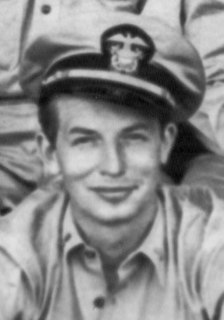
Oswald A. Powers (1915–1942) was a United States Navy officer who received the Navy Cross posthumously for his actions in combat during World War II.

Curtis William Howard was a United States Navy officer who received the Navy Cross posthumously for his actions during the Battle of Midway during World War II.
John W. Brock (1914–1942) was a United States Navy officer who received the Navy Cross posthumously for his actions in combat during World War II.
John P. Gray (1914–1942) was a United States Navy officer who received the Navy Cross posthumously for his actions in combat during World War II.
References
- This article incorporates text from the public domain Dictionary of American Naval Fighting Ships .
- "Roche". Dictionary of American Naval Fighting Ships. Retrieved March 23, 2007.
  | This biographical article related to the United States Navy is a stub. You can help Wikipedia by expanding it. |