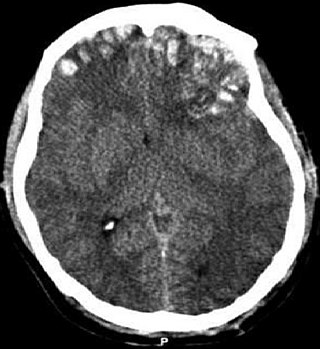
A traumatic brain injury (TBI), also known as an intracranial injury, is an injury to the brain caused by an external force. TBI can be classified based on severity, mechanism, or other features. Head injury is a broader category that may involve damage to other structures such as the scalp and skull. TBI can result in physical, cognitive, social, emotional and behavioral symptoms, and outcomes can range from complete recovery to permanent disability or death.

Physical medicine and rehabilitation, also known as physiatry, is a branch of medicine that aims to enhance and restore functional ability and quality of life to people with physical impairments or disabilities. This can include conditions such as spinal cord injuries, brain injuries, strokes, as well as pain or disability due to muscle, ligament or nerve damage. A physician having completed training in this field may be referred to as a physiatrist.

Chronic traumatic encephalopathy (CTE) is a neurodegenerative disease linked to repeated trauma to the head. The encephalopathy symptoms can include behavioral problems, mood problems, and problems with thinking. The disease often gets worse over time and can result in dementia. It is unclear if the risk of suicide is altered.
Polytrauma and multiple trauma are medical terms describing the condition of a person who has been subjected to multiple traumatic injuries, such as a serious head injury in addition to a serious burn. The term is defined via an Injury Severity Score (ISS) equal to or greater than 16. It has become a commonly applied term by US military physicians in describing the seriously injured soldiers returning from Operation Iraqi Freedom in Iraq and Operation Enduring Freedom in Afghanistan. The term is generic, however, and has been in use for a long time for any case involving multiple trauma.
Ross D. Zafonte is an American board-certified physiatrist known for his academic work in traumatic brain injury and is recognized as an expert in his field. His textbook, Brain Injury Medicine: Principles and Practice, is regarded as a standard in brain injury care. Zafonte has spoken at national and international conferences about traumatic brain injury, spasticity and other neurological disorders, and has authored more than 300 peer review journal articles, abstracts and book chapters. He serves on the editorial board of the Journal of Neurotrauma and NeuroEngineering and Rehabilitation.
Frank H. Krusen was an American physiatrist. He is regarded as a "founder" of the field of physical medicine and rehabilitation. He founded the first Department of Rehabilitation at Temple Hospital in 1928. Physiatrists remember his scholarly contributions, most notably through his numerous contributions to the medical literature on the use of therapeutic modalities in medicine, and his foundational textbook, Physical Medicine, published in 1941, and subsequently titled, Krusen's Handbook of Physical Medicine and Rehabilitation 1]. Dr. Krusen was the driving force behind the establishment of the first residency program in Physical Medicine at Mayo Clinic in 1936. He was also a charter member of the American Academy of Physical Medicine and Rehabilitation (AAPM&R) and served as its president from 1941-1942. His focused on the field on education, research, and collaboration with other colleagues in medicine and rehabilitation services, a framework for professional activities that remains relevant for PM&R in the 21st century.
The American Academy of Physical Medicine and Rehabilitation (AAPM&R) is the national medical specialty society in the United States for physicians who specialize in physical medicine and rehabilitation (PM&R). These physicians are called "physiatrists" or "rehabilitation physicians". Founded in 1938, AAPM&R also offers education, advocates for PM&R, and promotes PM&R research.
Steven R. Flanagan is a nationally renowned expert in the field of traumatic brain injury (TBI) and is professor and chairman of the Department of Rehabilitation Medicine at the New York University School of Medicine, and the medical director of the Rusk Institute of Rehabilitation Medicine at the NYU Langone Medical Center.
Kristjan T. Ragnarsson, M.D., is an American physiatrist with an international reputation in the rehabilitation of individuals with disorders of the central nervous system. He is currently the Dr. Lucy G. Moses Professor and Chair of Rehabilitation Medicine at The Mount Sinai Medical Center in New York City.

Steven L. West is an American research scientist and rehabilitation counselor specializing in addictions issues among persons with disabilities. He is a Professor in the Department of Counseling, Educational Psychology and Research at the University of Memphis in Memphis, TN.

The VA Palo Alto Health Care System (VAPAHCS) is a United States Department of Veterans Affairs healthcare group located in California which consists of three inpatient facilities, plus seven outpatient clinics in San Jose, Capitola, Monterey, Stockton, Modesto, Sonora, and Fremont.

The Virginia Commonwealth University (VCU) Center for Rehabilitation Science and Engineering (CERSE) is a comprehensive, interdisciplinary, University-approved Center of Excellence furthering the science and serving the needs of persons with disabilities. CERSE is administrated and coordinated by the Department of Physical Medicine and Rehabilitation, funded through the VCU Office of Research, the School of Medicine, the Department of Physical Medicine and Rehabilitation (PM&R), and the Virginia Department of Rehabilitative Services (DRS). CERSE serves as the mechanism for coordination, consolidation, and support of evidence based disability research endeavors from multiple schools and departments at VCU and a number of affiliate organizations. In partnership with the clinical services provided through the VCU Medical Center, the Hunter Holmes McGuire VA Medical Center (VAMC), Sheltering Arms Rehabilitation Programs, VCU Children’s Hospital of Richmond, the U.S. Navy, the U.S. Marine Corps and other affiliated programs, CERSE has brought together researchers, clinicians, rehabilitation specialists, therapists, and academicians from the numerous backgrounds and specialties. These collaborations optimize resources, avoid duplication of effort, and increase the capacity to successfully compete for high-level grant and foundation funding. CERSE is currently composed of seven Research Cores built on the strength of existing disability research and training:
- Neurorehabilitation
- Musculoskeletal and Pain Rehabilitation
- Employment and Economic Outcomes
- Defense and Veterans Rehabilitation
- Pediatric Rehabilitation
- Rehabilitation Engineering and Technology
- Health Disparities

Segun Toyin Dawodu is a Nigerian Physiatrist and lawyer with the WellSpan Health, he served as an Associate Professor of Pain Medicine at Albany Medical College.
The Galveston Orientation and Amnesia Test (GOAT) is a measure of attention and orientation, especially to see if a patient has recovered from post-traumatic amnesia (PTA) after a traumatic brain injury. This was the first measure created to test post-traumatic amnesia, and is still the most widely used test. The test was created by Harvey S. Levin and colleagues (1979), and features ten questions that assess temporal and spatial orientation, biographical recall, and memory. Points are awarded for responses to each question, with a 100 points possible. A score greater than 78 for three consecutive days is considered the threshold for emergence from post-traumatic amnesia. This test is intended for patients aged 15 years or older. Younger patients are given a modified version of the test, known as the Children's Orientation and Attention Test (COAT).

The Veterans Traumatic Brain Injury Care Improvement Act is a bill introduced in the 113th U.S. Congress that would extend medical treatment and rehabilitation services to U.S. military veterans suffering from traumatic brain injuries.
The Chronic Effects of Neurotrauma Consortium or CENC is a federally funded research project devised to address the long-term effects of mild traumatic brain injury in military service personnel (SMs) and Veterans. Announced by President Barack Obama on August 20, 2013, the CENC was one of two major initiatives developed in response to the injuries incurred by U.S. service personnel during Operation Enduring Freedom and Operation Iraqi Freedom. The project is jointly funded in the amount of $62.175 million by the Department of Defense (DoD) and the Department of Veterans Affairs (VA). The CENC is led by Dr. David X. Cifu of the Virginia Commonwealth University.
Bruce M. Gans is an American physiatrist. Gans serves as the chief medical officer and executive vice president at Kessler Institute for Rehabilitation

Odette Harris is a professor of neurosurgery at Stanford University and the Director of the Brain Injury Program for the Stanford University School of Medicine. She is the Deputy Chief of Staff, Rehabilitation at the VA Palo Alto Health Care System.
Sleep disorder is a common repercussion of traumatic brain injury (TBI). It occurs in 30%-70% of patients with TBI. TBI can be distinguished into two categories, primary and secondary damage. Primary damage includes injuries of white matter, focal contusion, cerebral edema and hematomas, mostly occurring at the moment of the trauma. Secondary damage involves the damage of neurotransmitter release, inflammatory responses, mitochondrial dysfunctions and gene activation, occurring minutes to days following the trauma. Patients with sleeping disorders following TBI specifically develop insomnia, sleep apnea, narcolepsy, periodic limb movement disorder and hypersomnia. Furthermore, circadian sleep-wake disorders can occur after TBI.

Alison Nenos Cernich is an American neuropsychologist specializing in traumatic brain injury and computerized neuropsychological assessment. She is the deputy director of the Eunice Kennedy Shriver National Institute of Child Health and Human Development. Cernich was previously deputy director of the Defense Centers of Excellence for Psychological Health and Traumatic Brain Injury, assistant professor of neurology at University of Maryland School of Medicine, and chief of neuropsychology at the VA Maryland Health Care System.


