
Communication is usually defined as the transmission of information. The term may also refer to the message communicated through such transmissions or the field of inquiry studying them. There are many disagreements about its precise definition. John Peters argues that the difficulty of defining communication emerges from the fact that communication is both a universal phenomenon and a specific discipline of institutional academic study. One definitional strategy involves limiting what can be included in the category of communication. By this logic, one possible definition of communication is the act of developing meaning among entities or groups through the use of sufficiently mutually understood signs, symbols, and semiotic conventions.

A corporate identity or corporate image is the manner in which a corporation, firm or business enterprise presents itself to the public. The corporate identity is typically visualized by branding and with the use of trademarks, but it can also include things like product design, advertising, public relations etc. Corporate identity is a primary goal of the corporate communications, in order to maintain and build the identity to accord with and facilitate the corporate business objectives.

Communication studies or communication science is an academic discipline that deals with processes of human communication and behavior, patterns of communication in interpersonal relationships, social interactions and communication in different cultures. Communication is commonly defined as giving, receiving or exchanging ideas, information, signals or messages through appropriate media, enabling individuals or groups to persuade, to seek information, to give information or to express emotions effectively. Communication studies is a social science that uses various methods of empirical investigation and critical analysis to develop a body of knowledge that encompasses a range of topics, from face-to-face conversation at a level of individual agency and interaction to social and cultural communication systems at a macro level.
Centennial College of Applied Arts and Technology is a diploma- and degree-granting college in Toronto, Ontario, Canada. It is the oldest publicly funded college in Ontario. Its campuses are situated on the east side of the city, particularly in Scarborough, with an aerospace centre at Downsview Park in North York.

Tet is a Latvian internet service provider, telecommunications, technology and entertainment company. Since 2017, it also is an electricity service provider.
Marketing Communications refers to the use of different marketing channels and tools in combination. Marketing communication channels focus on how businesses communicate a message to its desired market, or the market in general. It is also in charge of the internal communications of the organization. Marketing communication tools include advertising, personal selling, direct marketing, sponsorship, communication, public relations, social media, customer journey and promotion.
Mass communication is the process of imparting and exchanging information through mass media to large segments of the population. It is usually understood for relating to various forms of media, as its technologies are used for the dissemination of information, of which journalism and advertising are part. Mass communication differs from other types of communication, such as interpersonal communication and organizational communication, because it focuses on particular resources transmitting information to numerous receivers. The study of mass communication is chiefly concerned with how the content of mass communication persuades or otherwise affects the behavior, the attitude, opinion, or emotion of the people receiving the information.

An advertising campaign is a series of advertisement messages that share a single idea and theme which make up an integrated marketing communication (IMC). An IMC is a platform in which a group of people can group their ideas, beliefs, and concepts into one large media base. Advertising campaigns utilize diverse media channels over a particular time frame and target identified audiences.

Selex ES was a subsidiary of Finmeccanica S.p.A., active in the electronics and information technology business, based in Italy and the UK, and formed in January 2013, following Finmeccanica's decision to combine its existing SELEX Elsag and SELEX Sistemi Integrati businesses into SELEX Galileo, the immediate predecessor of Selex ES. From 1 January 2016, the activities of Selex ES merged into Leonardo-Finmeccanica's Electronics, Defence and Security Systems Sector becoming Leonardo S.p.A.
Business communication is communication that is intended to help a business achieve a fundamental goal, through information sharing between employees as well as people outside the company. It includes the process of creating, sharing, listening, and understanding messages between different groups of people through written and verbal formats. The way that people communicate and operate within a business is very vital to how successful the company will be in the business world. Business communication occurs internally, employee-to-employee, or externally, business-to-business or business-to-consumer. This internal and external communication can happen through verbal or non-verbal communication methods. Often these internal and external forms of communication come with barriers, which can prevent the receiver from understanding the information sent by the sender.

A brand is a name, term, design, symbol or any other feature that distinguishes one seller's good or service from those of other sellers. Brands are used in business, marketing, and advertising for recognition and, importantly, to create and store value as brand equity for the object identified, to the benefit of the brand's customers, its owners and shareholders. Brand names are sometimes distinguished from generic or store brands.

Active Audience Theory argues that media audiences do not just receive information passively but are actively involved, often unconsciously, in making sense of the message within their personal and social contexts. Decoding of a media message may therefore be influenced by such things as family background, beliefs, values, culture, interests, education and experiences. Decoding of a message means how well a person is able to effectively receive and understand a message. Active Audience Theory is particularly associated with mass-media usage and is a branch of Stuart Hall's Encoding and Decoding Model.
MICA, formerly Mudra Institute of Communications, Ahmedabad, is a business school and an autonomous, non-profit institute of higher education, located on the outskirts of the western Indian city of Ahmedabad. Established in 1991, MICA is the only residential institute in India and perhaps in the Asia-Pacific region, dedicated to creating leadership in the area of Strategic Marketing and Communication. MICA has a wide range of academic offerings including residential programmes for Post Graduate Management Studies and a Fellow Programme in Management (Communication).
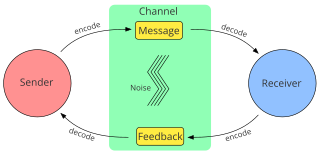
Models of communication are simplified representations of the process of communication. Most models try to describe both verbal and non-verbal communication and often understand it as an exchange of messages. Their function is to give a compact overview of the complex process of communication. This helps researchers formulate hypotheses, apply communication-related concepts to real-world cases, and test predictions. Despite their usefulness, many models are criticized based on the claim that they are too simple because they leave out essential aspects. The different components and their interactions are usually presented in the form of a diagram. Several basic components and interactions reappear in many of the models. They include the idea that a sender encodes information in the form of a message and sends it to a receiver through a channel. The receiver needs to decode the message to understand the initial idea and provides some form of feedback. In both cases, noise may interfere and distort the message.
N. Ravichandran was the 4th (regular) director of The Indian Institute of Management Indore. He is an MSc in maths from Annamalai University and holds a PhD from Indian Institute of Technology, Madras. He is currently a professor at IIM Ahmedabad in the area of operations management and quantitative techniques. He started the five-year Integrated Management Programme at IIM Indore and increased the batch size of the flagship PGP programme from 240 to 450.

Tanya Dubash is an Indian businesswoman, and an executive director and chief brand officer at the Godrej Group, and is known for taking up the responsibility for a rebranding exercise in 2008, Godrej Masterbrand Strategy. She serves on the boards of Godrej Industries Limited, Godrej Consumer Products Limited, Godrej Agrovet Limited. She was a board member of Bhartiya Mahila Bank and a trustee of Brown University. She is the elder daughter of the industrialist Adi Godrej.

Hareesh Tibrewala is an Indian businessman and an entrepreneur. He is the joint CEO for Mirum India. He has spoken on various topics related to entrepreneurship, digital marketing and marketing automation, and has also penned articles on chatbots, blockchain, marketing automation, augmented reality, healthcare marketing, human resources and virtual reality.

Dr. Mahul Brahma is an author and an Indian actor, working in the Bengali film industry. He has acted in a Bengali feature film Hoyto Manush Noy (2018) and a Bengali Short Film Elixir (2016) the latter was selected for the Cannes Short Film corner, 2016. Mahul's book Decoding Luxe is on the luxury market in India. The book is an in-depth study on the various dimensions of luxury. Mahul's second book Dark Luxe explores the dark side of luxury. His third book Luxe Inferno is a philosophical journey for the true meaning of luxury. These three books are a part of ‘The Luxe Trilogy’. After the trilogy, Dr. Brahma wrote his fourth book Quarantined: Love in the time of Corona, an anthology of six love stories of people locked down during the outbreak of coronavirus. The book was written during the COVID-19 crisis in 2020. Dr. Brahma made his directorial debut with short film PostIt (2018). Dr Brahma’s fifth book How to Communicate Strategically in Corporate World (2020) captures the evolving strategic role of communications in today’s corporate world.
WildBrain Studios is the in-house television studio arm of Canadian entertainment company WildBrain based in Vancouver which was established in 2016 as DHX Studios.


