
Bruxism is excessive teeth grinding or jaw clenching. It is an oral parafunctional activity; i.e., it is unrelated to normal function such as eating or talking. Bruxism is a common behavior; the global prevalence of bruxism is 22.22%. Several symptoms are commonly associated with bruxism, including aching jaw muscles, headaches, hypersensitive teeth, tooth wear, and damage to dental restorations. Symptoms may be minimal, without patient awareness of the condition. If nothing is done, after a while many teeth start wearing down until the whole tooth is gone.
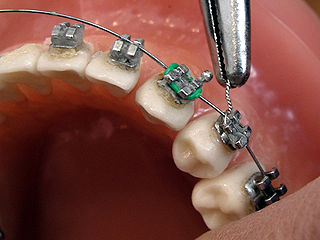
Orthodontics is a dentistry specialty that addresses the diagnosis, prevention, management, and correction of mal-positioned teeth and jaws, as well as misaligned bite patterns. It may also address the modification of facial growth, known as dentofacial orthopedics.
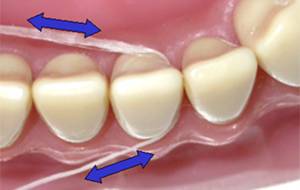
Dental floss is a cord of thin filaments used in interdental cleaning to remove food and dental plaque from between teeth or places a toothbrush has difficulty reaching or is unable to reach. Its regular use as part of oral cleaning is intended to maintain oral health.

Orthodontic retainers are custom-made devices, usually made of wires or clear plastic, that hold teeth in position after surgery or any method of realigning teeth. Once a phase of orthodontic treatment has been completed to straighten teeth, there remains a lifelong risk of relapse due to a number of factors: recoil of periodontal fibres, pressure from surrounding soft tissues, the occlusion and patient’s continued growth and development. By using retainers to hold the teeth in their new position for a length of time, the surrounding periodontal fibres adapt to changes in the bone which can help minimize any changes to the final tooth position after the completion of orthodontic treatment. Retainers may also be used to treat overjets.

Dental braces are devices used in orthodontics that align and straighten teeth and help position them with regard to a person's bite, while also aiming to improve dental health. They are often used to correct underbites, as well as malocclusions, overbites, open bites, gaps, deep bites, cross bites, crooked teeth, and various other flaws of the teeth and jaw. Braces can be either cosmetic or structural. Dental braces are often used in conjunction with other orthodontic appliances to help widen the palate or jaws and to otherwise assist in shaping the teeth and jaws.

A dental technician is a member of the dental team who, upon prescription from a dental clinician, constructs custom-made restorative and dental appliances.

A dental implant is a prosthesis that interfaces with the bone of the jaw or skull to support a dental prosthesis such as a crown, bridge, denture, or facial prosthesis or to act as an orthodontic anchor. The basis for modern dental implants is a biological process called osseointegration, in which materials such as titanium or zirconia form an intimate bond to the bone. The implant fixture is first placed so that it is likely to osseointegrate, then a dental prosthetic is added. A variable amount of healing time is required for osseointegration before either the dental prosthetic is attached to the implant or an abutment is placed which will hold a dental prosthetic or crown.
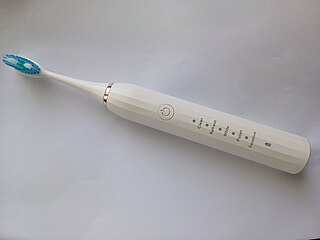
An electric toothbrush, motorized toothbrush, or battery-powered toothbrush is a toothbrush that makes rapid automatic bristle motions, either back-and-forth oscillation or rotation-oscillation, in order to clean teeth. Motions at sonic speeds or below are made by a motor. In the case of ultrasonic toothbrushes, ultrasonic motions are produced by a piezoelectric crystal. A modern electric toothbrush is usually powered by a rechargeable battery charged through inductive charging when the brush sits in the charging base between uses.

Clear aligners are orthodontic devices that are a transparent, plastic form of dental braces used to adjust teeth.

In orthodontics, a malocclusion is a misalignment or incorrect relation between the teeth of the upper and lower dental arches when they approach each other as the jaws close. The English-language term dates from 1864; Edward Angle (1855–1930), the "father of modern orthodontics", popularised it. The word derives from mal- 'incorrect' and occlusion 'the manner in which opposing teeth meet'.
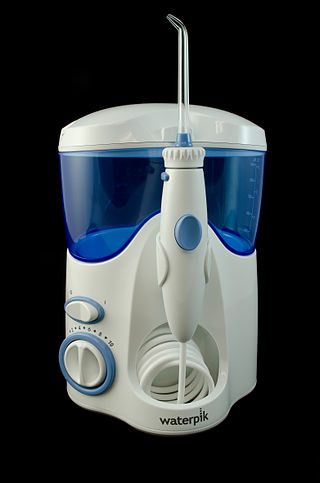
An oral irrigator is a home dental care device which uses a stream of high-pressure pulsating water intended to remove dental plaque and food debris between teeth and below the gum line. Regular use of an oral irrigator is believed to improve gingival health. The devices may also provide easier cleaning for braces and dental implants. However, more research is needed to confirm plaque biofilm removal and effectiveness when used by patients with special oral or systemic health needs.
A dental emergency is an issue involving the teeth and supporting tissues that are of high importance to be treated by the relevant professional. Dental emergencies do not always involve pain, although this is a common signal that something needs to be looked at. Pain can originate from the tooth, surrounding tissues or can have the sensation of originating in the teeth but be caused by an independent source. Depending on the type of pain experienced an experienced clinician can determine the likely cause and can treat the issue as each tissue type gives different messages in a dental emergency.
Orthodontic technology is a specialty of dental technology that is concerned with the design and fabrication of dental appliances for the treatment of malocclusions, which may be a result of tooth irregularity, disproportionate jaw relationships, or both.
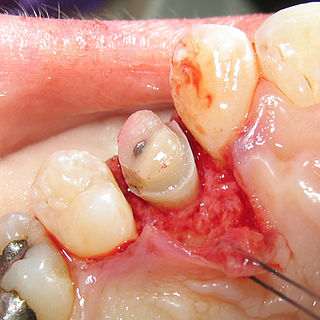
Crown lengthening is a surgical procedure performed by a dentist, or more frequently a periodontist, where more tooth is exposed by removing some of the gingival margin (gum) and supporting bone. Crown lengthening can also be achieved orthodontically by extruding the tooth.

In dentistry, overjet is the extent of horizontal (anterior-posterior) overlap of the maxillary central incisors over the mandibular central incisors. In class II malocclusion the overjet is increased as the maxillary central incisors are protruded.
Pre-eruption guidance is an orthodontic treatment method that allows for expansion of existing erupting teeth long before they appear in the mouth. The use off pre-eruption guidance appliances and the timing of extractions of certain deciduous teeth aligns the teeth naturally as opposed to orthodontic mechanical movement of permanent teeth into alignment after they have erupted. Research shows that pre-eruption guidance produces far more stable tooth alignment than alternative treatments.

Tooth mobility is the horizontal or vertical displacement of a tooth beyond its normal physiological boundaries around the gingival (gum) area, i.e. the medical term for a loose tooth.

Anchorage a medical term in orthodontics is defined as a way of resisting movement of a tooth or number of teeth by using different techniques. Anchorage is an important consideration in the field of orthodontics as this is a concept that is used frequently when correcting malocclusions. Unplanned or unwanted tooth movement can have dire consequences in a treatment plan, and therefore using anchorage stop a certain tooth movement becomes important. Anchorage can be used from many different sources such as teeth, bone, implants or extra-orally.
An Adams clasp is a component used to retain a custom-made medical device in the mouth. The clasp functions by engaging the mesiobuccal and distobuccal undercuts of a tooth, typically the maxillary first molar and is used to retain a wide range of devices prescribed in a variety of medical and dental specialties.

