Related Research Articles

The Great Patriotic War is a term used in Russia and some other former republics of the Soviet Union to describe the conflict fought during the period from 22 June 1941 to 9 May 1945 along the many fronts of the Eastern Front of World War II, primarily between the Soviet Union and Nazi Germany. For some legal purposes, this period may be extended to 11 May 1945 to include the end of the Prague offensive.
Nazism and the acts of Nazi Germany affected many countries, communities, and people before, during and after World War II. Nazi Germany's attempt to exterminate several groups viewed as subhuman by Nazi ideology was eventually stopped by the combined efforts of the wartime Allies headed by the United Kingdom, the Soviet Union, and the United States.
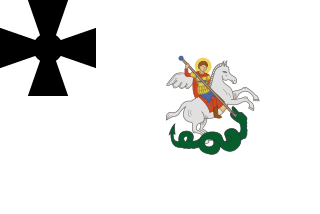
The Lokot Autonomy or Lokot Republic was an autonomous republic in the occupied territories of the Bryansk, Oryol and Kursk Oblasts of the Soviet Union by German Nazi troops, and more specifically by Guderian's 2nd Panzer Army during World War II.

The Battles of Rzhev were a series of Red Army offensives against the Wehrmacht between 8 January 1942 and 31 March 1943, on the Eastern Front of World War II. The battles took place in the northeast of Smolensk Oblast and the south of Tver Oblast, in and around the salient surrounding Rzhev. Due to the high losses suffered by the Red Army, the campaign became known by veterans and historians as the "Rzhev Meat Grinder".
Soviet partisans were members of resistance movements that fought a guerrilla war against Axis forces during World War II in the Soviet Union, the previously Soviet-occupied territories of interwar Poland in 1941–45 and eastern Finland. The activity emerged after Nazi Germany's Operation Barbarossa was launched from mid-1941 on. It was coordinated and controlled by the Soviet government and modeled on that of the Red Army.

Forced labor of Germans in the Soviet Union was considered by the Soviet Union to be part of German war reparations for the damage inflicted by Nazi Germany on the Soviet Union during the Axis-Soviet campaigns (1941–1945) of World War II. Soviet authorities deported German civilians from Germany and Eastern Europe to the USSR after World War II as forced laborers, while ethnic Germans living in the USSR were deported during World War II and conscripted for forced labor. German prisoners of war were also used as a source of forced labor during and after the war by the Soviet Union and by the Western Allies.

The military occupation of Latvia by Nazi Germany was completed on 10 July 1941, by Germany's armed forces. Initially, the territory of Latvia was under the military administration of Army Group North, but on 25 July 1941, Latvia was incorporated as Generalbezirk Lettland, subordinated to Reichskommissariat Ostland, an administrative subdivision of Nazi Germany. Anyone not racially acceptable or who opposed the German occupation, as well as those who had cooperated with the Soviet Union, was killed or sent to concentration camps in accordance with the Nazi Generalplan Ost.

Arbeitseinsatz was a forced labour category of internment within Nazi Germany during World War II. When German men were called up for military service, Nazi German authorities rounded up civilians to fill in the vacancies and to expand manufacturing operations. Some labourers came from Germany but exponentially more from roundups in the German-occupied territories. Arbeitseinsatz was not restricted to the industry sector and to arms producing factories; it also took place, for example, in the farming sector, community services, and even in the churches.

Alexander Alexandrovich Vishnevsky was a Soviet surgeon, member of the Academy of Medical Sciences of the USSR (1953), honoured worker of science of the RSFSR (1956), Colonel General of Medical Corps (1966), and a Hero of Socialist Labor (1966). Vishnevsky first conducted a cardiac surgery under the local anesthesia (1953).

Ostarbeiter was a Nazi German designation for foreign slave workers gathered from occupied Central and Eastern Europe to perform forced labor in Germany during World War II. The Germans started deporting civilians at the beginning of the war and began doing so at unprecedented levels following Operation Barbarossa in 1941. They apprehended Ostarbeiter from the newly-formed German districts of Reichskommissariat Ukraine, District of Galicia, and Reichskommissariat Ostland. These areas comprised German-occupied Poland and the conquered territories of the Soviet Union. According to Pavel Polian, although the Ostarbeiter from most occupied territories were predominantly men, of the "eastern workers" taken from occupied Soviet territories over 50% were women, and of those from Poland nearly 30% were women. Eastern workers included ethnic Ukrainians, Poles, Belarusians, Russians, Armenians, Tatars, and others. Estimates of the number of Ostarbeiter range between 3 million and 5.5 million.

The use of slave and forced labour in Nazi Germany and throughout German-occupied Europe during World War II took place on an unprecedented scale. It was a vital part of the German economic exploitation of conquered territories. It also contributed to the mass extermination of populations in occupied Europe. The Germans abducted approximately 12 million people from almost twenty European countries; about two thirds came from Central Europe and Eastern Europe. Many workers died as a result of their living conditions – extreme mistreatment, severe malnutrition and abuse were the main causes of death. Many more became civilian casualties from enemy (Allied) bombing and shelling of their workplaces throughout the war. At the peak of the program, the forced labourers constituted 20% of the German work force. Counting deaths and turnover, about 15 million men and women were forced labourers at one point during the war.

World War II losses of the Soviet Union were about 27,000,000 both civilian and military from all war-related causes, although exact figures are disputed. A figure of 20 million was considered official during the Soviet era. The post-Soviet government of Russia puts the Soviet war losses at 26.6 million, on the basis of the 1993 study by the Russian Academy of Sciences, including people dying as a result of effects of the war. This includes 8,668,400 military deaths as calculated by the Russian Ministry of Defence.

Victims of Yalta or The Secret Betrayal is a 1977 book by Nikolai Tolstoy that chronicles the fate of Soviet citizens who had been under German control during World War II and at its end fallen into the hands of the Western Allies. According to the secret Moscow agreement from 1944 that was confirmed at the 1945 Yalta conference, all citizens of the Soviet Union were to be repatriated without choice—a death sentence for many by execution or extermination through labour.
Boris Gavriilovich Shpitalny was a Soviet designer of aircraft guns and cannons and one of the first people awarded the title Hero of Socialist Labor.
The Soviet partisans in Estonia were Communist partisans who attempted to wage guerrilla warfare against the German armed forces during the German occupation of Estonia. The majority of partisans sent in by the Soviets were quickly picked up by the local Estonian militias.
The South Ural Military District was a military administrative division of the Soviet Armed Forces that existed from 1 December 1941 to 15 January 1958.
From the beginning of the Second World War, the Soviet policy—intended to discourage defection—advertised that any soldier who had fallen into enemy hands, or simply encircled without capture, was guilty of high treason and subject to execution, confiscation of property, and reprisal against their families. Issued in August 1941, Order No. 270 classified all commanders and political officers who surrendered as culpable deserters to be summarily executed and their families arrested. Sometimes Red Army soldiers were told that the families of defectors would be shot; although thousands were arrested, it is unknown if any such executions were carried out. As the war continued, Soviet leaders realized that most Soviet citizens had not voluntarily collaborated. In November 1944, the State Defense Committee decided that freed prisoners of war would be returned to the army while those who served in German military units or police would be handed over to the NKVD. At the Yalta Conference, the Western Allies agreed to repatriate Soviet citizens regardless of their wishes. The Soviet regime set up many NKVD filtration camps, hospitals, and recuperation centers for freed prisoners of war, where most stayed for an average of one or two months. These filtration camps were intended to separate out the minority of voluntary collaborators, but were not very effective.
The special groups of the NKVD for fighting against nationalists were units set up by the People's Commissariat for Internal Affairs of the Soviet Union mainly in territories annexed by the USSR before the German-Soviet war due to the Molotov–Ribbentrop Pact, in particular they fought against the OUN and UPA in Ukraine, the Forest Brothers, in the Baltic states and against the Belarusian Black Cats, a special unit of the Schutzstaffel. They were also known as the Agent-Combat Groups (ABG), legend groups, false UPA detachments and the NKVD units dressed as UPA fighters.

Anna Mikhaylovna Lisitsyna was a Soviet partisan who was posthumously awarded the title Hero of the Soviet Union on 25 September 1943 for her resistance activities.
Major Leonid Georgievich Belousov was a Soviet flying ace who served throughout World War II, even after both of his legs had to be amputated due to injuries.
References
- ↑ "ВОЕННАЯ ЛИТЕРАТУРА --[ Энциклопедии ]-- Великая Отечественная война 1…".
{{cite web}}: Check|url=value (help)[ dead link ] - ↑ "ВОЕННАЯ ЛИТЕРАТУРА --[ Энциклопедии ]-- Великая Отечественная война 1…".
{{cite web}}: Check|url=value (help)[ dead link ] - ↑ "ВОЕННАЯ ЛИТЕРАТУРА --[ Энциклопедии ]-- Великая Отечественная война 1…".
{{cite web}}: Check|url=value (help)[ dead link ] - ↑ Земсков В. Н. Сталин и народ. Почему не было восстания/ Виктор Земсков. — Москва: Родина, 2020. — 240 с.