Related Research Articles
Decane is an alkane hydrocarbon with the chemical formula C10H22. Although 75 structural isomers are possible for decane, the term usually refers to the normal-decane ("n-decane"), with the formula CH3(CH2)8CH3. All isomers, however, exhibit similar properties and little attention is paid to the composition. These isomers are flammable liquids. Decane is a component of gasoline (petrol) and kerosene. Like other alkanes, it is a nonpolar solvent, does not dissolve in water, and is readily combustible. Although it is a component of fuels, it is of little importance as a chemical feedstock, unlike a handful of other alkanes.

Oxalate (IUPAC: ethanedioate) is the dianion with the formula C
2O2−
4, also written (COO)2−
2. Either name is often used for derivatives, such as salts of oxalic acid, for example sodium oxalate Na2C2O4, or dimethyl oxalate ((CH3)2C2O4). Oxalate also forms coordination compounds where it is sometimes abbreviated as ox.
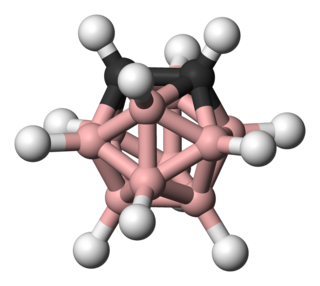
Carboranes are electron-delocalized clusters composed of boron, carbon and hydrogen atoms that may also contain other metallic and nonmetallic elements in the cluster framework. Like many of the related boron hydrides, these clusters are polyhedra or fragments of polyhedra, and are similarly classified as closo-, nido-, arachno-, hypho-, etc. based on whether they represent a complete (closo-) polyhedron, or a polyhedron that is missing one (nido-), two (arachno-), three (hypho-), or more vertices. Carboranes are a notable example of heteroboranes.
The IUPAC International Chemical Identifier is a textual identifier for chemical substances, designed to provide a standard way to encode molecular information and to facilitate the search for such information in databases and on the web. Initially developed by IUPAC and NIST from 2000 to 2005, the format and algorithms are non-proprietary.

Isocyanic acid is a chemical compound with the formula HNCO, discovered in 1830 by Liebig and Wöhler. This colourless substance is volatile and poisonous, with a boiling point of 23.5 °C. Isocyanic acid is the simplest stable chemical compound that contains carbon, hydrogen, nitrogen, and oxygen, the four most commonly found elements in organic chemistry and biology.

In organic chemistry, the tropylium ion or cycloheptatrienyl cation is an aromatic species with a formula of [C7H7]+. Its name derives from the molecule tropine from which cycloheptatriene (tropylidene) was first synthesized in 1881. Salts of the tropylium cation can be stable, even with nucleophiles of moderate strength e.g., tropylium tetrafluoroborate and tropylium bromide (see below). Its bromide and chloride salts can be made from cycloheptatriene and bromine or phosphorus pentachloride, respectively.

ChemSpider is a database of chemicals. ChemSpider is owned by the Royal Society of Chemistry.
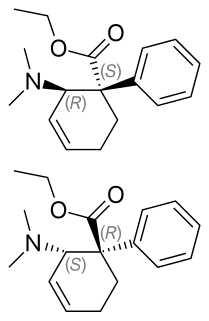
Tilidine, or tilidate is a synthetic opioid painkiller, used mainly in Germany, Switzerland, South Africa and Belgium for treatment of moderate to severe pain, both acute and chronic. Its onset of pain relief after oral administration is about 10–15 minutes and peak relief from pain occurs about 25–50 minutes after oral administration.
1,8-Diaminonaphthalene is an organic compound with the formula C10H6(NH2)2. It is one of several isomeric naphthalenediamines. It is a colorless solid that darkens in air due to oxidation. It is a precursor to commercial pigments.
In chemistry, isomers are ions or molecules with identical formulas but distinct structures. Isomers do not necessarily share similar properties. Two main forms of isomerism are structural isomerism and stereoisomerism.

Xylonic acid is a sugar acid that can be obtained by oxidation of the hemiacetal/aldehyde group of xylose. The C-2 epimer is known as lyxonic acid.
Methoxyethylmercuric acetate is a chemical compound formerly used as a pesticide for seeds of cotton and small grains. It is highly toxic, and can pose a threat to the brain and central nervous system.

The tetramethylbenzenes constitute a group of substances of aromatic hydrocarbons, which structure consists of a benzene ring with four methyl groups (–CH3) as a substituent. Through their different arrangement, they form three structural isomers with the molecular formula C10H14. They also belong to the group of C4-benzenes. The best-known isomer is durene.
Tetrafluoroberyllate or orthofluoroberyllateBeF2−
4 is an anion containing beryllium and fluorine. The ion has a tetrahedral shape, the same size and outer electron structure as sulfate. Therefore, many compounds that contain sulfate, have equivalents with tetrafluoroberyllate. Examples of these are the Langbeinites, and Tutton's salts.

Bitartrate is an anion which is the conjugate base of tartaric acid. It may also refer to any salt or monoester of tartaric acid.

Sodium hydrogenoxalate is the sodium salt of hydrogenoxalate. The only difference from oxalic acid is that one of the two hydrogen atoms has been replaced with a sodium atom. It is acutely toxic if it touches the skin or is swallowed.

Trithionic acid is a polythionic acid consisting of three sulfur atoms. It can be viewed as two bisulfite radicals bridged by a sulfur atom.
Prop-1-en-2-ol is a three-carbon enol. It is liquid at room temperature. It is a tautomer of acetone.

A dibromoanthracene is a derivative of anthracene with two bromine atoms. All compounds have the formula C14H8Br2.
References
- ↑ "QJ3360000 | C10H10N2 | ChemSpider". www.chemspider.com.
- ↑ "1,3-Naphthalenediamine | C10H10N2 | ChemSpider". www.chemspider.com.
- ↑ "QJ3380000 | C10H10N2 | ChemSpider". www.chemspider.com.
- ↑ "1,5-DAN | C10H10N2 | ChemSpider". www.chemspider.com.
- ↑ "1,7-Naphthalenediamine | C10H10N2 | ChemSpider". www.chemspider.com.
- ↑ "1,8-Diaminonaphthalene | C10H10N2 | ChemSpider". www.chemspider.com.
- ↑ "2,3-Diaminonaphthalene | C10H10N2 | ChemSpider". www.chemspider.com.
- ↑ "2,6-Naphthalenediamine | C10H10N2 | ChemSpider". www.chemspider.com.
- ↑ "2,7-Naphthalenediamine | C10H10N2 | ChemSpider". www.chemspider.com.
 | This set index page lists chemical compounds articles associated with the same name. If an internal link led you here, you may wish to change the link to point directly to the intended article. |