
Lieutenant Colonel Airey Middleton Sheffield Neave, was a British soldier, lawyer and Member of Parliament (MP) from 1953 until his assassination in 1979.

Operation Pegasus was a military operation carried out on the Lower Rhine near the village of Renkum, close to Arnhem in the Netherlands. Overnight on 22–23 October 1944, Allied military forces, Britain's MI9 intelligence organization, and the Dutch Resistance evacuated 138 men, mostly soldiers trapped in German-occupied territory who had been in hiding since the Battle of Arnhem a month earlier.
MI9, the British Directorate of Military Intelligence Section 9, was a secret department of the War Office between 1939 and 1945. During World War II it had two principal tasks: assisting in the escape of Allied prisoners of war (POWs) held by the Axis countries, especially Nazi Germany; and helping Allied military personnel, especially downed airmen, evade capture after they were shot down or trapped behind enemy lines in Axis-occupied countries. During World War II, about 35,000 Allied military personnel, many helped by MI9, escaped POW camps or evaded capture and made their way to Allied or neutral countries after being trapped behind enemy lines.
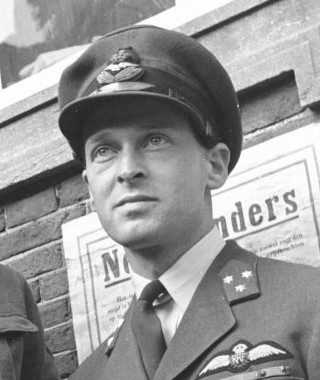
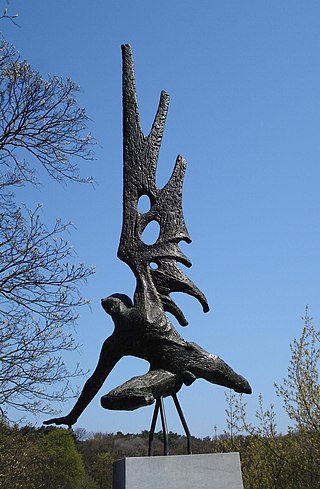
Siebren Erik Hazelhoff Roelfzema was a Dutch writer who became a resistance fighter and RAF pilot during the Second World War. Near the end of the war he was adjudant (assistant) to Queen Wilhelmina. He was made Knight 4th class of the Military William Order. He is perhaps best known for his book Soldaat van Oranje which described his experiences in the war. His book was later made into a film. The book and the film about it eventually were made into the most successful Dutch musical ever, premiering 30 October 2010.
Englandspiel, or Operation North Pole, was a successful counterintelligence operation of the Abwehr from 1942 to 1944 during World War II. German counter-intelligence operatives, headed by Hermann Giskes of the Abwehr and Joseph Schreider of the Sicherheitsdienst (SD), captured Allied resistance agents operating in the Netherlands and used the agents' radios and codes to dupe the United Kingdom's clandestine organization, the Special Operations Executive (SOE), into continuing to infiltrate agents, weapons, and supplies into the Netherlands. The Germans captured nearly all the agents and weapons sent by the United Kingdom (Britain).

The Comet Line was a Resistance organization in occupied Belgium and France in the Second World War. The Comet Line helped Allied soldiers and airmen shot down over occupied Belgium evade capture by Germans and return to Great Britain. The Comet Line began in Brussels where the airmen were fed, clothed, given false identity papers, and hidden in attics, cellars, and people's homes. A network of volunteers then escorted them south through occupied France into neutral Spain and home via British-controlled Gibraltar. The motto of the Comet Line was "Pugna Quin Percutias", which means "fight without arms", as the organization did not undertake armed or violent resistance to the German occupation.

Abraham Pierre Tony Luteyn was a Dutch officer who successfully escaped from the German prisoner of war camp of Colditz. Sometimes he is referred to as Anthony Luteyn.

Harold Cole, also known as Harry Cole,Paul Cole, and many other aliases, was a petty criminal, a confidence man, a British soldier, an operative of the Pat O'Leary escape line, and an agent of Nazi Germany. In 1940 and 1941, he helped many British soldiers escape France after its surrender to Nazi Germany in World War II. He became a double agent for the Germans in December 1941 and betrayed to the Gestapo 150 escape line workers and members of the French Resistance, of whom about 50 were executed or died in German concentration camps.
The Westerweel Group was a small resistance group with non-Jewish and Jewish members that operated during the Nazi occupation of the Netherlands. Led by a Dutch Christian Joop Westerweel and Jewish German refugee Joachim Simon, the group was initiated in August 1942 and its first objective was to hide a Jewish youth group of "Palestine pioneers" whose members were ordered to be deported to the Nazi Westerbork transit camp. They were primarily young Jews from Germany and Austria who had fled to the Netherlands after 1933 where they followed an agricultural training to settle in Palestine. When threatened with deportation, the resistance group helped them to find hiding places and some of them were brought to Spain via Belgium and France.
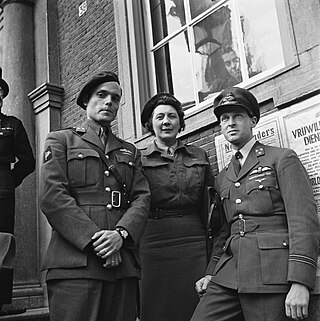
Peter Tazelaar was a member of the Dutch resistance during World War II and worked as an agent for the SOE. Following the war he served in Dutch East Indies, before returning to Europe to work behind the Iron Curtain in Eastern Europe for the United States, which served as an inspiration for Ian Fleming's James Bond series.
Lykele Faber, also given as Lijkele Faber was a Dutch commando and radio operator during World War II. He took part in the Battle of Arnhem and helped organize the Dutch resistance. In recognition of his services, Faber was decorated with the Dutch Bronze Cross (1945) and Cross of Merit (1945) and the British King's Medal for Courage in the Cause of Freedom (1947), among others.

Theodore Herman Bachenheimer, was an American soldier. In just three years, he achieved legendary status as one of the war's most daring reconnaissance scouts, he was better known as The Legendary Paratrooper or The G.I. General and was befriended by Martha Gellhorn.

The Shelburne Escape Line (1944) was a resistance organisation in occupied France in the Second World War. The Shelburne Line, financed by the British intelligence agency MI9, helped Allied airmen shot down over France evade capture by the occupying Germans and return to Great Britain by boat from the coast of Brittany. For the Allies, the rescue of downed airmen had a practical as well as a humanitarian objective. Training new and replacement air crews was expensive and time-consuming. Rescuing downed aircrew and returning them to duty became a priority.

Mathilde Adrienne Eugénie Verspyck "was a brave woman who was a devoted believer in the cause of freedom, for which she later sacrificed her life," according to her U.S. Medal of Freedom award.

The Pat O'Leary Line was a resistance organization in France during the Second World War. The Pat O'Leary escape line helped Allied soldiers and airmen stranded or shot down over occupied Europe evade capture by Nazi Germany and return to Great Britain. Downed airmen in northern France and other countries were fed, clothed, given false identity papers, hidden in attics, cellars, and people's homes, and escorted to Marseille, where the line was based. From there, a network of people escorted them to neutral Spain. From Spain, British diplomats sent the escapees home from British-controlled Gibraltar. Many different escape lines were created in Europe of which the Pat Line was the oldest and one of the most important. Collectively, the many escape lines helped 7,000 Allied military personnel, mostly airmen, escape occupied France, Belgium, and the Netherlands. The Pat Line received financial assistance from MI9, a British intelligence agency.
Escape and evasion lines in World War II helped people escape European countries occupied by Nazi Germany. The focus of most escape lines in Western Europe was assisting American, British, Canadian and other Allied airmen shot down over occupied Europe to evade capture and escape to neutral Spain or Sweden from where they could return to the United Kingdom. A distinction is sometimes made between "escapers" and "evaders". Most of those helped by escape lines were evaders.
Max Windmüller was a German member of the Dutch resistance. He was forced to flee from the National Socialists to the Netherlands with his parents because of their Jewish faith. He joined the Westerweel Group there and saved the lives of many Jewish children and young people. The members of the Westerweel group organized identification papers, hiding places and escape opportunities, especially for German-Jewish children and young people who had fled from Germany. In this group, Jews and members of other faiths worked together to save the Jews from persecution. Such cooperation was not a matter of course in the Netherlands. Windmüller personally saved around 100 young Jews, and the entire Westerweel group saved 393 Jews. In July 1944, the Gestapo stormed a secret meeting of the Resistance group in Paris in which Windmüller and other members of the Jewish resistance were arrested. They were then taken to Gestapo headquarters where they were interrogated and tortured. When the liberation of the camp by Allied troops was imminent, Windmüller was deported from occupied France with the last transport. On 21 April 1945, he was shot by a Schutzstaffel member.
Operation Marathon in World War II helped allied airmen who had been shot down or crash-landed in Nazi-occupied Europe evade capture by the Germans. The British intelligence organization, MI9, created the operation to gather downed airmen into isolated forest camps where they would await their rescue by allied military forces advancing after the Normandy Invasion of June 6, 1944. The Comet Line, a Belgian/French escape line, operated the forest camps with financial and logistical help from MI9.

Beatrice Wilhelmina Marie Albertina (Trix) Terwindt was a member of the Dutch resistance during World War II. After escaping from the German-occupied Netherlands, she became an agent of the British MI9 organization. Parachuting back into the Netherlands in February 1943 she was captured by the Germans on her arrival. She was a victim of Englandspiel, the successful counter-intelligence operation of the Germans. She spent the remainder of the war as a prisoner in Ravensbrück and Mauthausen concentration camps. Prior to the war she was one of the first flight attendants of KLM airline and after the war she again became a flight attendant for KLM.
Donald Darling, code named Sunday, was an agent for the clandestine British organizations MI6 and MI9 during World War II. The purpose of MI9 was to help prisoners of war to escape and downed airmen and stranded soldiers to evade capture in German-occupied Europe and return to Great Britain. Darling worked in Lisbon and Gibraltar. He financed and advised the escape and evasion lines which rescued soldiers and airmen and guided them to safety in neutral Portugal and Spain and British-owned Gibraltar. The escape lines rescued 7,000 soldiers and airmen in western Europe. Darling met and interviewed many of them on their arrival in Portugal and Gibraltar. As part of his work, Darling contributed intelligence to MI6 about conditions and events inside occupied Europe through knowing many of the key people involved in resistance and escape lines.


