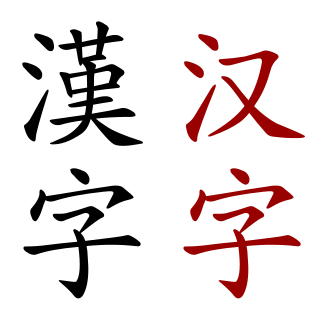
Chinese characters are logograms used to write the Chinese languages and several other languages historically influenced by Chinese culture. Chinese characters represent one of the four independent inventions of writing in human history to be universally accepted by scholars, and are the only one of these to be continuously used since its invention, with a documented history spanning more than three millennia. Over this span, the function and style of characters has evolved greatly. Most recently, countries using Chinese characters have standardised their forms and pronunciations. Broadly, simplified characters are used in mainland China, Singapore, and Malaysia, while traditional characters are used in Taiwan, Hong Kong, and Macau.
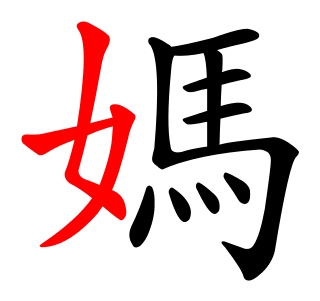
A Chinese radical or indexing component is a graphical component of a Chinese character under which the character is traditionally listed in a Chinese dictionary. This component is often a semantic indicator similar to a morpheme, though sometimes it may be a phonetic component or even an artificially extracted portion of the character. In some cases the original semantic or phonological connection has become obscure, owing to changes in character meaning or pronunciation over time.
Simplified characters are one of two standardized character sets widely used to write contemporary Chinese languages, along with traditional characters. Their development during the 20th century was part of an initiative by the People's Republic of China to promote literacy, and their use in ordinary circumstances on the mainland has been encouraged by the Chinese government since the 1950s. They are the official forms used in mainland China, Malaysia and Singapore, while traditional characters are officially used in Hong Kong, Macau, and Taiwan.
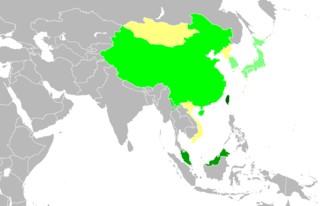
Traditional Chinese characters refer to one of several standard sets of characters used to write Chinese languages. In Taiwan, the set of traditional characters is regulated by Taiwan's Ministry of Education, standardized in the Standard Form of National Characters. These forms were predominant in written Chinese until the middle of the 20th century, when various countries that use Chinese characters began standardizing simplified sets of characters, often with characters that existed before as well-known variants of the predominant forms.

Shuowen Jiezi is an ancient Chinese dictionary compiled by Xu Shen during the Eastern Han dynasty. Although not the first comprehensive Chinese character dictionary, it was the first to analyze the structure of the characters and to give the rationale behind them, as well as the first to use the principle of organization by sections with shared components called "radicals".

The Kangxi Dictionary is a Chinese dictionary published in 1716 during the High Qing, considered from the time of its publishing until the early 20th century to be the most authoritative reference for written Chinese characters. Wanting an improvement upon earlier dictionaries, as well as to show his concern for Confucian culture and to foster standardization of the Chinese writing system, its compilation was ordered by the Kangxi Emperor in 1710, from whom the compendium gets its name. The dictionary was the largest of its kind, containing 47,043 character entries. Around 40% of them were graphical variants, while others were dead, archaic, or found only once in the Classical Chinese corpus. In today's vernacular written Chinese, fewer than a quarter of the dictionary's characters are commonly used.
Variant Chinese characters are Chinese characters that are homophones and synonyms. Most variants are allographs in most circumstances, such as casual handwriting. Some contexts require the usage of certain variants, such as in textbook editing.

The Hanyu Da Zidian, also known as the Grand Chinese Dictionary, is a reference dictionary on Chinese characters.

Ganlu Zishu is a Chinese orthography dictionary of the Tang dynasty. The first surviving orthographical dictionary for the regular script, it was authored by Yan Yuansun (顏元孫), a descendant of the famous scholar Yan Shigu. It is roughly based on Yan Shigu's work Ziyang, now surviving only in fragments. It was meant to be an official guide for the use of those who took the Imperial examination, thus the title "Ganlu", an allusion to the Analects (2:18).

Radical 15 or radical ice (冫部), meaning ice, is one of 23 of the 214 Kangxi radicals that are composed of 2 strokes.
The Standard Form of National Characters or the Standard Typefaces for Chinese Characters is the standardized form of Chinese characters set by the Ministry of Education of the Republic of China (Taiwan).

Radical 63 or radical door (戶部) meaning "door" is one of the 34 Kangxi radicals composed of 4 strokes.
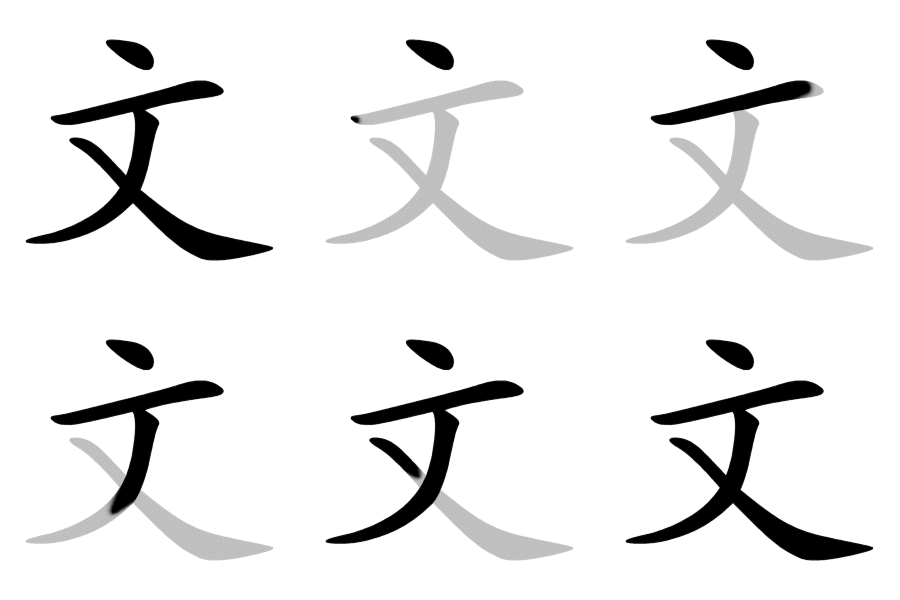
Radical 67 or radical script (文部) meaning "script" or "literature" is one of the 34 Kangxi radicals composed of 4 strokes.

Radical 96 or radical jade (玉部) meaning "jade" is one of the 23 Kangxi radicals composed of 5 strokes.
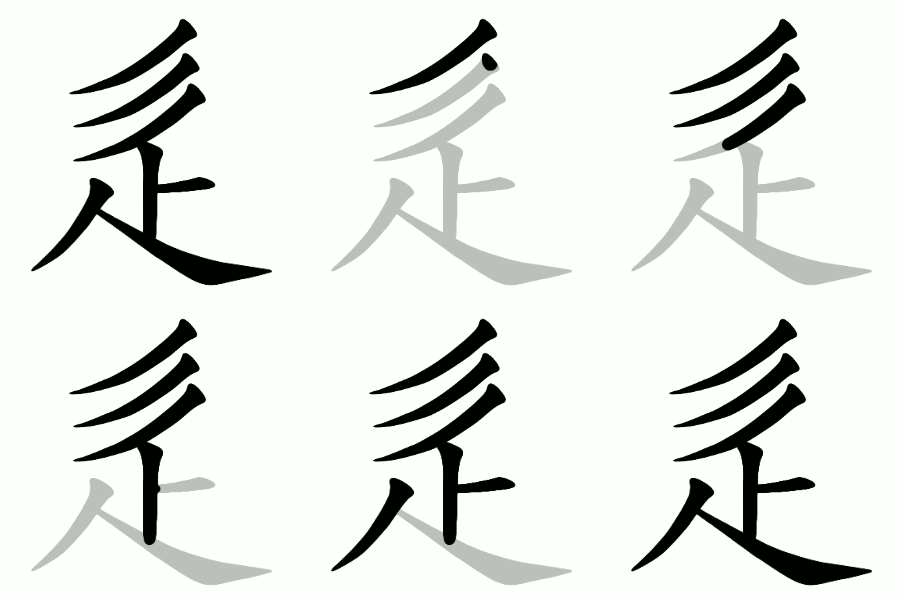
Radical 162 or radical walk (辵部) meaning "walk" is one of the 20 Kangxi radicals composed of 7 strokes. When used as a component, this radical character transforms into ⻍, ⻌, or ⻎.

Radical 168 or radical long (長部) meaning "long" or "grow" is one of the 9 Kangxi radicals composed of 8 strokes.
The Table of General Standard Chinese Characters is the current standard list of 8,105 Chinese characters published by the government of the People's Republic of China and promulgated in June 2013. Of the characters included, 3,500 are in Tier I and designated as frequently used characters, a reduction from the 7,000 in the earlier List of Commonly Used Characters in Modern Chinese; Tier II includes 3,000 characters that are designated as commonly used characters but less frequently used than those in Tier 1; Tier III includes characters commonly used as names and terminology. The list also offers a table of correspondences between 2,546 Simplified Chinese characters and 2,574 Traditional Chinese characters, along with other selected variant forms, effectively serving as Mainland China's standardization scheme for Traditional Characters.
Jiu zixing, also known as inherited glyphs form, or traditional glyph form, is a traditional printing orthography form of Chinese character which uses the orthodox forms, mainly referring to the traditional Chinese character glyphs, especially the printed forms after movable type printing. Jiu zixing was formed in the Ming Dynasty, and is also known as Kyūjitai in Japan. It also refers to the characters used in China before the Chinese writing reform and the issuing of the 1964 List of Character Forms of Common Chinese characters for Publishing.

Libian refers to the natural, gradual, and systematic simplification of Chinese characters over time during the 2nd Century BC, as Chinese writing transitioned from seal script character forms to clerical script characters during the early Han dynasty period, through the process of making omissions, additions, or transmutations of the graphical form of a character to make it easier to write. Libian was one of two conversion processes towards the new clerical script character forms, with the other being liding, which involved the regularisation and linearisation of character shapes.
The Chart of Standard Forms of Common National Characters or the Table of Standard Typefaces for Frequently-Used Chinese Characters is a list of 4,808 commonly used Chinese characters. The standard typefaces were prescribed by Taiwan's Ministry of Education, and have been adopted in the textbooks for primary and junior high schools in Taiwan since September 1982.

