
Look up Differentiation , differentiation , differentiate , or undifferentiated in Wiktionary, the free dictionary.
Differentiation may refer to:
Differentiation may refer to:


Ontogeny is the origination and development of an organism, usually from the time of fertilization of the egg to adult. The term can also be used to refer to the study of the entirety of an organism's lifespan.
Unit may refer to:

Marketing is the process of exploring, creating, and delivering value to meet the needs of a target market in terms of goods and services; potentially including selection of a target audience; selection of certain attributes or themes to emphasize in advertising; operation of advertising campaigns; attendance at trade shows and public events; design of products and packaging attractive to buyers; defining the terms of sale, such as price, discounts, warranty, and return policy; product placement in media or with people believed to influence the buying habits of others; agreements with retailers, wholesale distributors, or resellers; and attempts to create awareness of, loyalty to, and positive feelings about a brand. Marketing is typically done by the seller, typically a retailer or manufacturer. Sometimes tasks are contracted to a dedicated marketing firm or advertising agency. More rarely, a trade association or government agency advertises on behalf of an entire industry or locality, often a specific type of food, food from a specific area, or a city or region as a tourism destination.
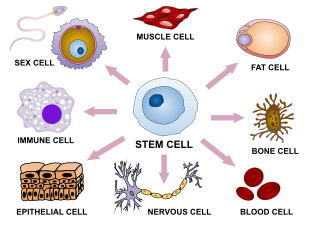
Cellular differentiation is the process in which a stem cell alters from one type to a differentiated one Usually, the cell changes to a more specialized type. Differentiation happens multiple times during the development of a multicellular organism as it changes from a simple zygote to a complex system of tissues and cell types. Differentiation continues in adulthood as adult stem cells divide and create fully differentiated daughter cells during tissue repair and during normal cell turnover. Some differentiation occurs in response to antigen exposure. Differentiation dramatically changes a cell's size, shape, membrane potential, metabolic activity, and responsiveness to signals. These changes are largely due to highly controlled modifications in gene expression and are the study of epigenetics. With a few exceptions, cellular differentiation almost never involves a change in the DNA sequence itself. Although metabolic composition does get altered quite dramatically where stem cells are characterized by abundant metabolites with highly unsaturated structures whose levels decrease upon differentiation. Thus, different cells can have very different physical characteristics despite having the same genome.
The Experience Economy is the sale of memorable experiences to customers. The term was first used in a 1998 article by B. Joseph Pine II and James H. Gilmore describing the next economy following the agrarian economy, the industrial economy, and the most recent service economy. The concept had been previously researched by many authors.

A superorganism or supraorganism is a group of synergetically interacting organisms of the same species. A community of synergetically interacting organisms of different species is called a holobiont.
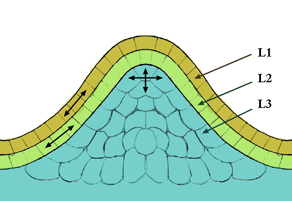
The meristem is a type of tissue found in plants. It consists of undifferentiated cells capable of cell division. Cells in the meristem can develop into all the other tissues and organs that occur in plants. These cells continue to divide until a time when they get differentiated and then lose the ability to divide.
In economics and marketing, product differentiation is the process of distinguishing a product or service from others, to make it more attractive to a particular target market. This involves differentiating it from competitors' products as well as a firm's own products. The concept was proposed by Edward Chamberlin in his 1933 The Theory of Monopolistic Competition.
In business, a competitive advantage is the attribute that allows an organization to outperform its competitors.
Differential may refer to:

Chondrocytes are the only cells found in healthy cartilage. They produce and maintain the cartilaginous matrix, which consists mainly of collagen and proteoglycans. Although the word chondroblast is commonly used to describe an immature chondrocyte, the term is imprecise, since the progenitor of chondrocytes can differentiate into various cell types, including osteoblasts.
In business literature, commoditization is defined as the process by which goods that have economic value and are distinguishable in terms of attributes end up becoming simple commodities in the eyes of the market or consumers. It is the movement of a market from differentiated to undifferentiated price competition and from monopolistic competition to perfect competition. Hence, the key effect of commoditization is that the pricing power of the manufacturer or brand owner is weakened: when products become more similar from a buyer's point of view, they will tend to buy the cheapest.
Niche may refer to:
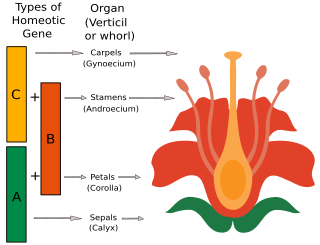
The ABC model of flower development is a scientific model of the process by which flowering plants produce a pattern of gene expression in meristems that leads to the appearance of an organ oriented towards sexual reproduction, a flower. There are three physiological developments that must occur in order for this to take place: firstly, the plant must pass from sexual immaturity into a sexually mature state ; secondly, the transformation of the apical meristem's function from a vegetative meristem into a floral meristem or inflorescence; and finally the growth of the flower's individual organs. The latter phase has been modelled using the ABC model, which aims to describe the biological basis of the process from the perspective of molecular and developmental genetics.
A target market is a group of customers within a business's serviceable available market at which a business aims its marketing efforts and resources. A target market is a subset of the total market for a product or service.
The prefix pseudo- is used to mark something that superficially appears to be one thing, but is something else. Subject to context, pseudo may connote coincidence, imitation, intentional deception, or a combination thereof.
Consumer confusion is a state of mind that leads to consumers making imperfect purchasing decisions or lacking confidence in the correctness of their purchasing decisions.

The following outline is provided as an overview of and topical guide to evolution:
Dedifferentiation is a transient process by which cells become less specialized and return to an earlier cell state within the same lineage. This suggests an increase in a cell potency, meaning that after dedifferentiation, cells may possess an ability to redifferentiate into more cell types than it did before. This is in contrast to differentiation, where differences in gene expression, morphology, or physiology arise in a cell, making its function increasingly specialized.