Dolmen of the Fairy Stone

Last updated

Dolmen of the Fairy Stone
Native names
Dolmen photo ajd.jpg
The dolmen in 2024
Type dolmen
Location Draguignan, Var, Provence-Alpes-Côte d'Azur, France
Coordinates 43°32′41″N6°27′11″E / 43.544771°N 6.4531°E / 43.544771; 6.4531
Height2.40 m (7 ft 10 in)
Built2500–2000 BC
Official nameDolmen dit La pierre de la Fée
Designated1889
Reference no.PA00081588
France location map-Regions and departements-2016.svg
Red pog.svg
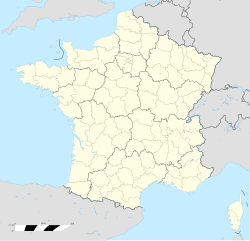
Location of Dolmen of the Fairy Stone in France

The Fairy Stone is a dolmen in Draguignan, in the south of France, classified as a monument historique since 1889. [1]

Contents

History

Archeological material

During the 1844 excavations, "a flint arrowhead, two bone buttons, and one oval-shaped lead bead" [2] were recovered. The human bones found showed no signs of burning, except for a fragment of a skull. [2] During the last restoration in 1951, the base of all the slabs was reinforced with a concrete foundation, and the trunk of the ancient oak tree behind the headstone slab was cut to reduce the pressure it was exerting on the building. [2] The earth extracted during the work was sifted, which made it possible to collect some archaeological material: about twenty beads (limestone, callais, lignite, serpentine), a pierced deer spittoon, and three Pomatias elegans snail opercula. [2]

The funerary objects have been dated to the Chalcolithic period ("Copper Age"). [3]

The terrorist attack (1975)

In 1975, a resident of Draguignan who opposed the transfer of the Var prefecture to Toulon [4] the previous year expressed his anger by blowing up the monument. [5]

Description

All that remains of the original structure are two orthostats and the chevet slab, measuring between 2.20 m and 2.40 m in height. A third support slab still existed in 1996. All elements are made of local limestone. The stone slab covering the tomb is monumental: 6 m long, 4.70 m wide and 0.58 m thick, weighing approximately 20 tons. [3]

During the second half of the 19th century, the dolmen was considered one of the most beautiful dolmens in France. Its location and surroundings were ideal. It was situated on a hilltop, protected by the shade of three trees: an oak, a juniper and a hackberry. Finally, it was fortunate to be located in Draguignan, the prefecture of the Var department at the time, making it easily accessible. [6]

According to local legend, women who wanted children would visit the fairy Esterelle, who would help them conceive.

References

  1. "Dolmen dit La pierre de la Fée". pop.culture.gouv.fr. Retrieved 23 October 2025.
  2. 1 2 3 4 Roudil, Odile; Bérard, Georges, eds. (1981). Les sépultures mégalithiques du Var. Paris: Ed. du C.N.R.S. ISBN   978-2-222-02921-2.
  3. 1 2 Mahieu, Eric; Barge, Hélène (2005). Les Mégalithes du Var – 27 itinéraires de découverte. Actilia Multimédia. ISBN   2-915097-02-X.
  4. Bataille pour une préfecture – Sudorama, mémoires du Sud de 1940 à nos jours (in French). Retrieved 23 October 2025 via fresques.ina.fr.
  5. Trans, Nadine de. "La Pierre de la Fée à Draguignan, le dolmen et la légende". Passion Provence (in French). Retrieved 23 October 2025.
  6. pierres, Les vaisseaux de (21 January 2025). "Les Vaisseaux de Pierres – Portrait de monument (2) : la "Pierre de la Fée" à Draguignan (Var), un dolmen emblématique du sud de la France –". Les Vaisseaux de Pierres (in French). Archived from the original on 10 August 2025. Retrieved 23 October 2025.