
Giovanni Benedetto Castiglione was an Italian Baroque painter, printmaker and draftsman, of the Genoese school. He is best known now for his etchings, and as the inventor of the printmaking technique of monotyping. He was known as Il Grechetto in Italy and in France as Le Benédette.

Giuseppe Bazzani was an Italian painter of the Rococo.

Domenico Maria Canuti was an Italian painter of the Baroque period, active mainly in Bologna and Rome. He was a major painter of fresco decorations. His ceiling decorations showed a mix of Bolognese and Roman influences.

Fortunato Duranti was an Italian painter and collector.

Panfilo Nuvolone (1581–1651) was an Italian painter of the Mannerist period, who painted both religious and still life topics, active in Cremona and Mantua.

Eleuterio Pagliano was an Italian painter of the Romantic period as well as an activist and fighter of the Risorgimento.

Fermo Guisoni was an Italian painter of the Renaissance period, active mainly in his native city of Mantua.

Giuseppe Bottani was an Italian painter active in the Baroque period.

Francesco Maria Raineri was an Italian painter of the late-Baroque, mainly active in Mantua.
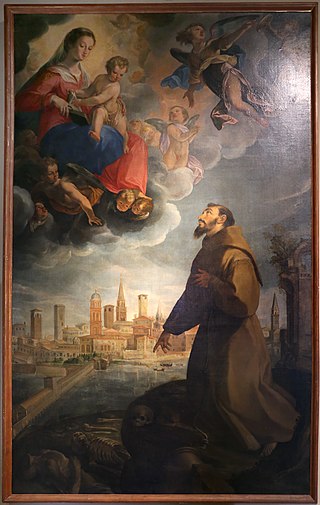
Francesco Borgani (1587–1624) was an Italian painter of the Baroque, mainly active in Mantua.

Pietro Facchetti was an Italian painter of the late Renaissance, mainly active in Rome.

Giuseppe Tominz, also known as Jožef Tominc, was an Italian-Slovene painter from the Austrian Littoral. He worked mostly in the cultural milieu of the upper bourgeoisie in the Austrian Illyrian Kingdom. He was one of the most prominent portraitists of the Biedermeier period. He became renowned for his realistic portraits. He worked mostly in the Austrian Littoral, but also produced religious paintings in Carniola and in Croatia. His handiwork can be seen in the Church of the Birth of the Blessed Virgin Mary in Donji Stoliv. Nowadays, many of his works are on display in the Revoltella Museum in Trieste, some in the National Gallery of Slovenia in Ljubljana, National Museum of Serbia and in the Museum of History and Art of Gorizia. He is considered part of both the Italian and the Slovenian national culture canon.

Giovanni Cadioli was an Italian painter of the Baroque, active mainly in his native Mantua. He was also an author of a guide to artworks in this city.
Filippo Prosperi was an Italian painter, mainly of sacred subjects, painted in a Neoclassical and Nazarene styles.
Pietro Gaudenzi was an Italian painter.

Giuseppe Oriolo or Orioli was an Italian painter of the late-Baroque.
Pio Panfili was an Italian painter and engraver.
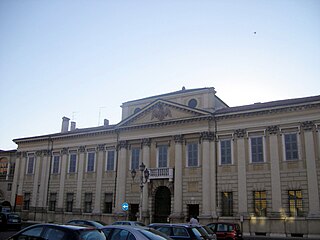
The Palazzo D'Arco is a Neoclassical-style palace located on Piazza Carlo D'Arco #4 in Mantua, region of Lombardy, Italy. The palace houses the Museo di Palazzo d'Arco, which displays the furnishings and artwork collected by the Duke D'Arco.
Siro Baroni was an Italian painter of the late-Baroque period, active in Mantua.

Giuseppe Maria Soli was an Italian architect.


