
Telford is a large town in the borough of Telford and Wrekin and ceremonial county of Shropshire, England, about 15 miles (24 km) east of Shrewsbury, 21 miles (34 km) south west of Stafford, 19 miles (31 km) north west of Wolverhampton and 28 miles (45 km) from Birmingham in the same direction. With an estimated population of 175,271 in 2017 and around 155,000 in Telford itself, Telford is the largest town in Shropshire and one of the fastest-growing towns in the United Kingdom.

Telford and Wrekin is a unitary authority in the ceremonial county of Shropshire, England with borough status. The district was created in 1974 as The Wrekin, then a non-metropolitan district of Shropshire. In 1998 the district became a unitary authority and was renamed Telford and Wrekin. It remains part of the Shropshire ceremonial county and shares institutions such as the Fire and Rescue Service and Community Health with the rest of Shropshire.

Donnington is an area / housing estate located in the borough of Telford and Wrekin and ceremonial county of Shropshire, England. The population of Donnington Ward was 6,883 at the 2011 Census.

The English county of Shropshire has a fairly large railway network, with 19 National Rail stations on various national lines; there are also a small number of heritage and freight lines, including the famous heritage Severn Valley Railway running along its eastern border with Worcestershire.
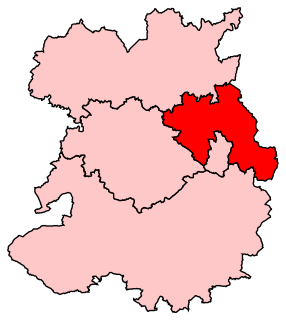
The Wrekin is a constituency in the House of Commons of the British Parliament, located in the county of Shropshire in the West Midlands of England. It has existed continuously since its creation by the Representation of the People Act 1918, and is named after a prominent landmark hill in the area, The Wrekin. The constituency has periodically swung back and forth between the Labour and Conservative parties since the 1920s, and has been held since 2005 by a Conservative MP, Mark Pritchard.
The Iron Bridge in Shropshire, England, was the first major bridge in the world to be made of cast iron.
The Wolverhampton–Shrewsbury line is the railway line from Wolverhampton to Shrewsbury via Wellington; it was originally built by the Shrewsbury and Birmingham Railway. The line is double track throughout, with rarely used relief sidings at Cosford and four tracks through Wellington station.
Donington is the name of a number of places in England:
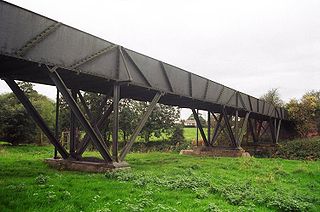
The Shrewsbury Canal was a canal in Shropshire, England. Authorised in 1793, the main line from Trench to Shrewsbury was fully open by 1797, but it remained isolated from the rest of the canal network until 1835, when the Birmingham and Liverpool Junction Canal built the Newport Branch from Norbury Junction to a new junction with the Shrewsbury Canal at Wappenshall. After ownership passed to a series of railway companies, the canal was officially abandoned in 1944; many sections have disappeared, though some bridges and other structures can still be found. There is an active campaign to preserve the remnants of the canal and to restore the Norbury to Shrewsbury line to navigation.

Muxton is a village between Lilleshall and Donnington in Shropshire, England. It now forms part of the new town of Telford, situated on the town's very north-eastern outskirts.
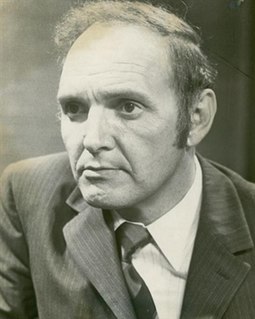
Norman Jones was an English actor, primarily on television. He appeared in three Doctor Who serials — The Abominable Snowmen, Doctor Who and the Silurians and The Masque of Mandragora.

The 11th Signal Brigade and Headquarters West Midlands is a signal formation of the British Army's 3rd UK Division. Its headquarters is located at Venning Barracks, in Donnington in Shropshire.

The Donnington Wood Canal was a 5.5-mile (8.9 km) private canal in East Shropshire, England, which ran from coal pits owned by Earl Gower at Donnington Wood to Pave Lane on the Wolverhampton to Newport Turnpike Road. It was completed in about 1767 and abandoned in 1904. The canal was part of a larger network of tub-boat canals, which were used for the transport of raw materials, particularly coal, limestone and ironstone, from the locations where they were mined to furnaces where the iron ore was processed. The canal was connected to the Wombridge Canal and the Shropshire Canal.

The Wombridge Canal was a tub-boat canal in Shropshire, England, built to carry coal and iron ore from mines in the area to the furnaces where the iron was extracted. It opened in 1788, and parts of it were taken over by the Shrewsbury Canal Company in 1792, who built an inclined plane at Trench. It lowered tub boats 75 feet (23 m), and remained in operation until 1921, becoming the last operational canal inclined plane in the country. The canal had been little used since 1919, and closed with the closure of the plane.
The Stafford–Shrewsbury line is a former railway line in England, which ran between Stafford in Staffordshire and Shrewsbury in Shropshire, via Newport and Wellington, from 1849 to 1966. The Shropshire Union Railways and Canal Company (SUR&CC) constructed and ran one of the few railways in England ever built by a canal company. The line served Newport and Wellington stations. The SUR&CC were solely responsible for the section from Stafford to Wellington; but the building and operation of the 10.5 mile (17 km)-long Shrewsbury-to-Wellington section was shared with the Shrewsbury and Birmingham Railway.

Donnington railway station was a railway station in Shropshire, England. It was built by the Shropshire Union Railway. Passenger service ceased in September 1964, and freight service ceased on 4 October 1965.
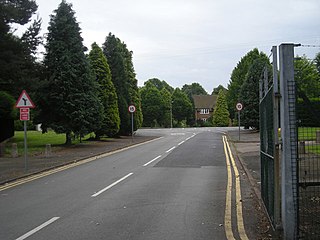
MoD Donnington is a British military base situated to the north of Donnington, Telford, Shropshire.
Lilleshall and Donnington is a civil parish in the borough of Telford and Wrekin, Shropshire, England. It contains 34 listed buildings that are recorded in the National Heritage List for England. Of these, three are listed at Grade I, the highest of the three grades, and the others are at Grade II, the lowest grade. The parish contains the village of Lilleshall and the surrounding countryside, the village of Muxton, and Donnington, a ward. Most of the listed buildings are houses and associated structures, farmhouses and farm buildings, a high proportion of which are timber framed and date from the 16th and 17th centuries. The other listed buildings include the ruins of an abbey and its garden wall, two churches, and a monument.
