Faith, derived from Latin fides and Old French feid, is confidence or trust in a person, thing, or concept. In the context of religion, one can define faith as confidence or trust in a particular system of religious belief. Religious people often think of faith as confidence based on a perceived degree of warrant, while others who are more skeptical of religion tend to think of faith as simply belief without evidence.

Religious conversion is the adoption of a set of beliefs identified with one particular religious denomination to the exclusion of others. Thus "religious conversion" would describe the abandoning of adherence to one denomination and affiliating with another. This might be from one to another denomination within the same religion, for example, from Baptist to Catholic Christianity or from Shi’a to Sunni Islam. In some cases, religious conversion "marks a transformation of religious identity and is symbolized by special rituals".
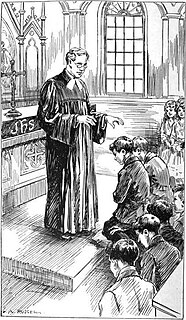
In Christian denominations that practice infant baptism, confirmation is seen as the sealing of Christianity created in baptism. Those being confirmed are known as confirmands. In some denominations, such as the Anglican Communion and Methodist Churches, confirmation bestows full membership in a local congregation upon the recipient. In others, such as the Roman Catholic Church, Confirmation "renders the bond with the Church more perfect", because, while a baptized person is already a member, "reception of the sacrament of Confirmation is necessary for the completion of baptismal grace".
Proselytism is the act of attempting to convert people to another religion or opinion. The word proselytize is derived from the Greek language prefix προσ- and the verb ἔρχομαι in the form of προσήλυτος. Historically in the Koine Greek Septuagint and New Testament, the word proselyte denoted a Gentile who was considering conversion to Judaism. Though the word proselytism originally referred to Early Christianity, it now refers to the attempt of any religion or religious individuals to convert people to their beliefs, or any attempt to convert people to a different point of view, religious or not. Proselytism is illegal in some countries.
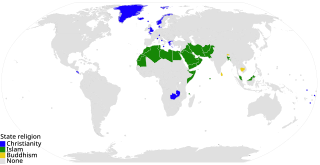
A state religion is a religious body or creed officially endorsed by the state. A state with an official religion, while not secular, is not necessarily a theocracy, a country whose rulers have both secular and spiritual authority. State religions are official or government-sanctioned establishments of a religion, but the state does not need be under the control of the religion nor is the state-sanctioned religion necessarily under the control of the state.
Irreligion is the absence, indifference to, rejection of, or hostility towards religion.
A lapsed Catholic is a baptized Catholic who is non-practicing. Such a person may still identify as a Catholic and remains a Catholic according to canon law.

Soul competency is a Christian theological perspective on the accountability of each person before God. According to the view, one's family relationships, church membership, or ecclesiastical or religious authorities cannot affect salvation of one's soul from damnation. Instead, each person is responsible to God for one's own personal faith in Jesus Christ and his death and resurrection.

Religion in New Zealand encompasses a wide range of groups and beliefs. Christianity is the most common religion with almost half of the population at the 2013 New Zealand census declaring an affiliation. Around six percent of the population is affiliated with non-Christian religions, with Hinduism being the largest at over two percent, while 42 percent of New Zealanders stated they had no religion in the most recent census, and 4 percent made no declaration.

Religion in Sweden is diversified. Christianity was the religion of virtually all of the Swedish population from the 12th to the early 20th century, but it has rapidly declined throughout the late 20th and early 21st century. In 2015, legally registered Christians comprised 69.9% of the total population.

Finland is a predominantly Christian nation where some 72.9% of the 5.5 million overall population follow Christianity; the vast majority being members of the Evangelical Lutheran Church of Finland (Protestant), 26.3% are unaffiliated, and 0.4% follow other religions like Islam, Hinduism, Buddhism, Judaism, folk religion etc.
Malaysia is a multicultural and multiconfessional country, whose official religion is Islam. As of the 2010 Population and Housing Census, 61.3 percent of the population practices Islam; 19.8 percent Buddhism; 9.2 percent Christianity; 6.3 percent Hinduism; and 3.4 percent traditional Chinese religions. The remainder is accounted for by other faiths, including Animism, Folk religion, Sikhism, Baha'i Faith and other belief systems. Numbers of self-described atheists in Malaysia are few; the state has come under criticism from human rights organisations for the government's discrimination against atheists, with some cabinet members saying that "the freedom of religion is not the freedom from religion".
The Abrahamic religions, also referred to collectively as Abrahamism, are a group of Semitic-originated religious communities of faith that claim descent from the Judaism of the ancient Israelites and the worship of the God of Abraham. The Abrahamic religions are monotheistic, with the term deriving from the patriarch Abraham.

Christianity, Islam and Traditionalist are the three main religions in Cameroon. Christian churches and Muslim centers of various denominations operate freely throughout Cameroon while the traditionalists operate in their shrines and temples which are also becoming popular today. Approximately 70 percent of the population is at least nominally Christian, 19 percent is nominally Muslim and 10 percent practice traditional indigenous religious beliefs. Other religious groups that constitute less than or just 1 percent of the population include Orthodox Jews, Bahá'ís, and persons who do not associate themselves with any particular religious movement. The Christian population is divided between Roman Catholics, Protestants, and other Christian denominations 6 percent). The vast majority of the Muslims are Sunni belonging to Maliki school of jurisprudence, with approximately 12% Ahmadiyya and 3% Shia. Christians and Muslims are found in every region, although Christians are chiefly in the southern and western provinces. it is worthy to note that unlike common belief, the population of the three northern regions is almost equally divided between the Christians and the Muslim. Not all in the north are Muslim tribes especially in North and far north where there are tribes like the Tupuri, Mundang, Mbe Massa etc. Islam can be said to fully concentrated in the Adamawa region of Cameroon. There is significant internal migration.

Christians are people who follow or adhere to Christianity, a monotheistic Abrahamic religion based on the life and teachings of Jesus Christ. The words Christ and Christian derive from the Koine Greek title Christós (Χριστός), a translation of the Biblical Hebrew term mashiach (מָשִׁיחַ).

Religion in the Czech Republic was dominated by Christianity until at least the early 20th century. Since the 1620 Battle of White Mountain religious sphere was accompanied by a widespread anti-Catholic sentiment even when the whole population nominally belonged to the Catholic Church. Overall, Christianity has steadily declined since the early 20th century and today remains only a minority. The Czech Republic has one of the oldest least religious populations in the world. Ever since the 1620 Battle of White Mountain, the Czech people have been historically characterised as "tolerant and even indifferent towards religion". According to Jan Spousta, among the irreligious people, who form the vast majority of modern Czechs, not all are atheists; indeed there has been an increasing distancing from both Christian dogmatic and atheistic ideologies, and at the same time ideas from Far Eastern religions have become widespread.

Estonia, which historically was a Lutheran Protestant nation, is today one of the "least religious" countries in the world in terms of declared attitudes, with only 14 per cent of the population declaring religion to be an important part of their daily life.

According to the 2001 population and housing census, approximately 61 percent of Dominica's population is Roman Catholic. Followers of evangelical churches represent 18 percent of the population, Seventh-day Adventists 6 percent, and Methodists 3.7 percent. Minority religious groups and denominations, whose members range from 1.6 percent to 0.2 percent of the population, include Rastafarians, Jehovah's Witnesses, Anglicans, and Muslims. According to the census, 1.4 percent of the population belongs to "other" religious groups, including Baptist, Nazarene, Church of Christ, Brethren Christian, the Baha'i Faith and Buddhist; 6 percent of the population claims no religious affiliation.

Multiple religious belonging refers to the idea that individuals can belong to more than one religious tradition. While this is often seen as a common reality in regions such as Asia with its many religions, religious scholars have begun to discuss multiple religion belonging with respect to religious traditions such as Judaism, Christianity, and Islam.