Underpants are underwear worn on the lower body generally extending no higher than the navel. In British English they are often called simply pants. If a given pair of underpants has a wider waistband, it might bear the brand name of the manufacturer on it.

A swimsuit is an item of clothing designed to be worn by people engaging in a water-based activity or water sports, such as swimming, diving and surfing, or sun-orientated activities, such as sun bathing. Different types may be worn by men, women, and children. A swimsuit can be described by various names, some of which are used only in particular locations or for particular types of suit, including swimwear, bathing suit, bathing attire, swimming costume, bathing costume, swimming suit, swimmers, swimming togs, bathers, cossie, or swimming trunks, besides others.

A skirt is the lower part of a dress or a separate outer garment that covers a person from the waist downwards.
A child safety lock is a special-purpose lock for cabinets, drawers, bottles, etc. that is designed to help prevent children from getting at any dangerous things or contents. Young children are naturally curious about their surroundings and will always explore, but as they may be unaware of dangerous substances or situations, the results can be fatal. Numerous cases of poisoning have resulted from eating brightly colored pills or spilling cleaning solvents.
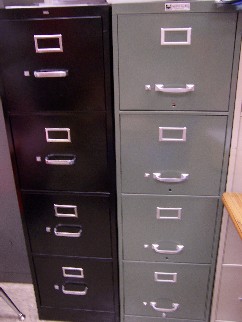
A filing cabinet is an item of office furniture for storing paper documents in file folders. In the most simple context, it is an enclosure for drawers in which articles are stored. The two most common forms of filing cabinets are vertical files and lateral files. A vertical file cabinet has drawers that extend from the short side of the cabinet. A lateral file cabinet has drawers that extend from the long side of the cabinet. These are also called side filers in Great Britain. There are also shelf files which go on shelves. In the United States, file cabinets are usually built to accommodate 8.5 × 11 paper, and in other countries, filing cabinets are often designed to hold other sizes of paper, such as A4 paper.

A chest of drawers, also called a dresser or a bureau, is a type of cabinet that has multiple parallel, horizontal drawers generally stacked one above another.

A teddy, also called a camiknicker, is a garment which covers the torso and crotch in the one garment. It is a similar style of garment to a one-piece swimsuit or bodysuit, but is typically looser and sheerer. The garment is put on by stepping into the leg holes and pulling the garment up to cover the torso. It may cover the whole of the torso or partially and may also cover the arms. They may open at the crotch so that the wearer may use the bathroom without taking it completely off. As an undergarment, it combines the functions of a camisole and panties, and may be preferred to avoid a visible panty line. It is also found as lingerie.
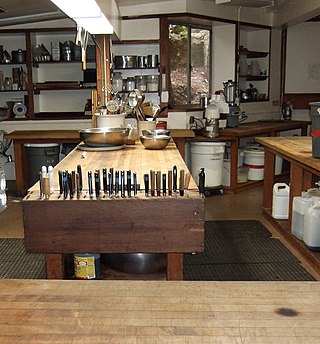
Kitchen cabinets are the built-in furniture installed in many kitchens for storage of food, cooking equipment, and often silverware and dishes for table service. Appliances such as refrigerators, dishwashers, and ovens are often integrated into kitchen cabinetry. There are many options for cabinets available at present.

Panchira (パンチラ) is a Japanese word referring to a brief glimpse of a woman's underwear. The term carries risqué connotations, similar to the word upskirt in English.

Sagging is a manner of wearing trousers that sag so that the top of the trousers or jeans is significantly below the waist, sometimes revealing much of the wearer's underpants.

A drawer is a box-shaped container inside a piece of furniture that can be pulled out horizontally to access its contents. Drawers are built into numerous types of furniture, including cabinets, chests of drawers (bureaus), desks, and the like.
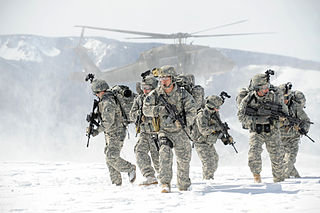
The Extended Cold Weather Clothing System is a protective clothing system developed in the 1980s by the United States Army Natick Soldier Research, Development and Engineering Center, Natick, Massachusetts. The first generation ECWCS consisted of parka and trousers plus 20 other individual clothing, handwear, headwear and footwear items which are used in various combinations to meet the cold weather environmental requirements of the US military. The Extended Climate Warfighter Clothing System, or Gen III ECWCS, is designed to maintain adequate environmental protection in temperatures ranging between −60 and +40 °F.
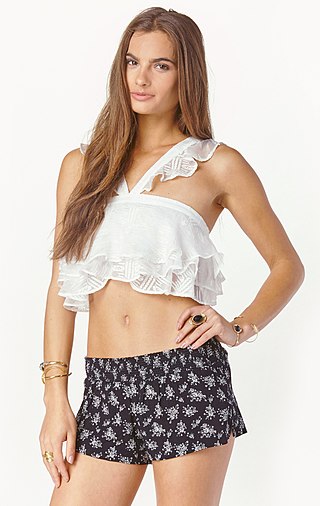
French knickers are a type of women's underwear or lingerie. The term is predominantly used in the United Kingdom (UK) and Australia to describe a style of underpants that look similar to a pair of shorts. French knickers are worn from the hip, concealing some of the upper thigh and all of the buttocks. The garment features an "open leg" style that allows for a more comfortable fit and the straight-cut leg cuffs can be designed with or without trimming. The fabric is often bias cut.

The sidebar is a graphical control element that displays various forms of information to the right or left side of an application window or operating system desktop. Examples of the sidebar can be seen in the Opera web browser, Apache web OpenOffice, LibreOffice, SoftMaker Presentations and File Explorer; in each case, the app exposes various functionalities via the sidebar.

Trousers, slacks, or pants are an item of clothing worn from the waist to anywhere between the knees and the ankles, covering both legs separately. In some parts of the United Kingdom, the word pants is ambiguous: it can mean underpants rather than trousers. Shorts are similar to trousers, but with legs that come down only to around the area of the knee, higher or lower depending on the style of the garment. To distinguish them from shorts, trousers may be called "long trousers" in certain contexts such as school uniform, where tailored shorts may be called "short trousers" in the UK.

Underwear, underclothing, or undergarments are items of clothing worn beneath outer clothes, usually in direct contact with the skin, although they may comprise more than a single layer. They serve to keep outer clothing from being soiled or damaged by bodily excretions, to lessen the friction of outerwear against the skin, to shape the body, and to provide concealment or support for parts of it. In cold weather, long underwear is sometimes worn to provide additional warmth. Special types of undergarments have religious significance. Some items of clothing are designed as undergarments, while others, such as T-shirts and certain types of shorts, are appropriate both as underwear and outerwear. If made of suitable material or textile, some underwear can serve as nightwear or swimwear, and some undergarments are intended for sexual attraction or visual appeal.

Wearing underwear as outerwear is a fashion trend popularized by celebrities, sports and media. It began as a practical and comfortable variation of clothing, such as the T-shirt and the sleeveless shirt, but later evolved into provocative, controversial fashion statements. 21st century versions include the display of thongs and bras in women's clothing, and the display of underpants under low-slung pants in men. Wearing underwear as outerwear has historical antecedents in the display of undergarments in the sixteenth and seventeenth centuries.

The 100 prisoners problem is a mathematical problem in probability theory and combinatorics. In this problem, 100 numbered prisoners must find their own numbers in one of 100 drawers in order to survive. The rules state that each prisoner may open only 50 drawers and cannot communicate with other prisoners. At first glance, the situation appears hopeless, but a clever strategy offers the prisoners a realistic chance of survival.
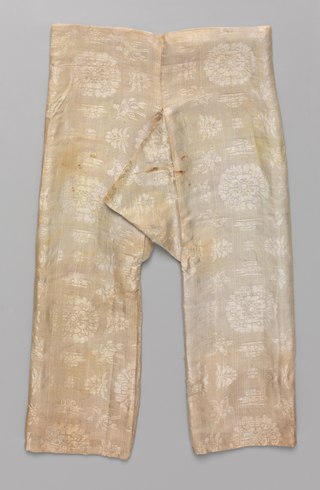
Ku or kuzi, collectively refers to the traditional Chinese trousers in Hanfu in the broad sense. Ku can also refer to the kaidangku, which are Chinese trousers without a rise as opposed to the trousers with a rise, referred as hedangku or kun in ancient times.

