
Hades, in the ancient Greek religion and mythology, is the god of the dead and the king of the underworld, with which his name became synonymous. Hades was the eldest son of Cronus and Rhea, although this also made him the last son to be regurgitated by his father. He and his brothers, Zeus and Poseidon, defeated their father's generation of gods, the Titans, and claimed joint rulership over the cosmos. Hades received the underworld, Zeus the sky, and Poseidon the sea, with the solid earth available to all three concurrently. In artistic depictions, Hades is typically portrayed holding a bident and wearing his helm with Cerberus, the three-headed guard-dog of the underworld, standing at his side.

In ancient Greek mythology and religion, Persephone, also called Kore or Cora, is the daughter of Zeus and Demeter. She became the queen of the underworld after her abduction by her uncle Hades, the king of the underworld, who would later also take her into marriage.
Medusa is one of the three Gorgons in Greek mythology.

Numidia was the ancient kingdom of the Numidians in northwest Africa, initially comprising the territory that now makes up Algeria, but later expanding across what is today known as Tunisia and Libya. The polity was originally divided between the Massylii in the east and the Masaesyli in the west. During the Second Punic War, Masinissa, king of the Massylii, defeated Syphax of the Masaesyli to unify Numidia into the first Berber state in present-day Algeria. The kingdom began as a sovereign state and later alternated between being a Roman province and a Roman client state.
Menoetius or Menoetes, meaning doomed might, is a name that refers to three distinct beings from Greek mythology:
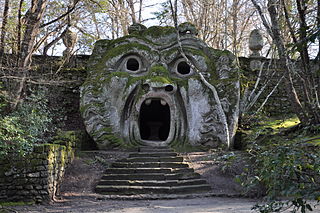
Orcus was a god of the underworld, punisher of broken oaths in Etruscan and Roman mythology. As with Hades, the name of the god was also used for the underworld itself. Eventually, he was conflated with Dis Pater and Pluto.

In ancient Greek religion and mythology, Pluto was the ruler of the Greek underworld. The earlier name for the god was Hades, which became more common as the name of the underworld itself. Pluto represents a more positive concept of the god who presides over the afterlife. Ploutōn was frequently conflated with Ploûtos, the Greek god of wealth, because mineral wealth was found underground, and because as a chthonic god Pluto ruled the deep earth that contained the seeds necessary for a bountiful harvest. The name Ploutōn came into widespread usage with the Eleusinian Mysteries, in which Pluto was venerated as both a stern ruler and a loving husband to Persephone. The couple received souls in the afterlife and are invoked together in religious inscriptions, being referred to as Plouton and as Kore respectively. Hades, by contrast, had few temples and religious practices associated with him, and he is portrayed as the dark and violent abductor of Persephone.

The University of Dundee is a public research university based in Dundee, Scotland. It was founded as a university college in 1881 with a donation from the prominent Baxter family of textile manufacturers. The institution was, for most of its early existence, a constituent college of the University of St Andrews alongside United College and St Mary's College located in the town of St Andrews itself. Following significant expansion, the University of Dundee gained independent university status by royal charter in 1967 while retaining elements of its ancient heritage and governance structure.

The word chthonic, or chthonian, is derived from the Ancient Greek word χθών, "khthon", meaning earth or soil. It translates more directly from χθόνιος or "in, under, or beneath the earth" which can be differentiated from Γῆ, or "ge", which speaks to the living surface of land on the earth. In Greek, chthonic is a descriptive word for things relating to the underworld and can be used in the context of chthonic gods, chthonic rituals, chthonic cults, and more. This is as compared to the more commonly referred-to Olympic gods and their associated rites and cults. Olympic gods are understood to reference that which exists above the earth, particularly in the sky. Gods that are related to agriculture are also considered to have chthonic associations as planting and growing take place in part under the earth.

Deakin University is a public university in Victoria, Australia. Founded in 1974, the university was named after Alfred Deakin, the second Prime Minister of Australia.
Hades in the ancient Greek religion and myth, is the god of the dead and the king of the underworld, with which his name became synonymous.
Gayle Lynds is an American former journalist, editor and author. Lynds is known as the Queen of Espionage Fiction for her spy fiction or spy thrillers novels. Lynds is the co-founder of International Thriller Writers.

Dusa McDuff FRS CorrFRSE is an English mathematician who works on symplectic geometry. She was the first recipient of the Ruth Lyttle Satter Prize in Mathematics, was a Noether Lecturer, and is a Fellow of the Royal Society. She is currently the Helen Lyttle Kimmel '42 Professor of Mathematics at Barnard College.

In Greek mythology, the Greek underworld, or Hades, is a distinct realm where an individual goes after death. The earliest idea of afterlife in Greek myth is that, at the moment of death, an individual's essence (psyche) is separated from the corpse and transported to the underworld. In early mythology the dead were indiscriminately grouped together and led a shadowy post-existence; however, in later mythology elements of post-mortem judgment began to emerge with good and bad people being separated.
Melinoë is a chthonic nymph or goddess invoked in one of the Orphic Hymns and represented as a bringer of nightmares and madness. The name "Melinoë" also appears on a metal tablet in association with Persephone. In the hymn, Melinoë has characteristics that seem similar to Hecate and the Erinyes, and Melinoë's name is sometimes thought to be an epithet of Hecate.
Dundee University Students' Association (DUSA) is the students' association, legal representative and students' union for matriculated students of the University of Dundee. It is known locally as 'The Union'.
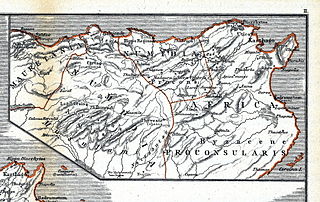
Numidia was a Roman province on the North African coast, comprising roughly the territory of north-east Algeria.
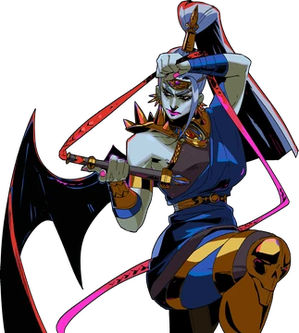
Megaera is a character in the 2020 video game Hades. She is the first major opponent of the protagonist, Zagreus, being tasked with preventing him from leaving the Underworld by Hades. She was created by Greg Kasavin and designed by Jen Zee, with her design made attractive due to Vee's desire to appreciate classical tradition and the mindset that gods are beautiful because they are gods. She is voiced by Avalon Penrose. She is fought most times Zagreus travels through the first area of the game, Tartartus, and can be found at the House of Hades. Zagreus is able to pursue a relationship with her alone or together with the character Thanatos, with Megaera consenting to a polyamorous relationship with the three. Her polyamorous relationship, as well as her relationship with Zagreus, was the subject of commentary, with one critic suggesting that she and Zagreus have a dominant-submissive relationship respectively. She has also been well received, praised for the attractiveness of her voice.

Dusa is a character in the 2020 video game Hades. She is a maid who serves Hades, and who periodically interacts with the protagonist. Zagreus, in addition to the character Megaera. She was created by Greg Kasavin and designed by Jen Zee, with her design made attractive due to Vee's desire to appreciate classical tradition and the mindset that gods are beautiful because they are gods. She is voiced by Courtney Vineys. During the game, the player may have Zagreus pursue her romantically, only for Dusa to turn out to not share these feelings and possibly not having romantic feelings at all, instead forming a platonic love for one another. This has been well-received, with critics noting how her being asexual and aromantic was a rarity. She has also been praised for her design and voice.
