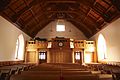
Potchefstroom, colloquially known as Potch, is an academic city in the North West Province of South Africa. It hosts the Potchefstroom Campus of the North-West University. Potchefstroom is on the Mooi Rivier, roughly 120 km (75 mi) west-southwest of Johannesburg and 45 km (28 mi) east-northeast of Klerksdorp.

The Volksraad of the South African Republic was the parliament of the former South African Republic (ZAR), it existed from 1840 to 1877, and from 1881 to 1902 in part of what is now South Africa. The body ceased to exist after the British Empire's victory in the Second Anglo-Boer War. The Volksraad sat in session in Ou Raadsaal in Church Square, Pretoria.
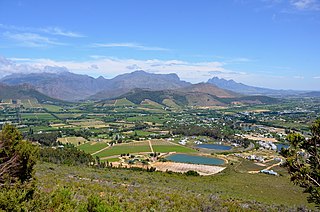
Franschhoek is a small town in the Western Cape Province and one of the oldest towns in South Africa. It was formerly known as Oliphants hoek. It is situated about 75 kilometres (47 mi) from Cape Town, a 45-minute drive away. The whole area, including townships such as Groendal and suburbs such as Wemmershoek, has a population of slightly over 20,000 people while the town proper, known as Hugenote, has a population of around 1,000. Since 2000, it has been incorporated into Stellenbosch Municipality. In 2022, Franschhoek was mentioned in Time magazine as one of the top 50 places in the world to visit.

Ohrigstad, formerly Andries Orieg Stad, is a small town to the north of Lydenburg in the Limpopo province, South Africa.

Many people of European heritage in South Africa are descended from Huguenots. Most of these originally settled in the Cape Colony, but were absorbed into the Afrikaner and Afrikaans-speaking population, because they had religious similarities to the Dutch colonists.
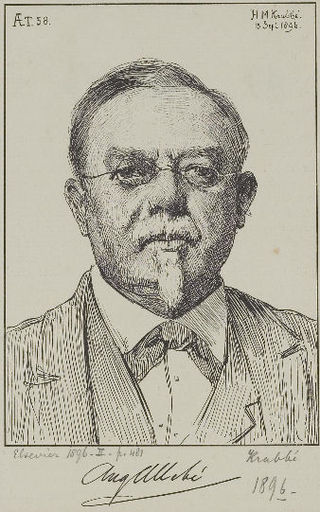
August Allebé was an artist and teacher from the Northern Netherlands. His early paintings were in a romantic style, but in his later work he was an exponent of realism and impressionism. He was a major initiator and promoter of Amsterdam Impressionism, the artist's association St. Lucas, and the movement of the Amsterdamse Joffers. Amsterdam Impressionism – sometimes referred to by art historians as the School of Allebé – was the counterflow to the very strong Hague School in the movement of Dutch Impressionism. As a professor at the Royal Academy of Amsterdam he fostered a cosmopolitan attitude toward art and the promotion and motivation of his students, and provided a significant stimulus to developments in modern art.
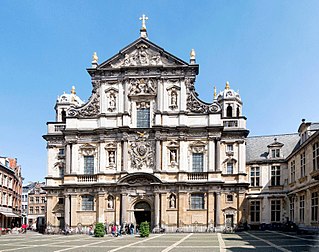
St. Charles Borromeo Church is a church in central Antwerp, located on the Hendrik Conscience square. It was built in 1615-1621 as the Jesuit church of Antwerp, which was closed in 1773. It was rededicated in 1779 to Saint Charles Borromeo. The church was formerly known for 39 ceiling pieces by Rubens that were lost in a fire when lightning struck the church on 18 July 1718.

The Groote Kerk is a Dutch Reformed church in Cape Town, South Africa. The church is South Africa's oldest place of Christian worship. The first church on this land was built in 1678. Willem Adriaan van der Stel laid the cornerstone for the church. It was replaced by the present building in 1841 built by Herman Schuette and the original tower was retained. The pulpit is the work of Anton Anreith and the carpenter Jacob Graaff, and was inaugurated on 29 November 1789. The Groote Kerk lays claim to housing South Africa's largest church organ, which was installed in 1954
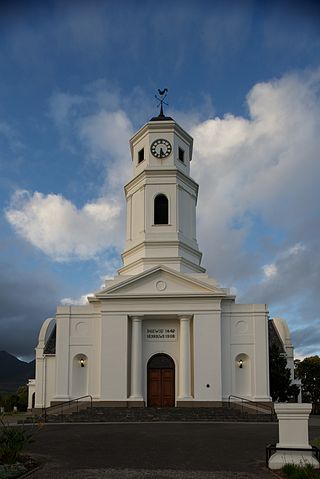
The Moederkerk, is a place of worship of the Dutch Reformed Church in George. The church was built in 1842. The cornerstone for the church was laid on 14 April 1832. Slaves were used for some of the building work like the digging of the six-foot deep by five-foot wide foundations. Due to financial problems it took 12 years to complete the church and it was consecrated on 9 October 1842. Although a historical building, the church is still active and sermons are held every Sunday.

Oud Eik en Duinen is a cemetery in The Hague, the Netherlands, formerly called Eik en Duinen and also nicknamed "the Dutch Père-Lachaise". The cemetery is built around a chapel constructed around 1247 by William II of Holland in honor of his father, Floris IV, Count of Holland. This chapel was partially demolished in 1581, and in the 17th century the area was again used as a cemetery. When Eik en Duinen was full, a new cemetery, Nieuw Eykenduynen, was constructed in 1891 across the road, and since then the old cemetery is known as "Old" Eik en Duinen.
The Rev. Pieter Daniel Rossouw was a pastor of the Dutch Reformed Church in South Africa (NGK) and an early writer in the Afrikaans language.
The Fordsburg Reformed Church was a congregation of the Dutch Reformed Church in South Africa (NGK) that served the western Johannesburg suburb of Fordsburg from November 6, 1896, to 1988.

The Johannesburg Reformed Church was the first congregation of the Dutch Reformed Church in South Africa (NGK) to be founded in Johannesburg on August 14, 1887. All the congregations on the Witwatersrand stem from it, but by the 2010s, the NGK yearbook recorded only 90 in its ward which had long ceased to operate independently.
The Johannesburg North Reformed Church/Andrew Murray Congregation is a bilingual congregation of the Dutch Reformed Church in South Africa (NGK) in the Johannesburg suburb of Orchards. It was formed in 1999 by the merger of the NGK congregation and the Andrew Murray Congregation and functions as a church without borders.
The Johannesburg East Reformed Church was a congregation of the Dutch Reformed Church in South Africa (NGK) in the Johannesburg suburb of Doornfontein, just east of downtown. It is also known as the Irene Church after the sobriquet of its second and third churches on 1 Beit Street. Five weeks before its centennial, on June 1, 1997, Johannesburg East was absorbed by the Johannesburg Reformed Church (NGK), from whence it had seceded on July 8, 1897.

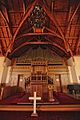
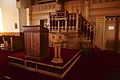
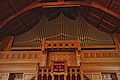
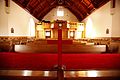
The Potchefstroom Reformed Church (in Potchefstroom, North West, South Africa, is the oldest congregation of the Dutch Reformed Church in South Africa in what was then the Transvaal or South African Republic. At its founding in March 1842, it was the 28th congregation in what would later become South Africa and the tenth outside of the Western and Southern Cape Synod.

Hendrik Muller Szn. was a Dutch merchant and politician. He is the father of Hendrik Pieter Nicolaas Muller.

The Moederkerk, in Swellendam, South Africa, is the only congregation of the NG Church in the historic Overbergse town of the same name.
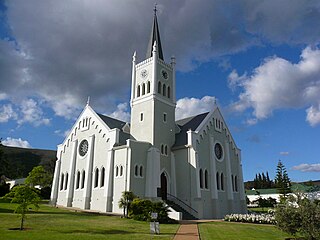
The Dutch Reformed Church in Barrydale is a congregation of the Dutch Reformed Church centered on the village of Barrydale in the picturesque surroundings of the Langeberg on the R62, 62.5 km (38.8 mi) south-east of Montagu, 76 km (47 mi) south-west of Ladismith and more or less equidistant through the Tradouw Pass from Swellendam and Heidelberg. In 2014, the congregation had 49 baptized and 211 professing members. In that year the pastor was Rev. W. J. van Zyl.