Related Research Articles
The Norwich School of painters was the first provincial art movement established in Britain, active in the early 19th century. Artists of the school were inspired by the natural environment of the Norfolk landscape and owed some influence to the work of landscape painters of the Dutch Golden Age such as Hobbema and Ruisdael.
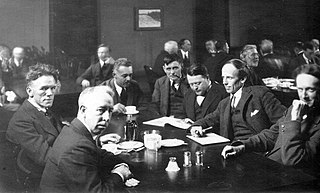
The Group of Seven, once known as the Algonquin School, was a group of Canadian landscape painters from 1920 to 1933, originally consisting of Franklin Carmichael (1890–1945), Lawren Harris (1885–1970), A. Y. Jackson (1882–1974), Frank Johnston (1888–1949), Arthur Lismer (1885–1969), J. E. H. MacDonald (1873–1932), and Frederick Varley (1881–1969). Later, A. J. Casson (1898–1992) was invited to join in 1926, Edwin Holgate (1892–1977) became a member in 1930, and LeMoine FitzGerald (1890–1956) joined in 1932.
Richard Arthur Wollheim was a British philosopher noted for original work on mind and emotions, especially as related to the visual arts, specifically, painting. Wollheim served as the president of the British Society of Aesthetics from 1992 onwards until his death in 2003.

Edward Jeffrey Irving Ardizzone,, who sometimes signed his work "DIZ", was an English painter, print-maker and war artist, and the author and illustrator of books, many of them for children. For Tim All Alone, which he wrote and illustrated, Ardizzone won the inaugural Kate Greenaway Medal from the Library Association for the year's best children's book illustration by a British subject. For the 50th anniversary of the Medal in 2005, the book was named one of the top ten winning titles, selected by a panel to compose the ballot for public election of an all-time favourite.

Sir William Rothenstein was an English painter, printmaker, draughtsman, lecturer, and writer on art. Emerging during the early 1890s, Rothenstein continued to make art right up until his death. Though he covered many subjects – ranging from landscapes in France to representations of Jewish synagogues in London – he is perhaps best known for his work as a war artist in both world wars, his portraits, and his popular memoirs, written in the 1930s. More than two hundred of Rothenstein's portraits of famous people can be found in the National Portrait Gallery collection. The Tate Gallery also holds a large collection of his paintings, prints and drawings. Rothenstein served as Principal at the Royal College of Art from 1920 to 1935. He was knighted in 1931 for his services to art. In March 2015 'From Bradford to Benares: the Art of Sir William Rothenstein', the first major exhibition of Rothenstein's work for over forty years, opened at Bradford's Cartwright Hall Gallery, touring to the Ben Uri in London later that year.
The Canadian Society of Painters in Water Colour, founded in 1925 is considered to be Canada's official national watercolour Society. Since the 1980s the Society has enjoyed Vice-regal Patronage from the incumbent Governor-General of Canada. Recognized by a long list of international exhibitions it is the Canadian equivalent of such other national societies as the American Watercolor Society of the United States, the Royal Watercolour Society of the United Kingdom, etc.

The Lincoln College of Art was an educational institution devoted to the arts, based in the English city of Lincoln with its origins in the mid-nineteenth century. The institution changed shape and name numerous times over its history before being absorbed into the University of Lincoln. Midway through the nineteenth century, the then British Government's Department of Science and Art, based in South Kensington, began establishing a network of art schools as a means of promoting and aiding manufacturing. One of the oldest institutions of its kind in Britain, it became one of Britain's leading art schools, and was one of the first to introduce the teaching of the techniques derived from the French School of Impressionism. Many of its students went on to exhibit at the Paris Salon and the Royal Academy. Amongst its alumni are members of the Newlyn School and two Royal Academicians. It also popularised the art and crafts exhibitions in Lincolnshire that became important annual events in the late 19th and early 20th centuries.
Sustainable art is art in harmony with the key principles of sustainability, which include ecology, social justice, non-violence and grassroots democracy. Sustainable art may also be understood as art that is produced with consideration for the wider impact of the work and its reception in relationship to its environments.
Jatin Das is an Indian painter, sculptor and muralist. He is counted amongst the most contemporary artists of India.
Kit Barker (1916–1988) was a British painter.
Pakala Tirumal Reddy (1915–1996) was an Indian artist. He was the fifth child born to Ram Reddy and Ramanammachild at Annaram village, Karimnagar district, Telangana, India. He received his diploma in painting from J. J. School of Art, Bombay in 1939. He married Yashoda Reddy on 9 May 1947, and she completed a master's of art and Ph.D. degrees and authored over 22 compilations and novels.
Alexandra Annette Grant is an American visual artist who examines language and written texts through painting, drawing, sculpture, video, and other media. She uses language and exchanges with writers as a source for much of that work. Grant examines the process of writing and ideas based in linguistic theory as it connects to art and creates visual images inspired by text and collaborative group installations based on that process. She is based in Los Angeles.

Katharine Cameron RWS RE was a Scottish artist, watercolourist, and printmaker, best known for her paintings and etchings of flowers. She was associated with the group of artists known as the Glasgow Girls.
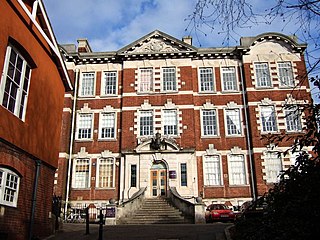
Exeter College of Art and Design was an art college based in Exeter, Devon. Founded in 1854, it amalgamated with what would become Plymouth University in 1989.

Art in modern Scotland includes all aspects of the visual arts in the country since the beginning of the twentieth century. In the early twentieth century, the art scene was dominated by the work of the members of the Glasgow School known as the Four, led Charles Rennie Mackintosh, who gained an international reputation for their combination of Celtic revival, Art and Crafts and Art Nouveau. They were followed by the Scottish Colourists and the Edinburgh School. There was a growing interest in forms of Modernism, with William Johnstone helping to develop the concept of a Scottish Renaissance. In the post-war period, major artists, including John Bellany and Alexander Moffat, pursued a strand of "Scottish realism". Moffat's influence can be seen in the work of the "new Glasgow Boys" from the late twentieth century. In the twenty-first century Scotland has continued to produce influential artists such as Douglas Gordon and Susan Philipsz.

Daniel J. Robbins was an American art historian, art critic, and curator, who specialized in avant-garde 20th-century art and helped encourage the study of it. Robbins' area of scholarship was on the theoretical and philosophical origins of Cubism. His writings centered on the importance of artists such as Albert Gleizes, Jean Metzinger, Henri Le Fauconnier and Jacques Villon. He was a specialist in early Modernism, writing on Salon Cubists and championed contemporaries such as Louise Bourgeois and the Color Field painters. Art historian Peter Brooke referred to Robbins as "the great pioneer of the broader history of Cubism".
Mary Davis, Lady Davis was a British artist known as a designer and painter of fans.
Velasquez Gallery, also known as Velasquez Gallery at Tye's, and later Tye's Art Gallery, was a Melbourne art gallery that showed contemporary traditional, and later, modernist Australian art, including some sculpture and prints, as well as Australian indigenous art. It operated from 1940 to 1955.
References
- Art and Artists (Published by Hansom Books, 1973)
- Dolman, B. Who's Who in Art (Twenty-Second Edition, 1986)
- Baile de Laperriere, C. Who's Who in Art (31st Edition, 2004)
- Windsor, A. British Sculptors of the Twentieth Century (Published by Ashgate, 2002)
- Osborne, A. On View: A Guide to Museum and Gallery Acquisitions in Great Britain (Plaistow Publications, 1969)
- The Year's Art (Published by J.S. Virture & Co., Ltd., 1941)
- Information File - National Art Library, London.