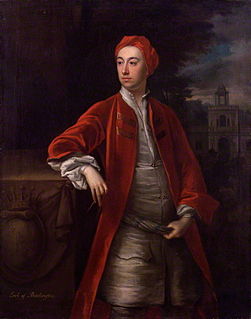
Richard Boyle, 3rd Earl of Burlington and 4th Earl of Cork, was an Anglo-Irish architect and noble often called the "Apollo of the Arts" and the "Architect Earl". The son of the 2nd Earl of Burlington and 3rd Earl of Cork, Burlington never took more than a passing interest in politics despite his position as a Privy Counsellor and a member of both the British House of Lords and the Irish House of Lords. His great interests in life were architecture and landscaping, and he is remembered for being a builder and a patron of architects, craftsmen and landscapers, Indeed, he is credited with bringing Palladian architecture to Britain and Ireland. His major projects include Burlington House, Westminster School, Chiswick House and Northwick Park.

A theodolite is a precision optical instrument for measuring angles between designated visible points in the horizontal and vertical planes. The traditional use has been for land surveying, but it is also used extensively for building and infrastructure construction, and some specialized applications such as meteorology and rocket launching.
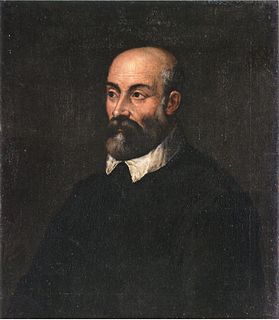
Andrea Palladio was an Italian Renaissance architect active in the Venetian Republic. Palladio, influenced by Roman and Greek architecture, primarily Vitruvius, is widely considered to be one of the most influential individuals in the history of architecture. While he designed churches and palaces, he was best known for country houses and villas. His teachings, summarized in the architectural treatise, The Four Books of Architecture, gained him wide recognition.

Palladian architecture is a European architectural style derived from and inspired by the designs of the Venetian architect Andrea Palladio (1508–1580). What is recognised as Palladian architecture today is an evolution of his original concepts. Palladio's work was strongly based on the symmetry, perspective, and values of the formal classical temple architecture of the Ancient Greeks and Romans. From the 17th century Palladio's interpretation of this classical architecture was adapted as the style known as "Palladianism". It continued to develop until the end of the 18th century.

Filippo Juvarra was an Italian architect, active in a late-Baroque style, who worked primarily in Italy, Spain, and Portugal.
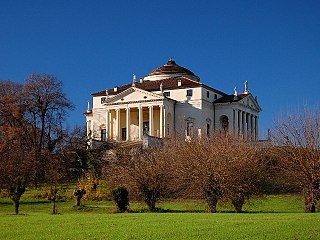
Villa La Rotonda is a Renaissance villa just outside Vicenza in northern Italy designed by Italian Renaissance architect Andrea Palladio. The villa’s correct name is Villa Almerico Capra Valmarana, but it is also known as "La Rotonda", "Villa Rotonda", "Villa Capra", and "Villa Almerico Capra". The name Capra derives from the Capra brothers, who completed the building after it was ceded to them in 1592. Along with other works by Palladio, the building is conserved as part of the World Heritage Site "City of Vicenza and the Palladian Villas of the Veneto".
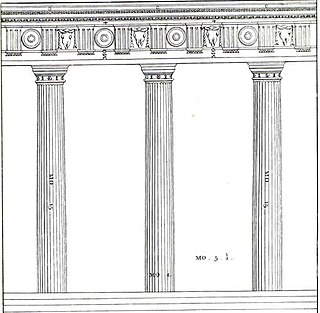
A module is a term that was in use among Roman architects, corresponding to the semidiameter of the column at its base. The term was first set forth by Vitruvius, and was employed by architects in the Italian Renaissance to determine the relative proportions of the various parts of the Classical orders. The module was divided by the 16th century theorists into thirty parts, called minutes, allowing for much greater precision than was thought necessary by Vitruvius, whose subdivision was usually six parts.
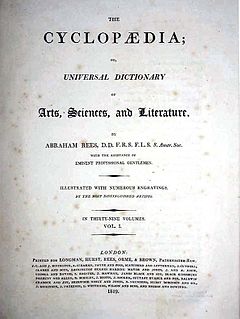
Rees's Cyclopædia, in full The Cyclopædia; or, Universal Dictionary of Arts, Sciences, and Literature was an important 19th-century British encyclopaedia edited by Rev. Abraham Rees (1743–1825), a Presbyterian minister and scholar who had edited previous editions of Chambers's Cyclopædia.

Wood engraving is a printmaking technique, in which an artist works an image or matrix of images into a block of wood. Functionally a variety of woodcut, it uses relief printing, where the artist applies ink to the face of the block and prints using relatively low pressure. By contrast, ordinary engraving, like etching, uses a metal plate for the matrix, and is printed by the intaglio method, where the ink fills the valleys, the removed areas. As a result, wood engravings deteriorate less quickly than copper-plate engravings, and have a distinctive white-on-black character.

I quattro libri dell'architettura is a treatise on architecture by the architect Andrea Palladio (1508–1580), written in Italian. It was first published in four volumes in 1570 in Venice, illustrated with woodcuts after the author's own drawings. It has been reprinted and translated many times, often in single-volume format.

William Halfpenny was an English architect and builder in the first half of the 18th century, and prolific author of builder's pattern books. In some of his publications he described himself as "architect and carpenter", and his books concentrate on the practical information a builder would need, as well as addressing "gentleman draughtsmen" designing their own houses. They were a popular alternative to the very expensive architectural treatises by British authors such as Colen Campbell and James Gibbs, or foreigners such as Serlio or Palladio. He also wrote under the name of Michael Hoare.

Uranometria is a star atlas produced by Johann Bayer. It was published in Augsburg in 1603 by Christoph Mangle under the full title Uranometria: omnium asterismorum continens schemata, nova methodo delineata, aereis laminis expressa. This translates to "Uranometria, containing charts of all the constellations, drawn by a new method and engraved on copper plates". The word "Uranometria" derives from Urania, muse of the heavens and "uranos" (oυρανός) the Greek word for sky / heavens. A literal translation of "Uranometria" is "Measuring the Heavens".

Batty Langley was an English garden designer, and prolific writer who produced a number of engraved designs for "Gothick" structures, summerhouses and garden seats in the years before the mid-18th century.

The Hammond–Harwood House is a historic house museum at 19 Maryland Avenue in Annapolis, Maryland, USA. Built in 1774, is one of the premier colonial houses remaining in America from the British colonial period (1607–1776). It is the only existing work of colonial academic architecture that was principally designed from a plate in Andrea Palladio's I Quattro Libri dell'Architettura (1570). The house was designed by the architect William Buckland in 1773–1774 for wealthy farmer Matthias Hammond of Anne Arundel County, Maryland. It was modeled on the design of the Villa Pisani in Montagnana, Italy, as depicted in Book II, Chapter XIV of Palladio's work. It was designated a National Historic Landmark in 1960, and is now managed by a non-profit organization as a museum.
The hoppus cubic foot was the standard volume measurement used for timber in the British Empire and countries in the British sphere of influence before the introduction of metric units. It is still used in the hardwood trade of some countries. This volume measurement was developed to estimate what volume of a round log would be usable timber after processing, in effect attempting to ‘square’ the log and allow for waste. The hoppus ton (HT) was also a traditionally used unit of volume in British forestry. One hoppus ton is equal to 50 hoppus feet or 1.8027 cubic metres. Some shipments of tropical hardwoods, especially shipments of teak from Myanmar (Burma), are still stated in hoppus tons.

Peter Nicholson was a Scottish architect, mathematician and engineer. Largely self-taught, he was apprenticed to a cabinet-maker but soon abandoned his trade in favour of teaching and writing. He practised as an architect but is best remembered for his theoretical work on the skew arch, his invention of draughtsman's instruments, including a centrolinead and a cyclograph, and his prolific writing on numerous practical subjects.

Genera Plantarum is a publication of Swedish naturalist Carl Linnaeus (1707–1778). The first edition was issued in Leiden, 1737. The fifth edition served as a complementary volume to Species Plantarum (1753). Article 13 of the International Code of Nomenclature for algae, fungi, and plants states that "Generic names that appear in Linnaeus' Species Plantarum ed. 1 (1753) and ed. 2 (1762–63) are associated with the first subsequent description given under those names in Linnaeus' Genera Plantarum ed. 5 (1754) and ed. 6 (1764)." This defines the starting point for nomenclature of most groups of plants.
Samuel Dunn was a British mathematician, teacher, cartographer and amateur astronomer.

Joshua Kirby, often mistakenly called John Joshua Kirby, was an English 18th-century landscape painter, engraver, writer, draughtsman and architect famed for his publications and teaching on linear perspective based on Brook Taylor's mathematics.

Elisha Kirkall (c.1682–1742) was a prolific English engraver, who made many experiments in printmaking techniques. He was noted for engravings on type metal that could be set up with letterpress for book illustrations, and was also known as a mezzotint artist.

