Related Research Articles

Efik mythology consists of a collection of myths narrated, sung or written down by the Efik people and passed down from generation to generation. Sources of Efik mythology include bardic poetry, art, songs, oral tradition and proverbs. Stories concerning Efik myths include creation myths, supernatural beings, mythical creatures, and warriors. Efik myths were initially told by Efik people and narrated under the moonlight. Myths, legends and historical stories are known in Efik as Mbụk while moonlight plays in Efik are known as Mbre Ọffiọñ.

Ọdinani, also Omenala, Omenana, Odinana or Ọmenani, are the traditional cultural beliefs and practices of the Igbo people of south east Nigeria. These terms, as used here in the Igbo language, are synonymous with the traditional Igbo "religious system" which was not considered separate from the social norms of ancient or traditional Igbo societies. Theocratic in nature, spirituality played a huge role in their everyday lives. Although it has largely been supplanted by Christianity, the indigenous belief system remains in strong effect among the rural and village populations of the Igbo, where it has at times influenced the colonial religions. Odinani is a pantheistic and polytheistic faith, having a strong central deity at its head. All things spring from this deity. Although a pantheon of other gods and spirits, these being Ala, Amadiọha, Anyanwụ, Ekwensu, Ikenga, exists in the belief system, as it does in many other Traditional African religions, the lesser deities prevalent in Odinani serve as helpers or elements of Chukwu, the central deity.

The Ibibio people are a coastal people in southern Nigeria. They are mostly found in Akwa Ibom and Cross River States. They are related to the Efik people. During the colonial period in Nigeria, the Ibibio Union asked for recognition by the British as a sovereign nation.
The Anaang are an ethnic group, whose land is primarily within 8 of the present 31 local government areas in Akwa Ibom State: Abak, Essien Udim, Etim Ekpo, Ika, Ikot Ekpene, Obot Akara, Oruk Anam, Ukanafun in Akwa Ibom State, and 3 of the 17 Local government areas in Abia State: Ugwunagbo, Obi Ngwa,and Ukwa East of Abia State.

The Gospel of Philip is a non-canonical Gnostic Gospel dated to around the 3rd century but lost in medieval times until rediscovered by accident, buried with other texts near Nag Hammadi in Egypt, in 1945.
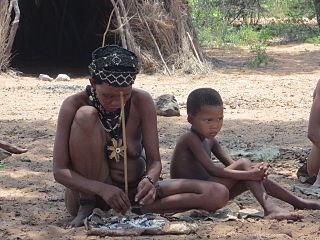
The ǃKung are one of the San peoples who live mostly on the western edge of the Kalahari desert, Ovamboland, and Botswana. The names ǃKung (ǃXun) and Ju are variant words for 'people', preferred by different ǃKung groups. This band level society used traditional methods of hunting and gathering for subsistence up until the 1970s. Today, the great majority of ǃKung people live in the villages of Bantu pastoralists and European ranchers.
Kaiso is a type of music popular in Trinidad and Tobago, and other countries, especially of the Caribbean, such as Grenada, Belize, Barbados, St. Lucia and Dominica, which originated in West Africa particularly among the Efik and Ibibio people of Nigeria, and later evolved into calypso music.

Mami Wata, or La Sirene, is a water spirit venerated in West, Central, and Southern Africa and in the African diaspora in the Americas. Mami Wata spirits are usually female but are sometimes male.

Tiffany Mitchell is a fictional character from the BBC soap opera EastEnders, played by Martine McCutcheon from 1995 until 1999. The character was created by writer Tony Jordan. She was introduced as a school friend of Bianca Jackson in January 1995.

The Efik are an ethnic group located primarily in southern Nigeria, and western Cameroon. Within Nigeria, the Efik can be found in the present-day Cross River State and Akwa Ibom state. The Efik speak the Efik language which is a member of the Benue–Congo subfamily of the Niger-Congo language group. The Efik refer to themselves as Efik Eburutu, Ifa Ibom, Eburutu and Iboku.

Nsibidi is a system of symbols or proto-writing developed by the Ekpe secret society of the old Calabar Kingdom that is now made up of Cross River State and Akwa Ibom State of Southern of Nigeria. They are classified as pictograms, though there have been suggestions that some are logograms or syllabograms.

Kerry Bishop is a fictional character from the Australian soap opera Neighbours, played by Linda Hartley-Clark. She made her first screen appearance during the episode broadcast on 1 February 1989. Kerry is Mavis and Harold Bishop's only daughter and David Bishop's sister. Kerry left home when she was young to travel the world. She met Eric and fell pregnant with their daughter, Sky. Following her arrival in Erinsborough, Kerry began a relationship with Joe Mangel and they eventually married. Kerry adopted Joe's son and fell pregnant again. However, while out protesting a duck hunt, Kerry was shot and she and her unborn child died. Kerry departed on 10 September 1990, but Hartley-Clark returned in 2004 and 2006 to record voice-overs. She also made an appearance in 2005 as Kerry's look-alike Gabrielle Walker.

The Oron people or Örö people are a sub-ethnic group of the larger Ibibio people, that make up the Akpakip Oro or Oron Nation. The Örö are located primarily in southern Nigeria in the riverine area of Akwa Ibom and the Cross River States and in Cameroon. Akpakip Oro are regarded as an ancient warrior people, speaking the Oro language which is in the Cross River language family of the Benue–Congo languages. They are ancestrally related to the Efik people of the Cross River State, the Ibeno and Eastern Obolo in Akwa Ibom, the Andoni people in Rivers State and the Balondo-ba-Konja in the Congo.
West African mythology is the body of myths of the people of West Africa. It consists of tales of various deities, beings, legendary creatures, heroes and folktales from various ethnic groups. Some of these myths traveled across the Atlantic during the period of the Trans-Atlantic slave trade to become part of Caribbean, Cuban and Brazilian mythology.
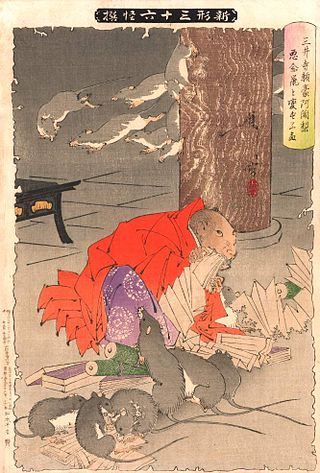
In mythology and folklore, a vengeful ghost or vengeful spirit is said to be the spirit of a dead person who returns from the afterlife to seek revenge for a cruel, unnatural or unjust death. In certain cultures where funeral and burial or cremation ceremonies are important, such vengeful spirits may also be considered as unhappy ghosts of individuals who have not been given a proper funeral.

Kev Dab Kev Qhuas is the common ethnic religion of the Miao people, best translated as the "practice of spirituality". The religion is also called Hmongism by a Hmong American church established in 2012 to organize it among Hmong people in the United States.
Medefaidrin (Medefidrin), or Obɛri Ɔkaimɛ, is a constructed language and script created as a Christian sacred language by an Ibibio congregation in 1930s Nigeria. It has its roots in glossolalia.
Efik names are names borne by the Efik people of Southern Nigeria and Western Cameroon. The naming system of the Efik is unique and differs from contemporary African names in several ways. The word for name in Efik is Enyiñ and the act of assigning a name to a child is Usio enyiñ.

Akata Warrior is a 2017 young adult fantasy novel by Nigerian American writer Nnedi Okorafor. It is a sequel to Akata Witch and the second book in The Nsibidi Scripts series. It won the inaugural Lodestar Award in 2018 as well as the 2018 Locus Award for Best Young Adult Novel.

The killing of twins was a cultural practice among some ethnic groups in Nigeria, predominantly among the Efik people. Giving birth to twins was considered a bad omen that could bring devastation or calamity upon society. Twin babies were believed not to be humans, and were seen as evil. In some remote areas, killing of twins is believed to be a myth. In the 21st century, it is believed that killing of twins as a sacrifice still exists among those living in Nigeria's federal capital territory.
References
- ↑ Okehie-Offoha, Marcellina Ulunma; Sadiku, Matthew N. O. (1996). Ethnic and Cultural Diversity in Nigeria. Africa World Press. ISBN 9780865432833.
- ↑ Ijoma, Phillip Koko (2003-04-29). Visions from the Dark World. AuthorHouse. ISBN 9781410709790.
- ↑ Achufusi, Ify Grace (1996). Women in Africa. Philipps-Universität Marburg.
- ↑ African Studies Abstracts: The Abstracts Journal of the African Studies Centre, Leiden. Hans Zell. 1998.
 | This Nigeria-related article is a stub. You can help Wikipedia by expanding it. |