Related Research Articles

The Battle of Philippi formed part of the Western Virginia Campaign of the American Civil War and was fought in and around Philippi, Virginia, on June 3, 1861. A Union Army victory, it was the first organized land action of the war, though generally viewed as a skirmish rather than a battle.

Roger Atkinson Pryor was an American newspaper editor and politician who became known for his fiery oratory in favor of secession from the United States; he was elected both to national and Confederate office, and served as a general for the Confederate Army during the American Civil War. In 1865 he moved to New York City to remake his life, and in 1868 brought his family north. He was among a number of influential southerners in the North who became known as "Confederate carpetbaggers."
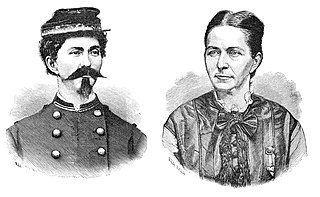
Loreta Janeta Velázquez was an American woman who wrote that she had masqueraded as a male Confederate soldier during the American Civil War. The book she wrote about her experiences says that after her soldier husband's accidental death, she enlisted in the Confederate States Army in 1861. She then fought at Bull Run, Ball's Bluff, and Fort Donelson, but was discharged when her sex was discovered while in New Orleans. Undeterred, she reenlisted and fought at Shiloh, until unmasked once more. She then became a Confederate spy, working in both male and female guises, and as a double agent also reporting to the U.S. Secret Service. She remarried three more times, being widowed in each instance.

Sarah Malinda Pritchard Blalock was a female soldier during the American Civil War. Despite originally being a sympathizer for the right of secession, she fought on both sides. She followed her husband, William Blalock, and joined the CSA's 26th North Carolina Regiment, disguising herself as a young man and calling herself Samuel Blalock. The couple eventually escaped by crossing Confederate lines and joining the Union partisans in the mountains of western North Carolina. During the last years of the war, she was a pro-Union marauder raiding the Appalachia region. Today she is one of the most remembered female combatants of the Civil War.
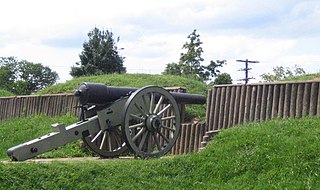
Fort Stevens, formerly named Fort Massachusetts, was part of the extensive fortifications built around Washington, D.C., during the American Civil War.
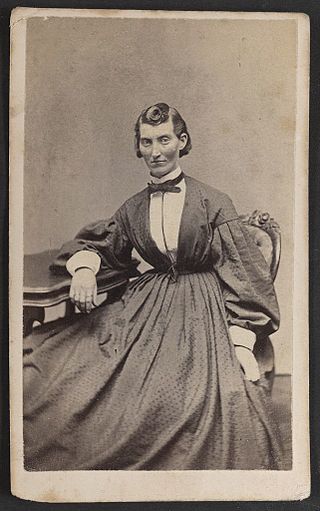
Frances Louisa Clayton, also recorded as Frances Clalin, was an American woman who purportedly disguised herself as a man to fight for the Union Army in the American Civil War, though many historians now believe her story was likely fabricated. Under the alias Jack Williams, she claimed to have enlisted in a Missouri regiment along with her husband, and fought in several battles. She claimed that she left the army soon after her husband died at Stones River.
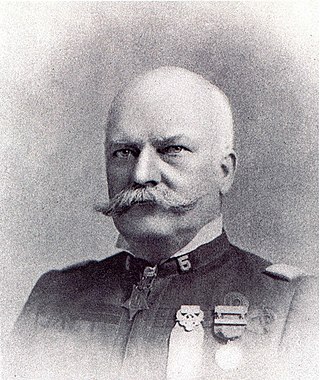
Edmund Rice was a soldier in the United States Army and a Medal of Honor recipient who achieved the rank of Brigadier General.

Michigan made a substantial contribution to the Union during the American Civil War. While the state itself was far removed from the combat theaters of the war, Michigan supplied many troops and several generals, including George Armstrong Custer. When, at the beginning of the war, Michigan was asked to supply no more than one regiment, Governor Austin Blair sent seven.

Lorinda Anna Blair Etheridge was a Union nurse and vivandière who served during the American Civil War. She was one of only two women to receive the Kearny Cross. She was inducted into the Michigan Women's Hall of Fame in 2010.

Kady Brownell was an American vivandière who helped the Union Army during the American Civil War. She went with her husband when he joined a Rhode Island regiment. Brownell trained with the soldiers. She fought in battle and helped the injured. At the First Battle of Bull Run, she held the flag high even as Confederate bullets were flying.

Nadine A. Turchin was the wife of Union Brigadier General John Basil Turchin. During the American Civil War, she traveled with her husband on his military campaigns and at times acted as his surrogate in command of his troops. She kept a detailed diary that remains a leading eyewitness account of her husband's colorful career. She became widely known in the Union army as "Madame Turchin."
This is a timeline of women in warfare in the United States before 1900.This list includes women who served in the United States Armed Forces in various roles. It also includes women who have been Warriors and fighters in other types of conflicts that have taken place in the United States. This list should also encompass women who served in support roles during military and other conflicts in the United States before the twentieth century.
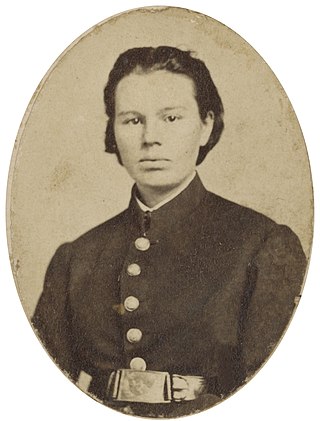
Frances Hook claimed that she, disguised as a man, enlisted as a soldier in the Union Army during the U.S. Civil War. She stated her aliases were Pvt. Frank Miller, Frank Henderson, Frank Martin and Frank Fuller. However, the enlistment records for the units in which she claimed to have served show no evidence of those aliases, nor any record to corroborate her story.
This is a timeline of women in warfare in the United States up until the end of World War II. It encompasses the colonial era and indigenous peoples, as well as the entire geographical modern United States, even though some of the areas mentioned were not incorporated into the United States during the time periods that they were mentioned.
Sophronia Smith Hunt was an American woman who disguised herself as a man and secretly served as a soldier in the Union Army during the American Civil War. Her first soldier husband died after he was wounded at the Battle of Jenkins' Ferry. They served in the 29th Iowa Infantry Regiment.

Marie Brose Tepe Leonard, known as "French Mary," was a vivandière of Franco-Turkish descent who fought for the Union Army during the American Civil War. Tepe served with the 27th and 114th Pennsylvania Infantry Regiments.
Maria Lewis, also known by the alias George Harris, was a Union Civil War soldier, and former slave, who gained distinction in the Eighth New York Cavalry.

At least four widows of veterans of the American Civil War are known to have survived into the 21st century. All were born in the 20th century and married their husbands while the women were still young and the men were in advanced age. This practice was not uncommon at the time due to the possibility of receiving pensions as dependents of Civil War veterans; the pensions were known for their generosity. Some of these unions were in name only, while others lived together as married couples.

Mary Morris Husband was an American nurse during the Civil War (1861–1865). She cared for soldiers who fought at the Battles of Antietam, Chancellorsville, and Gettysburg. She cared for her seriously ill son John until he was discharged by the surgeon. After recovering from miasmatic fever, Husband returned to service. She was among the nurses who treated thousands of soldiers in Fredericksburg, Virginia following the Battles of the Wilderness and Spotsylvania Court House. She nursed at the White House Hospital in June 1864. Among other leadership positions, she was the matron of the Third Corps hospital.
References
- ↑ "Niles, Martin C." www.nps.gov. National Park Service. 2018. Retrieved 17 December 2018.
- ↑ "Women Who Fought in Civil War Beside Hubby Dies, Aged Ninety-two". Washington Times. Washington D. C. 4 October 1920. Retrieved 17 December 2018.
- ↑ "Search For Soldiers". www.nps.gov. National Park Service. 2018. Retrieved 17 December 2018.
- 1 2 Eggleston, Larry G. (2015). Women in the Civil War: Extraordinary Stories of Soldiers, Spies, Nurses, Doctors, Crusaders, and Others. McFarland Publishers. pp. 74–75. ISBN 9781476607818.
- ↑ "Women Who Fought in Civil War Beside Hubby Dies, Aged Ninety-two". Washington Times. Washington D. C. 4 October 1920. Retrieved 17 December 2018.