Related Research Articles

An amphora is a type of container with a pointed bottom and characteristic shape and size which fit tightly against each other in storage rooms and packages, tied together with rope and delivered by land or sea. The size and shape have been determined from at least as early as the Neolithic Period. Amphorae were used in vast numbers for the transport and storage of various products, both liquid and dry, but mostly for wine. They are most often ceramic, but examples in metals and other materials have been found. Versions of the amphorae were one of many shapes used in Ancient Greek vase painting.
Classical archaeology is the archaeological investigation of the Mediterranean civilizations of Ancient Greece and Ancient Rome. Nineteenth-century archaeologists such as Heinrich Schliemann were drawn to study the societies they had read about in Latin and Greek texts. Many universities and foreign nations maintain excavation programs and schools in the area – such is the enduring appeal of the region's archaeology.
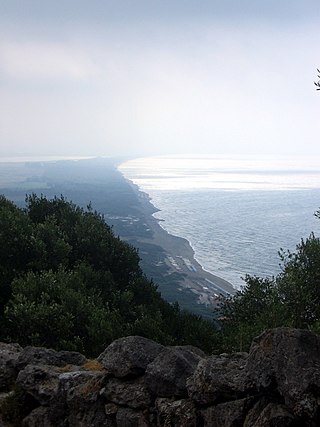
Cosa was an ancient Roman city near the present Ansedonia in southwestern Tuscany, Italy. It is sited on a hill 113 m above sea level and 140 km northwest of Rome on the Tyrrhenian Sea coast. It has assumed a position of prominence in Roman archaeology owing to its excavation.

Monte Testaccio or Monte Testaceo, also known as Monte dei Cocci, is an artificial mound in Rome composed almost entirely of testae, fragments of broken ancient Roman pottery, nearly all discarded amphorae dating from the time of the Roman Empire, some of which were labelled with tituli picti. It is one of the largest spoil heaps found anywhere in the ancient world, covering an area of 2 hectares at its base and with a volume of approximately 580,000 cubic metres (760,000 cu yd), containing the remains of an estimated 53 million amphorae. It has a circumference of nearly a kilometre (0.6 mi) and stands 35 metres (115 ft) high, though it was probably considerably higher in ancient times. It stands a short distance away from the east bank of the River Tiber, near the Horrea Galbae where the state-controlled reserve of olive oil was stored in the late 2nd century AD. The mound later had both religious and military significance.

The Archaeological Institute of America (AIA) is North America's oldest society and largest organization devoted to the world of archaeology. AIA professionals have carried out archaeological fieldwork around the world and AIA has established research centers and schools in seven countries. As of 2019, the society had more than 6,100 members and more than 100 affiliated local societies in the United States and overseas. AIA members include professional archaeologists and members of the public.
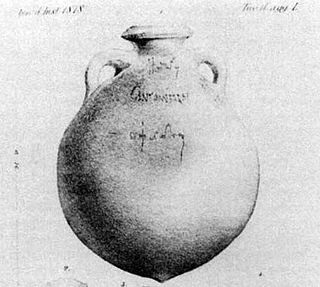
A titulus pictus is an ancient Roman commercial inscription made on the surface of certain artefacts, usually the neck of an amphora. Typically, these inscriptions were made in red or black paint. The inscription specifies information such as origin, destination, type of product, and owner. Tituli picti are frequent on ancient Roman pottery containers used for trade. They were not exclusively used for trade. They were also used to provide easily recognizable advertisements and may have served as insurance if a good was damaged in some way. There are around 2,500 tituli picti recorded in CIL IV.

Eileithyia Cave was a sacred cave dedicated to the goddess of childbirth, Eileithyia, on the island of Crete, that was used from the Neolithic era to the Roman, with worship flourishing in the Late Minoan period. It has been suggested that rock formations within the cave resemble female figures, most prominently a stalagmite in the centre that appears as a standing female.
Clementina Panella is an Italian archaeologist, a professor at the University of Rome La Sapienza, where she teaches Methodology of Archaeology. She has guided and co-written a number of articles on the commercial pottery of ancient Italy.
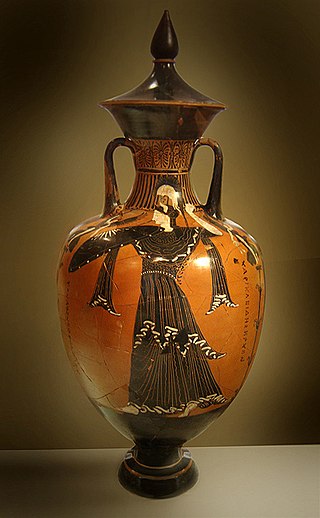
Panathenaic amphorae were the amphorae, large ceramic vessels, that contained the olive oil given as a prize in the Panathenaic Games. Some were ten imperial gallons and 60–70 cm (24–28 in) high. This oil came from the sacred grove of Athena at Akademia. The amphorae which held it had the distinctive form of tight handles, narrow neck and feet, and they were decorated with consistent symbols, in a standard form using the black figure technique, and continued to be so, long after the black figure style had fallen out of fashion. Some Panathenaic amphorae depicted Athena Promachos, goddess of war, advancing between columns brandishing a spear and wearing the aegis, and next to her the inscription τῶν Ἀθήνηθεν ἄθλων "(one) of the prizes from Athens". On the back of the vase was a representation of the event for which it was an award. Sometimes roosters are depicted perched on top of the columns. The significance of the roosters remains a mystery. Later amphorae also had that year's archon's name written on it making finds of those vases archaeologically important.

Flavia Domitilla the Younger or Flavia Domitilla Minor was the only daughter of the Roman Emperor Vespasian.

The Head of a Philosopher is a fragment of a bronze sculpture of Magna Graecia, discovered in 1969 on a shipwreck in the Straits of Messina. It is now in the Museo Nazionale della Magna Grecia in Reggio Calabria, Italy.

Gordion was the capital city of ancient Phrygia. It was located at the site of modern Yassıhüyük, about 70–80 km (43–50 mi) southwest of Ankara, in the immediate vicinity of Polatlı district. Gordion's location at the confluence of the Sakarya and Porsuk rivers gave it a strategic location with control over fertile land. Gordion lies where the ancient road between Lydia and Assyria/Babylonia crossed the Sangarius river. Occupation at the site is attested from the Early Bronze Age continuously until the 4th century CE and again in the 13th and 14th centuries CE. The Citadel Mound at Gordion is approximately 13.5 hectares in size, and at its height habitation extended beyond this in an area approximately 100 hectares in size. Gordion is the type site of Phrygian civilization, and its well-preserved destruction level of c. 800 BCE is a chronological linchpin in the region. The long tradition of tumuli at the site is an important record of elite monumentality and burial practice during the Iron Age.

Desilo is an underwater archaeological site in southern Bosnia and Herzegovina, located near the Neretva river and the Croatian border. The site was first discovered in the late 20th century, but Desilo's history can be traced as far back as ancient times. Investigations by a University of Mostar archaeological team in 2007 uncovered many sunken boats at the bottom of the small lake in Desilo valley. The archaeologists believe these boats to be Illyrian ships, dating back to the first and second centuries B.C. Further excavations in 2008 by University of Oslo archaeologists found evidence suggesting that Desilo was an Illyrian trading post. These archaeological findings are significant because they are the first known discovery of Illyrian ships. Additionally, Desilo functioning as a trading centre suggests there were peaceful interactions between the Illyrians and the Romans.
The Ayla-Axum amphorae are conical, carrot-shaped amphorae found around the Red Sea, particularly in the Late Roman/Byzantine period. Originally named after the widest range of finds in the Red Sea, subsequent findings since the mid-1990s indicate that the amphoras originate in Byzantine, or even early Islamic, Aqaba. Hence, the preferred nomenclature is now "Aqaba Amphora." The Aqaba amphora type has been found in many terrestrial sites throughout the region and beyond, such as in Eritrea and Ethiopia: Aksum, where amphora sherds with fabrics light red on the inside, pale gray on the outside, as well as greenish-gray fabric were found by the Deutsche Aksum Expedition ; Matara dating to the 4th through 7th centuries ; and Adulis examples of which are on display in the National Museum in Asmara. Other examples have been found at Berenike in Egypt, where the amphorae date to a circa AD 400 context in what may be the best-stratified examples ; from Aqaba in Jordan where many examples have been found, including their kilns; on The Shipwreck at Black Assarca Island, Eritrea ; and in the Mediterranean on the late 6th-century shipwreck at Iskandil Burnu, Turkey that is the sole example yet found in that sea. A number of the amphoras and sherds came to light during excavations at Zafar in Yemen, and eleven of the sherds were subjected to mineralogical analysis, which demonstrated that the amphoras originate in what is now Aqaba, Jordan.

Tel Anafa is an archaeological site and nature reserve in the Upper Galilee, Israel.

Palmyrene funerary reliefs are almost 4,000 busts on decorative slabs closing burial niches inside underground tombs, produced in Palmyra over three centuries from the middle of the first century BC. It is the largest corpus of portrait sculpture in the Roman world outside Rome and the largest collection of funerary representations from one place in the classical world.

Barbara Tsakirgis was an American classical archaeologist with specialization in Greek and Roman archaeology, particularly of ancient Greek houses and households. She worked in the archaeological excavation sites in Sicily and Athens for her doctoral thesis from Princeton University on the subject of Hellenistic houses at Morgantina. Her thesis was published as The Domestic Architecture of Morgantina in the Hellenistic and Roman Periods (1984). She taught at the Vanderbilt University's Department of Classical Studies and was an associate professor from 1992 to 2019.

Anna Marguerite McCann was an American art historian and archaeologist. She is known for being an early influencer—and the first American woman—in the field of underwater archaeology, beginning in the 1960s. McCann authored works pertaining to Roman art and Classical archaeology, and taught both art history and archaeology at various universities in the United States. McCann was an active member of the Archaeological Institute of America, and received its Gold Medal Award in 1998. She also published under the name Anna McCann Taggart.

Judith Sheila McKenzie was an Australian archaeologist whose work primarily focused on the architecture of the ancient Middle East. At the time of her death, McKenzie was Associate Professor of Late Antique Egypt and the Holy Land at the University of Oxford and Director of the Manar al-Athar project, an open-access image archive of the Middle East. McKenzie was known in particular for her work on the architecture of Petra and Alexandria, having published lengthy monographs on each.
Elizabeth Mary Pye, is a British conservator and academic. She had studied prehistoric archaeology at the University of Edinburgh and conservation at the University of London, before becoming a conservator at the British Museum. She was Professor of Archaeological and Museum Conservation at UCL Institute of Archaeology until she retired in 2013: she is now emeritus professor.
References
- ↑ "Obituary: Elizabeth L. Will, professor emeritus of classics and authority on amphoras". Office of News & Media Relations | UMass Amherst. Archived from the original on 2019-07-24. Retrieved 2019-07-24.
- ↑ RAUH, NICHOLAS K. (2010). "Elizabeth Lyding Will, 1924–2009". American Journal of Archaeology. 114 (3): 547–548. doi:10.3764/aja.114.3.547. JSTOR 25684293.
- ↑ Benjamin Wynn Fortson (1996). Studies in the prosody of Plautine Latin: a thesis. Harvard University.
- ↑ Kathleen Slane; Elizabeth L Will (3 January 2019). Cosa: The Roman and Greek Amphoras. University of Michigan Press. ISBN 978-0-472-13143-3.
- ↑ Anna Marguerite McCann (14 March 2017). The Roman Port and Fishery of Cosa: A Center of Ancient Trade. Princeton University Press. pp. 32–. ISBN 978-1-4008-8668-5.
