
The Bulgarian Exarchate was the official name of the Bulgarian Orthodox Church before its autocephaly was recognized by the Ecumenical See in 1945 and the Bulgarian Patriarchate was restored in 1953.

The Black Drin, or Black Drim is a river in North Macedonia and Albania. It flows out of Lake Ohrid in Struga, North Macedonia. It is 149 km (93 mi) long and its drainage basin is 3,504 km2 (1,353 sq mi). Its average discharge is 118 m3/s (4,200 cu ft/s). After flowing through North Macedonia for 56 km (35 mi), the Black Drin crosses the border to Albania, west of Debar. It merges with the White Drin in Kukës to form the Drin, which flows into the Adriatic Sea. It drains most of the eastern border region of Albania.

Malko Tarnovo is a town in Burgas Province, southeastern Bulgaria, 5 km from the Turkish border. It is the only town in the interior of the Bulgarian Strandzha Mountains and lies in Strandzha Nature Park. Malko Tarnovo is the administrative centre of the homonymous Malko Tarnovo Municipality. As of December 2009, the town had 2,449 inhabitants.
Makedoniya was a Bulgarian newspaper edited and published by Petko Slaveykov in Istanbul with the aim to help the foundation of an independent Bulgarian Church. Started in 1866, Makedoniya was one of the first Bulgarian newspapers and among the most popular at the time; it published news items, articles and discussion papers in the Bulgarian language and sometimes in the Greek language. It was stopped from printing in 1872 after the creation of the Bulgarian Exarchate. The newspaper had the title "Macedonia", as its main task per Slaveykov himself, was to educate the misguided (sic): Grecomans there, who he called Macedonists.

Echinos is a village and a community in the municipality Myki. Before the 2011 local government reform it was part of the municipality of Myki, of which it was a municipal district. The 2021 census recorded 2,780 inhabitants in the community. The community of Echinos covers an area of 85.691 km2.
The battle of Thessalonica was fought between the Bulgarian and the Byzantine Empires in the summer of 1014 near the city of Thessalonica in contemporary northern Greece. The Bulgarian army under the command of Nestoritsa was defeated by the Byzantines led by the governor of Thessalonica Theophylactus Botaniates and it was unable to divert the main Byzantine forces who were attacking the Bulgarian ramparts between the Belasitsa and Ograzhden mountains.
The battle of Bitola took place near the town of Bitola, in Bulgarian territory, between a Bulgarian army under the command of the voivode Ivats and a Byzantine army led by the strategos George Gonitsiates. It was one of the last open battles between the First Bulgarian Empire and the Byzantine Empire. The Bulgarians were victorious and the Byzantine Emperor Basil II had to retreat from the Bulgarian capital Ohrid, whose outer walls were by that time already breached by the Bulgarians. However, the Bulgarian victory only postponed the fall of Bulgaria to Byzantine rule in 1018.
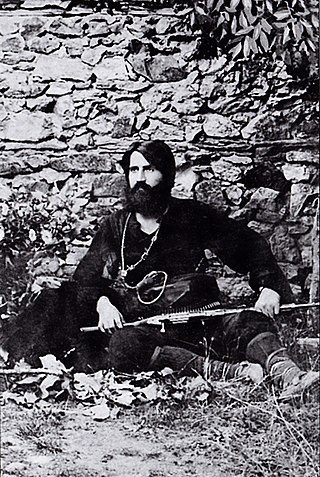
Petar Atsev was a Macedonian Bulgarian revolutionary, and a voyvoda of the Internal Macedonian-Adrianople Revolutionary Organization (IMARO) for the region of Prilep. He worked as a Bulgarian teacher.

The Church of St Nicholas is a partially preserved medieval Eastern Orthodox church in the town of Melnik in Blagoevgrad Province, southwestern Bulgaria. Dating to the late 12th century, it stands on top of an ancient Thracian sanctuary and a 5th-century basilica. In the Middle Ages, the church served as the cathedral of Melnik's bishop. The interior of the church features frescoes of rarely depicted scenes, as well as a 13th-century inscription. Its bell tower used to house one of the oldest extant church bells in Europe, discovered by archaeologists in the 2000s.
The Rupel Gorge or Rupel Pass is a steep river valley in the northern part of Central Macedonia, immediately south of the Greek-Bulgarian border. It was formed by the Strymon River, which stems from the Vitosha mountains and flows into the Aegean Sea. The gorge is rich in biodiversity which may be endangered by the project to build the Motorway 25 which is a part of European route E79. Strymon enters from Bulgaria into Greece west of village Promachonas, going through Roupel Pass, that it opened up, between the mountains Belasica and Orvilos. Here the ground gets flatter so the Strymon loses speed and splits into two branches. The western branch goes to lake Kerkini and then flows southeast where it rejoins the eastern branch near to the village of Lithotopi.
Prespa was a medieval town, situated in the homonymous area in south-western Macedonia. It was a residence and burial place of the Bulgarian emperor Samuel and according to some sources capital of the First Bulgarian Empire and seat of the Bulgarian Patriarchate in the last decades of the 10th century.

The official flag of the Internal Macedonian Revolutionary Organization was adopted in the early 1920s by the Central Committee of IMRO. In 1922, an article was issued by the member of the Macedonian Federative Organization Trifon Grekov entitled "The Flag of Independent Macedonia". It was published in the Bulgarian newspaper "Autonomous Macedonia", and proposed this flag to become the flag of the future Independent Macedonia. The flag was also the state flag of the proposed puppet state: Independent State of Macedonia. Today the flag is used by right wing political parties in North Macedonia like VMRO-DPMNE and also Bulgarian political parties like VMRO-BND.
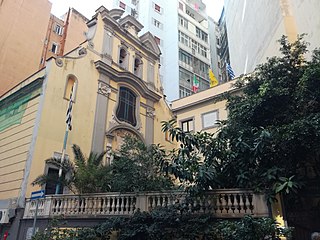
Thomas Asen Palaiologos was a prominent Byzantine exile in the Kingdom of Naples in the early 16th century. A descendant of two imperial dynasties, the Palaiologoi of Byzantium and the Asens of Bulgaria, Thomas Asen Palaiologos was active in the anti-Ottoman struggles of Greece. Before 1506, he resettled in Italy and was the donor for the construction of an Eastern Orthodox church in Naples.

Svoboda ili smart, written in pre-1945 Bulgarian orthography: "Свобода или смърть" and before 1899: "Свобода или смъртъ", was a revolutionary slogan used during the national-liberation struggles by the Bulgarian revolutionaries, called comitadjis. The slogan was in use during the second half of the 19th and the first half of the 20th centuries.
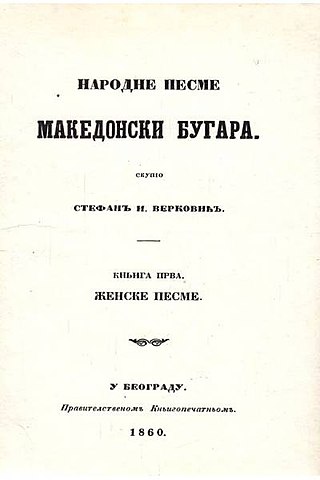
Folk Songs of the Macedonian Bulgarians is an ethnographic collection of folk songs collected by Stefan Verković, considered to be his most valuable contribution in the field of Bulgarian folklore. It was published in Serbian in 1860, in Belgrade.

Naum Hristov Tomalevski was a Bulgarian revolutionary, participant in the Macedonian revolutionary movement, member of the Internal Macedonian Revolutionary Organization (IMRO).
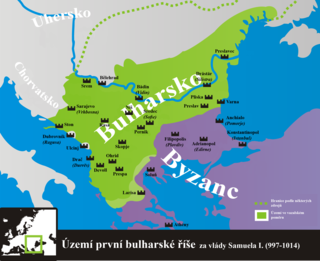
Peter and Boyan were late-10th century Bulgarian nobles (boyars) from Byzantine-administered northeastern Bulgaria. They are mentioned in Annales seu cronicae incliti Regni Poloniae by Jan Długosz in the context of their successful struggle against Byzantium:
Two Bulgarian warlords – Peter and Boyan – began a war against the Greeks, and after securing a few victories, worried Constantine's country so much, that its power was shaken and diminished for a long time.
Lefki is a village located Kastoria regional unit of Western Macedonia.

The Bitola Triodion is a Middle Bulgarian Glagolitic manuscript that contains a triodion from the late 12th century.
Trifon Kostadinov Grekov or Trifun Grekovski, also known as Trifun Greković, was a Macedonian physician, emigrant political activist during and after the First World War and Macedonian Partisan during the Second World War.
