Related Research Articles
Sanofi S.A. is a French multinational pharmaceutical and healthcare company headquartered in Paris, France. The corporation was established in 1973 and merged with Synthélabo in 1999 to form Sanofi-Synthélabo. In 2004, Sanofi-Synthélabo merged with Aventis and renamed to Sanofi-Aventis, which were each the product of several previous mergers. It changed its name back to Sanofi in May 2011. The company is a component of the Euro Stoxx 50 stock market index. In 2023, the company’s seat in Forbes Global 2000 was 89.
Emergent BioSolutions Inc. is an American multinational specialty biopharmaceutical company headquartered in Gaithersburg, Maryland. It develops vaccines and antibody therapeutics for infectious diseases and opioid overdoses, and it provides medical devices for biodefense purposes.

Sinovac Biotech Ltd. is a Chinese biopharmaceutical company based in Haidian District, Beijing that focuses on the research, development, manufacture, and commercialization of vaccines that protect against human infectious diseases. The company was listed on the Nasdaq but the exchange halted Sinovac's trading in February 2019 due to a proxy fight. The company has faced bribery probes in China. Its COVID-19 vaccine was also the target of a covert disinformation campaign by the US government.
Novavax, Inc. is an American biotechnology company based in Gaithersburg, Maryland, that develops vaccines to counter serious infectious diseases. Prior to 2020, company scientists developed experimental vaccines for influenza and respiratory syncytial virus (RSV), as well as Ebola and other emerging infectious diseases. During 2020, the company redirected its efforts to focus on development and approval of its NVX-CoV2373 vaccine for COVID-19.

A COVID‑19 vaccine is a vaccine intended to provide acquired immunity against severe acute respiratory syndrome coronavirus 2 (SARS-CoV-2), the virus that causes coronavirus disease 2019 (COVID‑19).
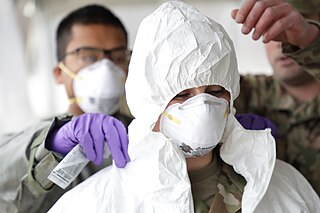
The COVID-19 pandemic in the U.S. state of Rhode Island is part of an ongoing worldwide viral pandemic of coronavirus disease 2019, a novel infectious disease caused by severe acute respiratory syndrome coronavirus 2. As of August 18, 2022, there has been 414,931 confirmed cases of COVID-19 in Rhode Island, 89 of which are currently hospitalized, and 3,636 reported deaths. Rhode Island's COVID-19 case rate and death rate per capita are the highest and twentieth highest, respectively, of the fifty states since the start of the pandemic.

COVID-19 drug development is the research process to develop preventative therapeutic prescription drugs that would alleviate the severity of coronavirus disease 2019 (COVID-19). From early 2020 through 2021, several hundred drug companies, biotechnology firms, university research groups, and health organizations were developing therapeutic candidates for COVID-19 disease in various stages of preclinical or clinical research, with 419 potential COVID-19 drugs in clinical trials, as of April 2021.

Operation Warp Speed (OWS) was a public–private partnership initiated by the United States government to facilitate and accelerate the development, manufacturing, and distribution of COVID-19 vaccines, therapeutics, and diagnostics. The first news report of Operation Warp Speed was on April 29, 2020, and the program was officially announced on May 15, 2020. It was headed by Moncef Slaoui from May 2020 to January 2021 and by David A. Kessler from January to February 2021. At the end of February 2021, Operation Warp Speed was transferred into the responsibilities of the White House COVID-19 Response Team.
ZF2001, trade-named Zifivax or ZF-UZ-VAC-2001, is an adjuvanted protein subunit COVID-19 vaccine developed by Anhui Zhifei Longcom in collaboration with the Institute of Microbiology at the Chinese Academy of Sciences. The vaccine candidate is in Phase III trials with 29,000 participants in China, Ecuador, Malaysia, Pakistan, and Uzbekistan.
The COVID-19 vaccination program in the Philippines was a mass immunization campaign against severe acute respiratory syndrome coronavirus 2 (SARS-CoV-2), the virus that causes coronavirus disease 2019 (COVID-19), in response to the pandemic in the country. The vaccination program was initiated by the Duterte administration on March 1, 2021, a day after the arrival of the country's first vaccine doses which were donated by the Chinese government.

Drew Weissman is an American physician and immunologist known for his contributions to RNA biology. Weissman is the inaugural Roberts Family Professor in Vaccine Research, director of the Penn Institute for RNA Innovation, and professor of medicine at the Perelman School of Medicine at the University of Pennsylvania (Penn).

EpiVacCorona is a peptide-based vaccine against COVID-19 developed by the Russian VECTOR Center of Virology. The lack of protective effectiveness of EpiVacCorona, which is still in use in Russia, has been reported in scientific literature and in the media. The vaccine consists of three chemically synthesized peptides that are conjugated to a large carrier protein. This protein is a fusion product of a viral nucleocapsid protein and a bacterial MBP protein. A phase III clinical trial to show whether or not the vaccine can protect people against COVID-19 was launched in November 2020 with more than three thousand participants. The conclusions and results of the trial have not been made public.
ARCT-021, also known as LUNAR-COV19, is a COVID-19 vaccine candidate developed by Arcturus Therapeutics.
PTX-COVID19-B is a messenger RNA (mRNA)-based COVID-19 vaccine, a vaccine for the prevention of the COVID-19 disease caused by an infection of the SARS-CoV-2 coronavirus, created by Providence Therapeutics—a private Canadian drug company co-founded by Calgary, Alberta-based businessman Brad T. Sorenson and San Francisco–based Eric Marcusson in 2013. A team of eighteen working out of Sunnybrook Research Institute in Toronto, Ontario developed PTX-COVID19-B in less than four weeks, according to the Calgary Herald. Human trials with sixty volunteers began on January 26, 2021, in Toronto.
Abdala, technical name CIGB-66, is a COVID-19 vaccine developed by the Center for Genetic Engineering and Biotechnology in Cuba. This candidate, named after a patriotic drama by Cuban independence hero José Martí, is a protein subunit vaccine containing COVID-derived proteins that trigger an immune response. The full results of the clinical trial have not yet been published. This candidate followed a previous one called CIGB-669 (MAMBISA).
The Sanofi–GSK COVID-19 vaccine, sold under the brand name VidPrevtyn Beta, is a COVID-19 vaccine developed by Sanofi Pasteur and GSK.

The COVID-19 vaccination in Vietnam is an ongoing immunization campaign against severe acute respiratory syndrome coronavirus 2 (SARS-CoV-2), in response to the ongoing pandemic in the country. Following the approval of the Oxford–AstraZeneca COVID-19 vaccine on 30 January 2021, vaccinations commenced on 8 March 2021, and will continue throughout the year with the goal of vaccinating 80% of the population by June 2022. The Sputnik V was later approved for use on 23 March 2021. The Sinopharm BIBP vaccine was approved for emergency use on 4 June 2021, while Pfizer–BioNTech COVID-19 vaccine, Moderna COVID-19 vaccine and Janssen COVID-19 vaccine were approved on 12 June 2021, 29 June 2021, and 15 July 2021, respectively. Vietnam approved Abdala vaccine from Center for Genetic Engineering and Biotechnology on 18 September 2021, and Covaxin from Bharat Biotech on 10 November 2021.
ARCT-154, also known as VBC-COV19-154 in Vietnam, is a COVID-19 vaccine candidate developed by Arcturus Therapeutics. For its development, Arcturus collaborated with Vinbiocare, a Vietnamese company, for support with clinical trials and manufacturing. The vaccine was authorised in Japan in November 2023.
COVID-19 vaccine clinical research uses clinical research to establish the characteristics of COVID-19 vaccines. These characteristics include efficacy, effectiveness, and safety. As of November 2022, 40 vaccines are authorized by at least one national regulatory authority for public use:
References
- 1 2 Graves, Helen (October 1, 2009). "Annie De Groot proves the power of one person". Boston Herald . Retrieved July 30, 2021.
- 1 2 3 "URI professor, vaccine pioneer honored by University of Chicago". URI News. University of Rhode Island. June 11, 2018. Retrieved July 30, 2021.
- ↑ MacMillan, John (June 15, 2020). "Dr. Annie De Groot '78: Designing a Vaccine". Grécourt Gate. Smith College . Retrieved July 30, 2021.
- ↑ Victoria White (October 27, 2015). "Ipsen and EpiVax produce next generation botulinum toxins". Drug Target Review.
- ↑ Berkowitz, Bram (September 1, 2020). "Ocean State Update: The biggest Rhode Island tech and startup news From August". Rhode Island Innovation. Retrieved July 30, 2021.
- ↑ "7 Major Coronavirus Developments — RI's EpiVax to Raise $1.75M for Clinical Trial for Vaccine". GoLocalProv. April 8, 2020. Retrieved July 30, 2021.
- ↑ Tognini, Giacomo (April 1, 2020). "Coronavirus Business Tracker: How The Private Sector Is Fighting The Covid-19 Pandemic". Forbes . Retrieved July 30, 2021.