
A periscope is an instrument for observation over, around or through an object, obstacle or condition that prevents direct line-of-sight observation from an observer's current position.

Fujiko Fujio was a manga writing duo formed by Japanese manga artists Hiroshi Fujimoto and Motoo Abiko. They formed their partnership in 1951, and used the Fujiko Fujio name from 1954 until dissolution of the partnership in 1987, upon Fujimoto's illness. The pair was best known for their popular comedies, including Obake no Q-Tarō, Ninja Hattori-kun, Kaibutsu-kun, and Doraemon, the main character of which is officially recognized as a cultural icon of modern Japan.
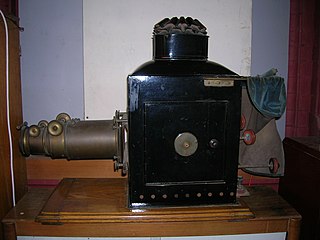
The opaque projector, epidioscope, epidiascope or episcope is a device which displays opaque materials by shining a bright lamp onto the object from above. A system of mirrors, prisms and/or imaging lenses is used to focus an image of the material onto a viewing screen. Because they must project the reflected light, opaque projectors require brighter bulbs and larger lenses than overhead projectors. Care must be taken that the materials are not damaged by the heat generated by the light source. Opaque projectors are not as common as the overhead projector.

The Dardo is an infantry fighting vehicle designed for the Italian Army as a replacement for the M113 APC. It is designed and built by the Iveco Fiat Oto Melara Syndicated Company based in Rome. Iveco is responsible for the hull and propulsion systems, while Oto Melara is responsible for the weapons and fire control systems.
Audiovisual education or multimedia-based education (MBE) is instruction where particular attention is paid to the audiovisual or multimedia presentation of the material with the goal of improving comprehension and retention.
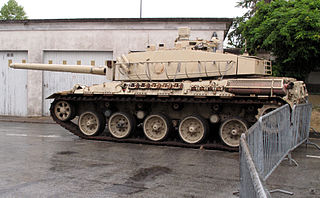
The AMX-32 was a French main battle tank developed by AMX and APX in the late 1970s during the Cold War as an export tank to fit in a specific market niche of nations with smaller defence budgets. While six prototypes were built, it failed to garner interest for foreign sales.

In the Roman Catholic Church and the Anglican Communion as well as some Lutheran denominations, a rural dean is a member of clergy who presides over a "rural deanery" ; "ruridecanal" is the corresponding adjective. In some Church of England dioceses rural deans have been formally renamed as area deans.
Lantpert was the son of Theodo, duke of Bavaria, and Gleisnot of Friuli.

Theodo, also known as Theodo V and Theodo II, was the Duke of Bavaria from 670 or, more probably, 680 to his death. It is with Theodo that the well-sourced history of Bavaria begins. He strengthened his duchy internally and externally and, according to the medieval chronicler Arbeo of Freising, he was a prince of great power whose fame extended beyond his borders.
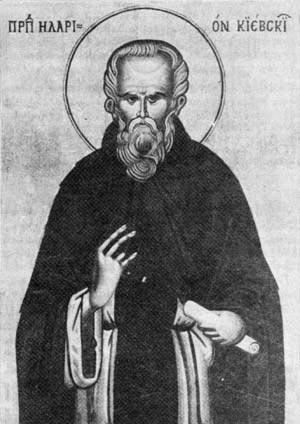
Hilarion or Ilarion was the first non-Greek Metropolitan of Kiev and all Rus in Medieval Kievan Rus (Ruthenia). He held the metropolitan post before or during the ongoing 11th century East–West Schism. While there is not much verifiable information regarding Hilarion's biography, there are several aspects of his life which have come to be generally accepted.
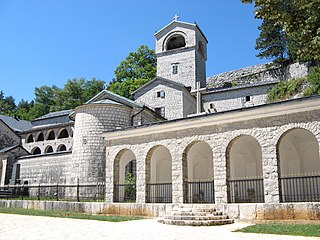
The Cetinje Monastery is a monastery of the Serbian Orthodox Church in Montenegro. It is located in Cetinje and is the seat of the Metropolitanate of Montenegro. A center of historical and cultural importance, it was founded c. 1484 by Prince Ivan Crnojević of Zeta, and designated as the cathedral monastery of the Eparchy of Zeta. It was devastated in 1692, during the Morean War, and rebuilt between 1701 and 1704 by Metropolitan Danilo Petrović-Njegoš on the site of the former court of Ivan Crnojević.

The LT vz. 34, formally designated as Lehký tank vzor 34 was a Czechoslovak-designed light tank used mainly by Slovakia during World War II. Its suspension was based on that of the Carden-Loyd tankette, of which the Czechs had purchased three, plus a manufacturing license, in 1930. Dissatisfied with the prototypes of the Tančík vz. 33 tankette, the Czech Army decided that it would be easier to design a light tank from scratch rather than modify a tankette's chassis to carry a fully rotating armored turret. 50 were built, the last of which was delivered during 1936, of which the Germans captured 22 - including the prototype, when they occupied Bohemia-Moravia in March 1939, but they promptly scrapped them. The Slovaks seized the remaining 27 when they declared independence from Czechoslovakia at the same time. In Slovak service it only saw combat during the Slovak National Uprising.
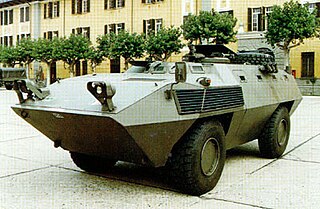
The Fiat CM6614 is a 4x4 wheeled armoured personnel carrier developed as a joint venture between Fiat and Oto Melara of Italy. The hull is welded steel, and the vehicle is amphibious. The first prototype was built in 1972.

A projector or image projector is an optical device that projects an image onto a surface, commonly a projection screen. Most projectors create an image by shining a light through a small transparent lens, but some newer types of projectors can project the image directly, by using lasers. A virtual retinal display, or retinal projector, is a projector that projects an image directly on the retina instead of using an external projection screen.

Orest Ivanovych Levytsky was a Ukrainian historian, ethnographer, and writer. He was a member of Kiev Hromada (Hromada), an editor of Kievan Past and a Russian language philologist.
Simeon Vratanja was the first bishop of the Eparchy of Vretanija (1609–11), the westernmost eparchy of the Serbian Patriarchate of Peć, and the first bishop of the Eastern Catholic Bishopric of Marča (1611–28).
Ernst Leitz GmbH was a German corporation based in Wetzlar, a German centre for optics as well as an important location for the precision engineering industry.
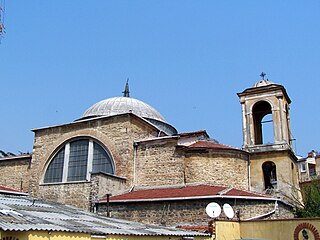
Surp Krikor Lusavoriç Armenian Church is an Armenian Apostolic church dedicated to Saint Gregory the Illuminator in Kuzguncuk, Üsküdar, Istanbul, Turkey. It was rebuilt in 1861.

The Panzerkampfwagen I Ausf. F, also known as VK 18.01, was a German light tank from World War II. Despite the fact that it was designated as a modification of the light tank Panzer I, the VK.18.01 was a completely new vehicle, had almost nothing to do with it. The Pz.Kpfw.I Ausf.F was created in 1942 as a light tank designed to storm fortified lines. In that same year, 30 units were produced. From 1943 it was used for anti-guerrilla operations on the Eastern Front and in Yugoslavia. Thirty Ausf F tanks were built between April and December 1942, eight of which were sent to the Eastern Front for evaluation.

The Palazzo Municipale is the Town Hall of Chioggia, located on Corso del Popolo, the main street of the Venetian city.
