Warren Sturgis McCulloch was an American neurophysiologist and cybernetician, known for his work on the foundation for certain brain theories and his contribution to the cybernetics movement. Along with Walter Pitts, McCulloch created computational models based on mathematical algorithms called threshold logic which split the inquiry into two distinct approaches, one approach focused on biological processes in the brain and the other focused on the application of neural networks to artificial intelligence.

Heinz von Foerster was an Austrian American scientist combining physics and philosophy, and widely attributed as the originator of Second-order cybernetics. He was twice a Guggenheim fellow and also was a fellow of the American Association for the Advancement of Science, 1980. He is well known for his 1960 Doomsday equation formula published in Science predicting future population growth.

Self-organization, also called spontaneous order, is a process where some form of overall order arises from local interactions between parts of an initially disordered system. The process can be spontaneous when sufficient energy is available, not needing control by any external agent. It is often triggered by seemingly random fluctuations, amplified by positive feedback. The resulting organization is wholly decentralized, distributed over all the components of the system. As such, the organization is typically robust and able to survive or self-repair substantial perturbation. Chaos theory discusses self-organization in terms of islands of predictability in a sea of chaotic unpredictability.

Your Sinclair, or YS as it was commonly abbreviated, was a commercially published and printed British computer magazine for the Sinclair range of computers, mainly the ZX Spectrum. It was in circulation between 1984 and 1993.
Second-order cybernetics, also known as the cybernetics of cybernetics, is the recursive application of cybernetics to itself and the reflexive practice of cybernetics according to such a critique. It is cybernetics where "the role of the observer is appreciated and acknowledged rather than disguised, as had become traditional in western science". Second-order cybernetics was developed between the late 1960s and mid 1970s by Margaret Mead, Heinz von Foerster and others. Foerster referred to it as "the control of control and the communication of communication" and differentiated first order cybernetics as "the cybernetics of observed systems" and second-order cybernetics as "the cybernetics of observing systems". It is closely allied to radical constructivism, which was developed around the same time by Ernst von Glasersfeld. While it is sometimes considered a break from the earlier concerns of cybernetics, there is much continuity with previous work and it can be thought of as a distinct tradition within cybernetics, with origins in issues evident during the Macy conferences in which cybernetics was initially developed. Its concerns include autonomy, epistemology, ethics, language, self-consistency, self-referentiality, and self-organizing capabilities of complex systems. It has been characterised as cybernetics where "circularity is taken seriously".
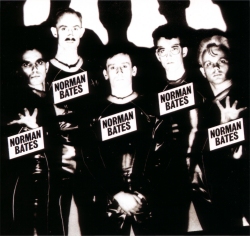
Landscape is an English synth-pop band, best known for the 1981 hits "Einstein a Go-Go" and "Norman Bates". Formed in London in 1975, the band toured constantly during the mid-to-late-1970s, playing rock, punk and jazz venues and releasing two instrumental EPs on its own Event Horizon label. The group began experimenting with computer-programmed music and electronic drums in the late 1970s and early 1980s, making records in the emerging genre of synth-pop.
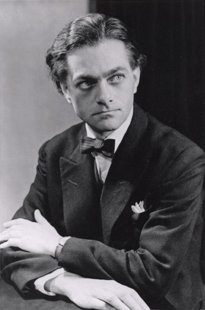
Andrew Gordon Speedie Pask was an English author, inventor, educational theorist, cybernetician and psychologist who made significant contributions to cybernetics, instructional psychology, experimental epistemology and educational technology. Pask first learned about cybernetics in the early 1950s when the originator of the subject, Norbert Wiener, spoke at Cambridge University, where Pask was an undergraduate student. Pask was asked to be of assistance during Wiener's talk.
Roy Ascott FRSA is a British artist, who works with cybernetics and telematics on an art he calls technoetic by focusing on the impact of digital and telecommunications networks on consciousness. Since the 1960s, Ascott has been a practitioner of interactive computer art, electronic art, cybernetic art and telematic art.
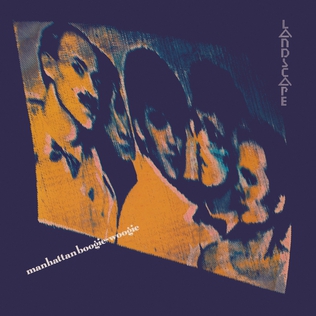
Manhattan Boogie-Woogie is the third and final album by Landscape and was released in 1982. It is the only Landscape album that does not include any instrumental tracks.
Interaction is action that occurs between two or more objects, with broad use in philosophy and the sciences. It may refer to:
Ranulph Glanville was an Anglo-Irish cybernetician and design theorist. He was a founding Vice-President of the International Academy for Systems and Cybernetic Sciences (2006-2009) and President of the American Society for Cybernetics (2009-2014).

Scene from Shakespeare's The Tempest, also known as Ferdinand courting Miranda is an oil painting by the English painter William Hogarth. It has been displayed at Nostell Priory since 1766, and was acquired by the National Trust in 2002. The National Trust claims that it is "the first known painting of a scene from Shakespeare".
New Cybernetics, as used by cybernetician Gordon Pask, is the meaningful transfer of information between coherences in all media in terms of attractions and repulsions between clockwise and anti-clockwise spins. This is a possibly defining paradigm of the new cybernetics or second-order cybernetics.
Conversation theory is a cybernetic and dialectic framework that offers a scientific theory to explain how interactions lead to "construction of knowledge", or "knowing": wishing to preserve both the dynamic/kinetic quality, and the necessity for there to be a "knower" Following Dubberly and Pangaro, a conversation in the context of conversation theory can be thought of as "the means by which existing knowledge is conveyed and new knowledge is generated”. So how do organisms engage and learn? Through a self-reflective mental loop that works recursively. Described in a more processed approach: one would open a channel, commit to engage, construct meaning and in the end either evolve or converge. This is the basis for Conversation Theory. The theory was developed by Gordon Pask, who credits Bernard Scott, Dionysius Kallikourdis, Brian Lewis and others during its initial development and implementation as well as Paul Pangaro during subsequent years.
Cybernetic Serendipity was an exhibition of cybernetic art curated by Jasia Reichardt, shown at the Institute of Contemporary Arts, London, England, from 2 August to 20 October 1968, and then toured across the United States. Two stops in the United States were the Corcoran Annex, Washington, D.C., from 16 July to 31 August 1969, and the newly opened Exploratorium in San Francisco, from 1 November to 18 December 1969.

Cybernetics is a wide-ranging field concerned with regulatory and purposive systems. The core concept of cybernetics is circular causality or feedback—where the observed outcomes of actions are taken as inputs for further action in ways that support the pursuit and maintenance of particular conditions, or their disruption. Cybernetics is named after an example of circular causality, that of steering a ship, where the helmsperson maintains a steady course in a changing environment by adjusting their steering in continual response to the effect it is observed as having. Other examples of circular causal feedback include: technological devices such as thermostats ; biological examples such as the coordination of volitional movement through the nervous system; and processes of social interaction such as conversation. Cybernetics is concerned with feedback processes such as steering however they are embodied, including in ecological, technological, biological, cognitive, and social systems, and in the context of practical activities such as designing, learning, managing, conversation, and the practice of cybernetics itself. Cybernetics' transdisciplinary and "antidisciplinary" character has meant that it intersects with a number of other fields, leading to it having both wide influence and diverse interpretations.
Text and conversation is a theory in the field of organizational communication illustrating how communication makes up an organization. In the theory's simplest explanation, an organization is created and defined by communication. Communication "is" the organization and the organization exists because communication takes place. The theory is built on the notion, an organization is not seen as a physical unit holding communication. Text and conversation theory puts communication processes at the heart of organizational communication and postulates, an organization doesn't contain communication as a "causal influence", but is formed by the communication within. This theory is not intended for direct application, but rather to explain how communication exists. The theory provides a framework for better understanding organizational communication.
Interactions of actors theory is a theory developed by Gordon Pask and Gerard de Zeeuw. It is a generalisation of Pask's earlier conversation theory: The chief distinction being that conversation theory focuses on analysing the specific features that allow a conversation to emerge between two participants, whereas interaction of actor's theory focuses on the broader domain of conversation in which conversations may appear, disappear, and reappear over time.
Cybernetic art is contemporary art that builds upon the legacy of cybernetics, where feedback involved in the work takes precedence over traditional aesthetic and material concerns. The relationship between cybernetics and art can be summarised in three ways: cybernetics can be used to study art, to create works of art or may itself be regarded as an art form in its own right.
Events from the year 1901 in Sweden

