Related Research Articles

The Madonna della Pietà, informally known as La Pietà, is a marble sculpture of Jesus and Mary at Mount Golgotha representing the "Sixth Sorrow" of the Blessed Virgin Mary by Michelangelo Buonarroti, now in Saint Peter's Basilica, Vatican City. It is a key work of Italian Renaissance sculpture and often taken as the start of the High Renaissance.
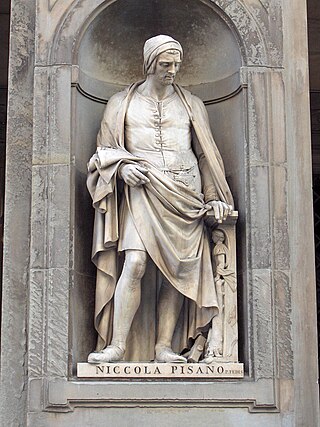
Nicola Pisano was an Italian sculptor whose work is noted for its classical Roman sculptural style. Pisano is sometimes considered to be the founder of modern sculpture.

Carrara is a town and comune in Tuscany, in central Italy, of the province of Massa and Carrara, and notable for the white or blue-grey marble quarried there. It is on the Carrione River, some 100 kilometres (62 mi) west-northwest of Florence. Its motto is Fortitudo mea in rota.
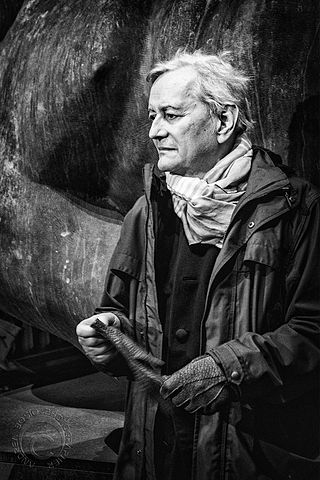
Igor Mitoraj was a Polish artist and sculptor. Known for his fragmented sculptures of the human body often created for large-scale public installations, he is considered one of the most internationally recognized Polish sculptors.

John Hogan was a sculptor from Tallow, County Waterford in Ireland. Described in some sources as the "greatest of Irish sculptors", according to the Dictionary of Irish Biography he was responsible for "much of the most significant religious sculpture in Ireland" during the 19th century. Working primarily from Rome, among his best known works are three versions of The Dead Christ, commissioned for churches in Dublin, Cork, and the Basilica of St. John the Baptist in Newfoundland, Canada.

The Agony and the Ecstasy (1961) is a biographical novel of Michelangelo Buonarroti written by American author Irving Stone. Stone lived in Italy for years visiting many of the locations in Rome and Florence, worked in marble quarries, and apprenticed himself to a marble sculptor. A primary source for the novel is Michelangelo's correspondence, all 495 letters of which Stone had translated from Italian by Charles Speroni and published in 1962 as I, Michelangelo, Sculptor. Stone also collaborated with Canadian sculptor Stanley Lewis, who researched Michelangelo's carving technique and tools. The Italian government lauded Stone with several honorary awards for his cultural achievements highlighting Italian history.

Bengt Erland Fogelberg, also known as Benedict Fogelberg, was a Swedish sculptor.
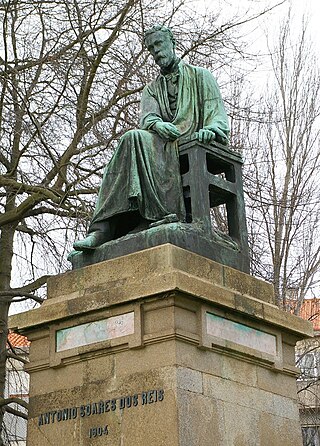
António Manuel Soares dos Reis was a Portuguese sculptor.

The Sleeping Hermaphrodite is an ancient marble sculpture depicting Hermaphroditus life size. In 1620, Italian artist Gian Lorenzo Bernini sculpted the mattress upon which the statue now lies. The form is partly derived from ancient portrayals of Venus and other female nudes, and partly from contemporaneous feminised Hellenistic portrayals of Dionysus/Bacchus. It represents a subject that was much repeated in Hellenistic times and in ancient Rome, to judge from the number of versions that have survived. Discovered at Santa Maria della Vittoria, Rome, the Sleeping Hermaphrodite was immediately claimed by Cardinal Scipione Borghese and became part of the Borghese Collection. The "Borghese Hermaphrodite" was later sold to the occupying French and was moved to The Louvre, where it is on display.

Ignazio Collino (1724–1793) was an Italian sculptor, active in the late-Baroque period, mainly in the region of the Piedmont.

Andrea Bolgi was an Italian sculptor responsible for several statues in St. Peter's Basilica, Rome. Towards the end of his life he moved to Naples, where he sculpted portrait busts. He died in Naples during a plague epidemic.
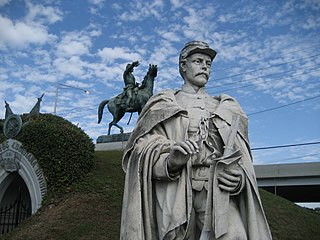
Alexander Doyle (1857–1922) was an American sculptor.

Pietro Tenerani was an Italian sculptor of the Neoclassic style.

Francesco Somaini was an Italian sculptor.

Christian Gottlieb Vilhelm Bissen was a Danish sculptor. He was also a professor at the Royal Danish Academy of Fine Arts with great influence on the next generation of Danish sculptors and for a while served as its director. Bissen was trained in the Neoclassical tradition from Bertel Thorvaldsen but after a stay in Paris around 1880, he was influenced by Naturalism. With the equestrian statue of Absalon he turned to Neo-romanticism.

Arturo Dazzi was an Italian painter and sculptor.

Márton Váró is a Hungarian sculptor, recognized for his monumental public art.

Luigi Bienaimé was a sculptor active in Italy during the Neoclassical period.

Antonio Allegretti (1840–1918) was an Italian sculptor. He was born in Cuneo, Piedmont, and died in Carrara, Italy. He trained in Genoa under Santo Varni. His submission to a contest in Genoa of the statue of Cain, awarded him a stipend and a Gold medal from the Accademia Linguistica, and he moved to Florence. There he made a portrait of Marchese Ginno Capponi. From there he moved to Rome, where he became professor of sculpture at the Royal Institute of Fine Arts in Rome.
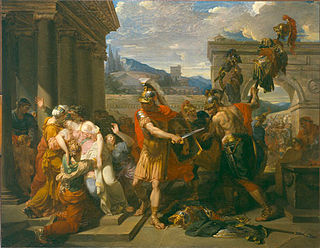
Jean-Baptiste Frédéric Desmarais (1756–1813) was a French painter of the Neoclassical period, who after 1786 was active in Italy, rising to be a professor of the Academies of Fine Arts of Lucca and Massa Carrara.
References
- ↑ Dizionario degli Artisti Italiani Viventi: pittori, scultori, e Architetti., by Angelo de Gubernatis. Tipe dei Successori Le Monnier, 1889, page 31.
| International | |
|---|---|
| Artists | |

 | This article about an Italian sculptor is a stub. You can help Wikipedia by expanding it. |