
John Lindley Byrne is a British-born American writer and artist of superhero comics. Since the mid-1970s, Byrne has worked on many major superheroes, with noted work on Marvel Comics' X-Men and Fantastic Four and the 1986 relaunch of DC Comics' Superman franchise, the first issue of which featured comics' first variant cover. Coming into the comics profession as penciller, inker, letterer and writer on his earliest work, Byrne began co-plotting the X-Men comics during his tenure on them, and launched his writing career in earnest with Fantastic Four. During the 1990s he produced a number of creator-owned works, including Next Men and Danger Unlimited. He scripted the first issues of Mike Mignola's Hellboy series and produced a number of Star Trek comics for IDW Publishing. In 2015, Byrne and his X-Men collaborator Chris Claremont were entered into the Will Eisner Award Hall of Fame.

John Buscema was an American comic book artist and one of the mainstays of Marvel Comics during its 1960s and 1970s ascendancy into an industry leader and its subsequent expansion to a major pop-culture conglomerate. His younger brother Sal Buscema is also a comic book artist.
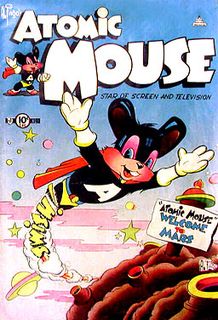
Atomic Mouse is a funny-animal superhero created in 1953 by Al Fago for Charlton Comics.
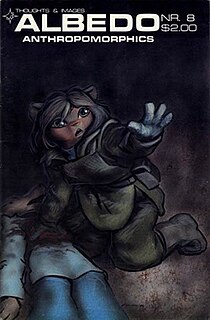
Albedo Anthropomorphics, or Albedo for short, was a furry comic book anthology series which was credited with starting the furry comic book subgenre that featured sophisticated stories with funny animals primarily intended for an adult audience. The first issue of Albedo was published in 1983; the most recent issue was published in 2005.

Alfonso Williamson was an American cartoonist, comic book artist and illustrator specializing in adventure, Western and science fiction/fantasy.

Michael Zulli is an American artist known for his work as an animal and wildlife illustrator and as a comic book illustrator.

Adventure into Fear is an American horror comic book series published by Marvel Comics from cover dates November 1970 through December 1975, for 31 issues. This is its trademarked cover title for all but its first nine issues, though the series is copyrighted in its postal indicia as simply Fear.

Jeremiah Ordway is an American writer, penciller, inker and painter of comic books.

Russ Jones is a Canadian novelist, illustrator, and magazine editor, active in the publishing and entertainment industries over a half-century, best known as the creator of the magazine Creepy for Warren Publishing. As the founding editor of Creepy in 1963, he is notable for a significant milestone in comics history by proving there was a readership eager to read graphic stories in a black-and-white magazine format rather than in a color comic book.
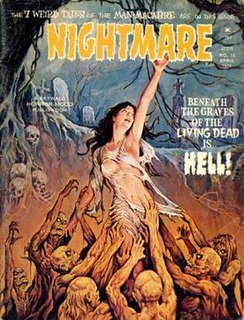
Skywald Publications was an American publisher of black-and-white comics magazines, primarily the horror anthologies Nightmare, Psycho, and Scream. It also published a small line of comic books and other genre magazines.
Richard Horie is an artist who has worked on many comics, mostly as a penciller and colorist, but also as writer and inker.

The Metamorphosis Odyssey is a lengthy allegorical story told in several distinct parts in several formats, from illustrated magazines to graphic novels to comic books. The work of American writer/artist Jim Starlin, the story introduces Vanth Dreadstar, who first appears in Epic Illustrated #3.

Kody Chamberlain is an American comic book artist. He was born in Thibodaux, Louisiana and relocated to Lafayette, Louisiana in 1993.
Pablo Marcos Ortega, known professionally as Pablo Marcos, is a comic book artist and commercial illustrator best known as one of his home country's leading cartoonists and for his work on such popular American comics characters as Batman and Conan the Barbarian, particularly during the 1970s. His signature character was Marvel Comics' the Zombie, for which Marcos drew all but one story in the black-and-white horror-comics magazine Tales of the Zombie (1973–1975).

The Ultimate Galactus Trilogy is a collection of three comic book limited series published by Marvel Comics. All three series are set in the Ultimate Marvel universe and are written by Warren Ellis. The series showcase the arrival of the planet-eating entity Gah Lak Tus on Earth.

Chamber of Darkness is a horror/fantasy anthology comic book published by the American company Marvel Comics. Under this and a subsequent name, it ran from 1969 to 1974. It featured work by creators such as writer-editor Stan Lee, writers Gerry Conway, Archie Goodwin, and Roy Thomas, and artists John Buscema, Johnny Craig, Jack Kirby, Tom Sutton, Barry Windsor-Smith, and Bernie Wrightson. Stories were generally hosted by either of the characters Digger, a gravedigger, or Headstone P. Gravely, in undertaker garb, or by one of the artists or writers.

Wayne W. Howard was an African-American comic book artist. He is best known for his 1970s work at Charlton Comics, where he became American comic books' first series creator known to be credited on covers, with the horror anthology Midnight Tales announcing "Created by Wayne Howard" on each issue — "a declaration perhaps unique in the industry at the time".
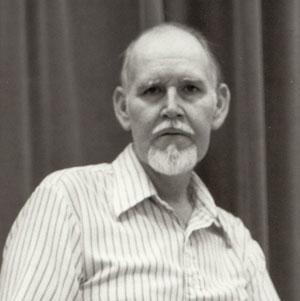
Samuel E. Grainger was an American comic book artist best known as a Marvel Comics inker during the 1960s and 1970s periods fans and historians call, respectively, the Silver Age and the Bronze Age of Comic Books. Series on which he worked include The Avengers, The Incredible Hulk and X-Men.

Sidney "Sid" Greene was an American comic book artist known for his work for a host of publishers from the 1940s to 1970s. As an inker on DC Comics series including Batman, Green Lantern, Justice League of America and The Atom, he helped to define the company's house style for its 1960s Silver Age superheroes.


