Related Research Articles

Cairo is the capital of Egypt and the city-state Cairo Governorate, and is the country's largest city, home to 10 million people. It is also part of the largest urban agglomeration in Africa, the Arab world and the Middle East: The Greater Cairo metropolitan area, with a population of 21.9 million, is the 12th-largest in the world by population. Cairo is associated with ancient Egypt, as the Giza pyramid complex and the ancient cities of Memphis and Heliopolis are located in its geographical area. Located near the Nile Delta, the city first developed as Fustat, a settlement founded after the Muslim conquest of Egypt in 640 next to an existing ancient Roman fortress, Babylon. Under the Fatimid dynasty a new city, al-Qāhirah, was founded nearby in 969. It later superseded Fustat as the main urban centre during the Ayyubid and Mamluk periods. Cairo has long been a centre of the region's political and cultural life, and is titled "the city of a thousand minarets" for its preponderance of Islamic architecture. Cairo's historic center was awarded World Heritage Site status in 1979. Cairo is considered a World City with a "Beta +" classification according to GaWC.

The Foreign relations of Egypt are the Egyptian government's external relations with the outside world. Egypt's foreign policy operates along a non-aligned level. Factors such as population size, historical events, military strength, diplomatic expertise and a strategic geographical position give Egypt extensive political influence in the Middle East, Africa, and within the Non-Aligned Movement as a whole. Cairo has been a crossroads of the Arab world's commerce and culture for centuries, and its intellectual and religious institutions are at the center of the region's social and cultural landmarks.

Banha is the capital of the Qalyubiyya Governorate in north-eastern Egypt. Between the capital of Cairo and the city of Tanta, Banha is an important transport hub, as rail lines from Cairo to various cities in the Nile Delta pass through it. Banha was founded as a city in 1850.

Nakhla is a Martian meteorite which fell in Egypt in 1911. It was the first meteorite reported from Egypt, the first one to suggest signs of aqueous processes on Mars, and the prototype for Nakhlite type of meteorites.
Shaaban Abdel Rahim, also known as Sha'bola, was an Egyptian pop (Sha'abi) singer, formerly working as makwagi and known for catchy songs with political lyrics.
Sakir-Har was an Hyksos king of the Fifteenth Dynasty of Egypt, ruling over some part of Lower Egypt during the Second Intermediate Period, possibly in the early 16th century BC.
The 2008 Duweika Rockslide happened on September 6, 2008 at a crowded self-built settlement in the Manshiyat Naser district of Cairo, Egypt, resulting in the first major urban disaster to hit the city in the 21st Century, where over 100 were killed, and hundreds of families were made homeless.

Tell el-Dab'a is an archaeological site in the Nile Delta region of Egypt where Avaris, the capital city of the Hyksos, once stood. Avaris was occupied by Asiatics from the end of the 12th through the 13th Dynasty. The site is known primarily for its Minoan frescoes.

Dina Tala'at Sayed Muhammad is an Egyptian belly dancer and actress. She was named as the "Last Egyptian Dancer" by the American magazine Newsweek. She has a master's degree in Philosophy.
Ezbet El Haggana/ Al-kilo arba'a wa nus is a 750 acre shiakha sub-district in the Nasr City West district, in the Eastern Area of Cairo, Egypt. Haggana is a mostly self-built informal settlement that Mike Davis called a mega-slum, due to its supposedly large size, high population density and lack of basic infrastructure, with housing issues similar to other deprived neighbourhoods in Egypt's cities.
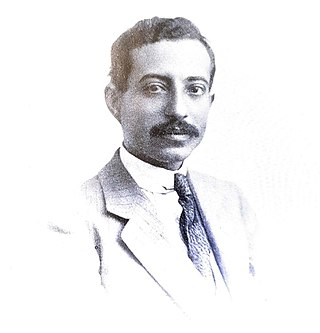
Ibrahim Abd al-Qadir al-Mazini was an Egyptian poet, novelist, journalist, and translator.
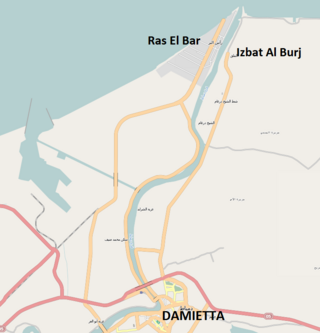
Ezbet El Borg is a coastal city with a large fishing industry in Damietta Governorate, Egypt. It is 15 km (9 mi) northeast of Damietta, and 210 km (130 mi) from Cairo. Its population is approximately 70,000.

Egypt men's national goalball team is the men's national team of Egypt. It takes part in international goalball competitions. Goalball is a team sport designed specifically for athletes with a vision impairment.
Ezbet El Nakhl is a district in the northern region of Greater Cairo, east of the Nile, in Egypt. The district is separated by the metro station into two regions, Eastern Ezbet El Nakhl & Western Ezbet El Nakhl.

The ancient Egyptian Temple of Ezbet Rushdi was discovered near the modern village of Ezbet Rushdi el-Saghira – itself just north of Tell el-Dab'a, the ancient Avaris – and dates to the Twelfth Dynasty. It was first excavated from 1951 by Shehata Adam who was working for the Egyptian Antiquities Service. The temple was again excavated in 1996 by an Austrian mission under Manfred Bietak.
Khaled Mohammed Bekhit is an Egyptian basketball player. He competed in the men's tournament at the 1984 Summer Olympics.
Muhammad Bakhit al-Muti'i was the Grand Mufti of Egypt, judge in the Shari'a Courts, rector of al-Azhar, and one of the leading Hanafi-Maturidi scholars of his time. He was educated at al-Azhar and was teaching in this university for several years. In 1914 he was appointed mufti, a title he held for seven years. He was known as the bitterest foe of the Islamic Reform movement led by Jamal al-Din al-Afghani and Muhammad 'Abduh. He was also known as a devout scholar who chose to lose his position as mufti rather than bow to government pressure to issue a particular fatwa.
Safaa Abdallah Mohammed El Tokhi, popularly known as Safaa El-Toukhi, is an Egyptian actress. She is best known for the roles in the films The Hunter, Gunshot and Kafr Delhab.
References
- ↑ Abdel Azim, Nazly Amr. Dealing with urban poverty: the case of Ezbet Bekhit and Manshiet Nasser. 1 February 2011. Cairo, Egypt. p. 80 – via The American University in Cairo.
- ↑ "Egypt: Buried alive; trapped by poverty and neglect in Cairo's informal settlements". ReliefWeb . 12 November 2009. Retrieved 11 July 2020.
{{cite web}}: CS1 maint: url-status (link)
 | This geography of Egypt article is a stub. You can help Wikipedia by expanding it. |