
Look up FSB in Wiktionary, the free dictionary.
FSB may refer to:
FSB may refer to:

In the United States government, independent agencies are agencies that exist outside the federal executive departments and the Executive Office of the President. In a narrower sense, the term refers only to those independent agencies that, while considered part of the executive branch, have regulatory or rulemaking authority and are insulated from presidential control, usually because the president's power to dismiss the agency head or a member is limited.

The Federal Security Service of the Russian Federation is the principal security agency of Russia and the main successor agency to the Soviet Union's KGB; its immediate predecessor was the Federal Counterintelligence Service (FSK) which was reorganized into the FSB in 1995. The three major structural successor components of the former KGB that remain administratively independent of the FSB are the Foreign Intelligence Service (SVR), the Federal Protective Service (FSO), and the Main Directorate of Special Programs of the President of the Russian Federation (GUSP).
A bailout is the provision of financial help to a corporation or country which otherwise would be on the brink of bankruptcy. A bailout differs from the term bail-in under which the bondholders or depositors of global systemically important financial institutions (G-SIFIs) are forced to participate in the recapitalization process but taxpayers are not. Some governments also have the power to participate in the insolvency process; for instance, the U.S. government intervened in the General Motors bailout of 2009–2013. A bailout can, but does not necessarily, avoid an insolvency process. The term bailout is maritime in origin and describes the act of removing water from a sinking vessel using a bucket.

The Office of Thrift Supervision (OTS) was a United States federal agency under the Department of the Treasury that chartered, supervised, and regulated all federally chartered and state-chartered savings banks and savings and loans associations. It was created in 1989 as a renamed version of the Federal Home Loan Bank Board, another federal agency. Like other U.S. federal bank regulators, it was paid by the banks it regulated. The OTS was initially seen as an aggressive regulator, but was later lax. Declining revenues and staff led the OTS to market itself to companies as a lax regulator in order to get revenue.
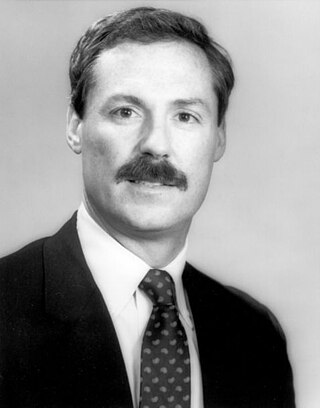
David Kemp Karnes was an American politician, businessman, and attorney. He was a United States Senator from Nebraska from 1987 to 1989, and was president and chief executive officer of The Fairmont Group Incorporated, a merchant banking/consulting company with offices in Omaha and the District of Columbia. Karnes also served in an "of counsel" capacity to the national law firm of Kutak Rock and practiced out of the firm's Omaha, Nebraska and Washington, D.C. offices. Karnes was also involved in numerous civic, educational, and charitable organizations both in Nebraska and nationally.

The Bolivian Socialist Falange is a Bolivian political party established in 1937. It is a far-right party drawing inspiration from fascism. It was the country's second-largest party between approximately 1954 and 1974. After that, its followers have tended to gravitate toward the government-endorsed military candidacy of General Juan Pereda (1978) and, especially, toward the ADN party of former dictator Hugo Banzer.

Alexander Vasilyevich Bortnikov is a Russian intelligence officer who has served as the director of the Federal Security Service (FSB) since 2008. He is one of the most powerful members of the silovik faction of president Vladimir Putin's inner circle. A Hero of the Russian Federation since 2019, he also holds the rank of General of the Army, the second highest grade in use in the Russian military. According to some experts, it is likely Bortnikov played a key role in Putin's decision to invade Ukraine in 2022.

The Federation of Small Businesses (FSB) is a UK business organisation representing small and medium-sized businesses. It was formed in 1974 as the National Federation of Self Employed (NFSE). The current name for the organisation was adopted in 1991. It is registered with Companies House as The National Federation of Self Employed & Small Businesses Limited.
Falangism in Latin America has been a feature of political life since the 1930s as movements looked to the national syndicalist clerical fascism of the Spanish state and sought to apply it to other Spanish-speaking countries. From the mid-1930s, the Falange Exterior, effectively an overseas version of the Spanish Falange, was active throughout Latin America in order to drum up support among Hispanic communities. However, the ideas would soon permeate into indigenous political groups. The term "Falangism" should not be applied to the military dictatorships of such figures as Alfredo Stroessner, Augusto Pinochet and Rafael Trujillo because while these individuals often enjoyed close relations to Francisco Franco's Spain, their military nature and frequent lack of commitment to national syndicalism and the corporate state mean that they should not be classed as Falangist. The phenomenon can be seen in a number of movements both past and present.
The Financial Stability Board (FSB) is an international body that monitors and makes recommendations about the global financial system. It was established in the 2009 G20 Pittsburgh Summit as a successor to the Financial Stability Forum (FSF). The Board includes all G20 major economies, FSF members, and the European Commission. Hosted and funded by the Bank for International Settlements, the board is based in Basel, Switzerland, and is established as a not-for-profit association under Swiss law.

The history of Bolivia from 1964 to 1982 is a time of periodic instability under various military dictators. On November 4, 1964, power passed from the elected leader of the Bolivian National Revolution, Víctor Paz Estenssoro to a military junta under vice-president General René Barrientos. Barrientos was elected president in 1966, but died suspiciously in a helicopter crash in 1969 while touring the countryside visiting the indigenous people of Bolivia. This led to a coup in September 1969 by General Ovando, who was overthrown in October 1970 by General Rogelio Miranda who was overthrown a couple of days later by General Juan José Torres, who in turn was overthrown in August 1971 by Hugo Banzer Suárez. Banzer ruled for seven years, initially from 1971 to 1974 with the support of Estenssoro's Nationalist Revolutionary Movement. In 1974, impatient with schisms in the party, he replaced civilians with members of the armed forces and suspended political activities. The economy grew impressively during Banzer's presidency, but demands for greater political freedom undercut his support. He called elections in 1978 and Bolivia once again plunged into turmoil. Juan Pereda ruled for only four months in 1978, but his ascent to the presidency marked the beginning of an even more unstable period in Bolivian history, with nine civilian and military presidents in little over four years (1978–1982). 1982 marked the return to a democratically elected government, with Guido Vildoso as president.
A systemically important financial institution (SIFI) is a bank, insurance company, or other financial institution whose failure might trigger a financial crisis. They are colloquially referred to as "too big to fail".

Denmark–Somalia relations are bilateral relations between Denmark and Somalia.

The London Somalia Conference was a diplomatic conference hosted by the Government of the United Kingdom, which took place in London on 23 February 2012. Attended by Somali government officials and members of the international community, it focused on resolving issues that have arisen in Somalia in the wake of the civil war.

Corruption in Somalia pertains to purported levels of corruption within Somalia's public and private sectors according to official metrics, anti-graft measures aimed at addressing those issues, as well as political dispensations and structural changes in government affecting transparency. Owing to a reported lack of accountability in the receipt and expenditure of public funds by the Transitional Federal Government, a federal Anti-Corruption Commission was put into place in 2011 so as to deter and eliminate graft. On Transparency International's 2023 Corruption Perceptions Index, Somalia scored 11 on a scale from 0 to 100. When ranked by score, Somalia ranked last among the 180 countries in the Index, where the country ranked first is perceived to have the most honest public sector. For comparison with worldwide scores, the best score was 90, the average score was 43, and the worst score was Somalia's, 11. For comparison with regional scores, the average score among sub-Saharan African countries was 33. The highest score in sub-Saharan Africa was 71 and the lowest score was Somalia's, 11.

Hassan Sheikh Mohamud is a Somali politician who has served as the president of Somalia since May 2022. He is the founder and current chairman of the Union for Peace and Development Party. He was indirectly elected as President of the Federal Republic of Somalia on 15 May 2022, defeating the incumbent president Mohamed Abdullahi Mohamed. He previously served as the 8th president of Somalia from 2012 to 2017. A civil and political rights activist, Hassan was previously a university professor and dean at SIMAD University, which he co-founded.

Abdisalam Omer Hadliye, also known as Abdisalan Hadliye Omar, is a Somali economist and politician. He was previously a Chief of Staff at the Executive Office of the Mayor of the District of Columbia, a Director of the UNDP Somalia Financial Services and Governance Program, and a Chief Business Officer for the District of Columbia Public Schools. He also served as Governor of the Central Bank of Somalia in 2013. He served as the Minister of Foreign Affairs of Somalia from 27 February 2015 to 29 March 2017.

Joseph M. Otting is an American businessman and government official. He served as the 31st Comptroller of the Currency from November 27, 2017 to May 29, 2020.