Related Research Articles

Charles Bulfinch was an early American architect, and has been regarded by many as the first native-born American to practice architecture as a profession.
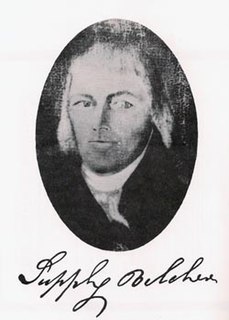
Supply Belcher was an American composer, singer, and compiler of tune books. He was one of the so-called Yankee tunesmiths or First New England School, a group of mostly self-taught composers who created sacred vocal music for local choirs. He was active first in Lexington, Massachusetts, then eventually moved to Farmington, Maine. Like most of his colleagues, Belcher could not make music his main occupation, and worked as tax assessor, schoolmaster, town clerk, and so on; nevertheless he was considerably well known for his musical activities, and even dubbed 'the Handell [sic] of Maine' by a local newspaper. Most of his works survive in The Harmony of Maine, a collection Belcher published himself in Boston in 1794.

Joseph Bloomfield was the fourth Governor of New Jersey. He also served two terms in the United States House of Representatives from 1817 to 1821.

Ebenezer Mattoon was a United States Representative from Massachusetts. He was born in North Amherst in the Province of Massachusetts Bay on August 19, 1755. He attended the common schools and received private instruction. He graduated from Dartmouth College in 1776. Mattoon served in the Revolutionary Army. He taught school and also engaged in agricultural pursuits.

James McSherry, was an American politician from Pennsylvania who served as a Federalist member of the U.S. House of Representatives for Pennsylvania's 5th congressional district from 1821 to 1823.
George French Strother was a nineteenth-century politician, lawyer and slaveowner in Virginia and Missouri.

George Parkman, a Boston Brahmin and a member of one of Boston's richest families, was a prominent physician, businessman, and philanthropist, as well the victim in the sensationally gruesome Parkman–Webster murder case, which shook Boston in 1849–1850.
Thomas Henry Barclay was an American lawyer who became one of the United Empire Loyalists in Nova Scotia and served in the colony's government.

Nathan Cutler was an American politician in Massachusetts and Maine. He was a Democrat.

John Treadwell was an American politician and the 21st Governor of Connecticut.
George Waddington was an English priest, traveller and church historian.
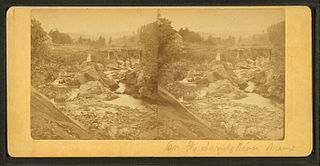
The Sandy River is a 73.3-mile-long (118.0 km) tributary of the Kennebec River in the U.S. state of Maine.

Warren C. Philbrook was a Justice of the Maine Supreme Judicial Court and Attorney General of Maine. A Republican, Philbrook served in a variety of political, legal, and judicial roles throughout the U.S. State of Maine throughout his career. Philbrook was a Freemason and a member of the Knights of Pythias, where he served as Chancellor Commander of Maine.
William Tripp was an American politician, lawyer, soldier, and surveyor.
Rufus Wyman (1778–1842) was an American physician. He was the first physician and superintendent of the Asylum for the Insane, renamed in 1823 to McLean Hospital, part of the Massachusetts General Hospital system, and the first mental hospital in the state.

Thomas Parker (1783–1860) was a judge, writer, and philanthropist from Maine, who is the namesake of Parker Hall at Bates College.
References
- ↑ "UMF's History: How We Got Here". University of Maine, Farmington. Retrieved 22 November 2016.
- ↑ Knowlton, McLeary, and Company 1885, p. 94.
- 1 2 Knowlton, McLeary, and Company 1885, pp. 99-101.
Bibliography
- Knowlton, McLeary, and Company (1885). A History of Farmington, Franklin County, Maine, from the Earliest Explorations to the Present Time, 1776-1885 (Public domain ed.). Press of Knowlton, McLeary, and Company.CS1 maint: multiple names: authors list (link) CS1 maint: ref=harv (link)
Attribution
-
 This article incorporates text from a publication now in the public domain : Knowlton, McLeary, and Company's A History of Farmington, Franklin County, Maine, from the Earliest Explorations to the Present Time, 1776-1885 (1885)
