
Ficus is a genus of about 850 species of woody trees, shrubs, vines, epiphytes and hemiepiphytes in the family Moraceae. Collectively known as fig trees or figs, they are native throughout the tropics with a few species extending into the semi-warm temperate zone. The common fig (F. carica) is a temperate species native to southwest Asia and the Mediterranean region, which has been widely cultivated from ancient times for its fruit, also referred to as figs. The fruit of most other species are also edible though they are usually of only local economic importance or eaten as bushfood. However, they are extremely important food resources for wildlife. Figs are also of considerable cultural importance throughout the tropics, both as objects of worship and for their many practical uses.

A banyan, also spelled "banian", is a fig that begins its life as an epiphyte, i.e. a plant that grows on another plant, when its seed germinates in a crack or crevice of a host tree or edifice. "Banyan" often specifically denominates Ficus benghalensis, which is the national tree of the Republic of India, though the name has also been generalized to denominate all figs that share a common life cycle and used systematically in taxonomy to denominate the subgenus Urostigma.

Ficus benghalensis, commonly known as the banyan, banyan fig and Indian banyan, is a tree native to the Indian Subcontinent. Specimens in India are among the largest trees in the world by canopy coverage.

Ficus macrophylla, commonly known as the Moreton Bay fig or Australian banyan, is a large evergreen banyan tree of the family Moraceae native to eastern Australia, from the Wide Bay–Burnett region in the north to the Illawarra in New South Wales, as well as Lord Howe Island. Its common name is derived from Moreton Bay in Queensland, Australia. It is best known for its imposing buttress roots. As Ficus macrophylla is a strangler fig, seed germination usually takes place in the canopy of a host tree and the seedling lives as an epiphyte until its roots establish contact with the ground. It then enlarges and strangles its host, eventually becoming a freestanding tree by itself. Individuals may reach 60 m (200 ft) in height. The large leathery, dark green leaves are 15–30 cm (6–12 in) long.

Ficus rubiginosa, commonly known as the rusty fig or Port Jackson fig, is a species of flowering plant native to eastern Australia in the genus Ficus. Beginning as a seedling that grows on other plants (hemiepiphyte) or rocks (lithophyte), F. rubiginosa matures into a tree 30 m (100 ft) high and nearly as wide with a yellow-brown buttressed trunk. The leaves are oval and glossy green and measure from 4 to 19.3 cm long and 1.25 to 13.2 cm wide.
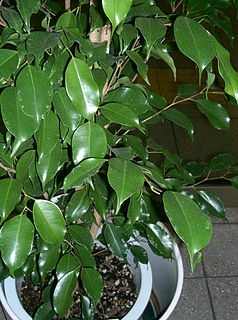
Ficus benjamina, commonly known as weeping fig, benjamin fig or ficus tree, and often sold in stores as just ficus, is a species of flowering plant in the family Moraceae, native to Asia and Australia. It is the official tree of Bangkok. The species is also naturalized in the West Indies and in the States of Florida and Arizona in the United States.

Ficus microcarpa, also known as Chinese banyan, Malayan banyan, Indian laurel, curtain fig, or gajumaru (ガジュマル), is a tree in the fig family Moraceae. It is native in a range from China through tropical Asia and the Caroline Islands to Australia. It is widely planted as a shade tree and frequently misidentified as F. retusa or as F. nitida.
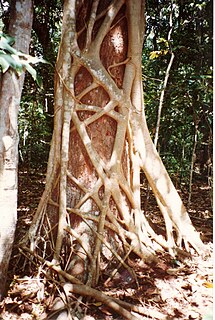
Strangler fig is the common name for a number of tropical and subtropical plant species, including some banyans and unrelated vines, including among many other species:

Ficus citrifolia, also known as the shortleaf fig, giant bearded fig or wild banyantree, is a species of banyan native to southern Florida, the Caribbean, Central America, and northern South America south to Paraguay. It is distinguished from the closely related Florida strangler fig mainly by the finer veining in the leaves.
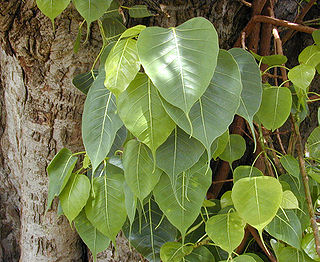
Ficus religiosa or sacred fig is a species of fig native to the Indian subcontinent and Indochina that belongs to Moraceae, the fig or mulberry family. It is also known as the bodhi tree, pippala tree, peepul tree, peepal tree or ashwattha tree. The sacred fig is considered to have a religious significance in three major religions that originated on the Indian subcontinent, Buddhism, Hinduism and Jainism. It is the type of tree that Gautama Buddha is believed to have attained enlightenment under, and Hindu and Jain ascetics also consider the tree to be sacred and often meditate under them.

Ficus elastica, the rubber fig, rubber bush, rubber tree, rubber plant, or Indian rubber bush, Indian rubber tree, is a species of plant in the fig genus, native to eastern parts of South Asia and southeast Asia. It has become naturalized in Sri Lanka, the West Indies, and the US State of Florida.

Opuntia ficus-indica is a species of cactus that has long been a domesticated crop plant grown in agricultural economies throughout arid and semiarid parts of the world. Likely having originated in Mexico, O. ficus-indica is the most widespread and most commercially important cactus. Common English names for the plant and its fruit are Indian fig opuntia, Barbary fig, cactus pear, and spineless cactus, among many. In Mexican Spanish, the plant is called nopal, while the fruit is called tuna, names that may be used in American English as culinary terms.

The wompoo fruit dove, also known as wompoo pigeon, is one of the larger fruit doves native to New Guinea and eastern Australia.

Pachylia ficus, known as the fig sphinx, is a moth of the family Sphingidae. It lives from the northern tip of South America in Uruguay through Central America to the southern tip of the United States straying into Arizona and Texas.

Ficus pumila is a species of flowering plant in the mulberry family, native to East Asia and naturalized in parts of the southeastern and south-central United States. It is also found in cultivation as a houseplant. The etymology of the species name corresponds to the Latin word pumilus meaning dwarf, and refers to the very small leaves of the plant.
Fig, Fig., FIG, or figs may refer to:
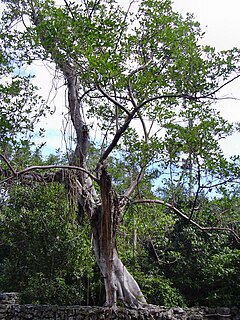
Ficus aurea, commonly known as the Florida strangler fig, golden fig, or higuerón, is a tree in the family Moraceae that is native to the U.S. state of Florida, the northern and western Caribbean, southern Mexico and Central America south to Panama. The specific epithet aurea was applied by English botanist Thomas Nuttall who described the species in 1846.

Ficus americana, commonly known as the West Indian laurel fig or Jamaican cherry fig, is a tree in the family Moraceae which is native to the Caribbean, Mexico in the north, through Central and South America south to southern Brazil. It is an introduced species in Florida, USA. The species is variable; the five recognised subspecies were previously placed in a large number of other species.

Ficus obliqua, commonly known as the small-leaved fig, is a tree in the family Moraceae, native to eastern Australia, New Guinea, eastern Indonesia to Sulawesi and islands in the southwestern Pacific Ocean. Previously known for many years as Ficus eugenioides, it is a banyan of the genus Ficus, which contains around 750 species worldwide in warm climates, including the edible fig. Beginning life as a seedling, which grows on other plants (epiphyte) or on rocks (lithophyte), F. obliqua can grow to 60 m (200 ft) high and nearly as wide with a pale grey buttressed trunk, and glossy green leaves.

Ficus carica is an Asian species of flowering plant in the mulberry family, known as the common fig. It is the source of the fruit also called the fig and as such is an important crop in those areas where it is grown commercially. Native to the Middle East and western Asia, it has been sought out and cultivated since ancient times and is now widely grown throughout the world, both for its fruit and as an ornamental plant. The species has become naturalized in scattered locations in Asia and North America.
