Hezbollah is a Lebanese Shia Islamist political party and paramilitary group. Hezbollah's paramilitary wing is the Jihad Council, and its political wing is the Loyalty to the Resistance Bloc party in the Lebanese Parliament. Its armed strength was assessed to be equivalent to that of a medium-sized army in 2016.

Politics in the Syrian Arab Republic takes place in the framework of a presidential republic with nominal multi-party representation in People's Council under the Ba'athist-dominated National Progressive Front. In practice, Syria is a one-party state where independent parties are outlawed; with a powerful secret police that cracks down on dissidents. Since the 1963 seizure of power by its Military Committee, the Arab Socialist Ba'ath Party has governed Syria as a totalitarian police state. After a period of intra-party strife, Hafez al-Assad gained control of the party following the 1970 coup d'état and his family has dominated the country's politics ever since.

The Syrian Arab Armed Forces are the military forces of the Syrian Arab Republic. They consist of the Syrian Army, Syrian Air Force, Syrian Navy, Syrian Air Defense Force, and paramilitary forces, such as the National Defence Forces. According to the Constitution of Syria, the President of Syria is the Commander-in-chief of the Armed Forces. Minister of Defense holds the position of Deputy Commander-in-chief of the Army and Armed Forces.
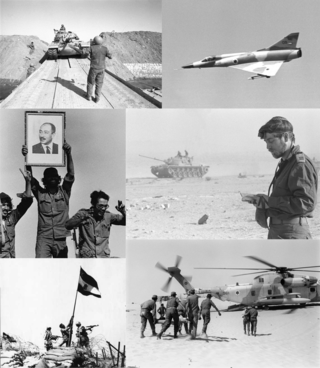
The Yom Kippur War, also known as the Ramadan War, the October War, the 1973 Arab–Israeli War, or the Fourth Arab–Israeli War, was fought from 6 to 25 October 1973 between Israel and a coalition of Arab states led by Egypt and Syria. Most of the fighting occurred in the Sinai Peninsula and Golan Heights, territories occupied by Israel in 1967. Some combat also took place in Egypt and northern Israel. Egypt aimed to secure a foothold on the eastern bank of the Suez Canal and use it to negotiate the return of the Sinai Peninsula.

The United Arab Republic was a sovereign state in the Middle East from 1958 until 1961. It was initially a political union between Egypt and Syria from 1958 until Syria seceded from the union following the 1961 Syrian coup d'état. Egypt continued to be known officially as the United Arab Republic until it was formally dissolved by Anwar Sadat in September 1971.

The United States Central Command is one of the eleven unified combatant commands of the U.S. Department of Defense. It was established in 1983, taking over the previous responsibilities of the Rapid Deployment Joint Task Force (RDJTF).

The national flag of Egypt is a tricolour consisting of the three equal horizontal red, white, and black bands of the Egyptian revolutionary flag that dates back to the 1952 Egyptian Revolution. The flag bears Egypt's national emblem, the Egyptian eagle of Saladin, centred in the white band.

The national flag of Syria was first adopted in 1958 to represent Syria as part of the United Arab Republic, and was used until 1961. It was readopted in 1980. Since its first adoption, variations of the red-white-black flag have been used in various Arab Unions of Syria with Egypt, Libya, Sudan, Yemen, and Iraq. Although Syria is not part of any Arab state union, the flag of the United Arab Republic was readopted to show Syria's commitment to Arab unity. The usage of the flag has become disputed because it is often associated with the Ba'ath Party and has come to represent parties loyal to Bashar al-Assad's government in the Syrian civil war.

The BTR-40 is a Soviet open-topped, wheeled armoured personnel carrier and reconnaissance vehicle. It is often referred to as the Sorokovka in Soviet service. It was eventually replaced in the APC role by the BTR-152 and in the scout car role by the BRDM-1.

Fawzi al-Qawuqji was a Lebanese-born Arab nationalist military figure in the interwar period. He served briefly in Palestine in 1936 fighting the British Mandatory suppression of the Palestinian Revolt. A political decision by the British enabled him to flee the country in 1937. He was a colonel in the Nazi Wehrmacht during World War II, and served as the Arab Liberation Army (ALA) field commander during the 1948 Palestine War.

The General Intelligence Presidency (GIP) is the primary intelligence agency of Saudi Arabia.
Syria, officially the Syrian Arab Republic, is a country in West Asia located in the Eastern Mediterranean and the Levant. It is bounded by the Mediterranean Sea to the west, Turkey to the north, Iraq to the east and southeast, Jordan to the south, and Israel and Lebanon to the southwest. It is a republic that consists of 14 governorates as subdivisions. Damascus is Syria's capital and largest city. With a population of 24.8 million, it is the 57th most populous country in the world and 8th most populuous in the Arab world. Syria is spread across an area of 185,180 square kilometres (71,500 sq mi), making it 87th largest country in the world.

The partition of the Ottoman Empire was a geopolitical event that occurred after World War I and the occupation of Constantinople by British, French, and Italian troops in November 1918. The partitioning was planned in several agreements made by the Allied Powers early in the course of World War I, notably the Sykes–Picot Agreement, after the Ottoman Empire had joined Germany to form the Ottoman–German alliance. The huge conglomeration of territories and peoples that formerly comprised the Ottoman Empire was divided into several new states. The Ottoman Empire had been the leading Islamic state in geopolitical, cultural, and ideological terms. The partitioning of the Ottoman Empire after the war led to the domination of the Middle East by Western powers such as Britain and France, and saw the creation of the modern Arab world and the Republic of Turkey. Resistance to the influence of these powers came from the Turkish National Movement but did not become widespread in the other post-Ottoman states until the period of rapid decolonization after World War II.
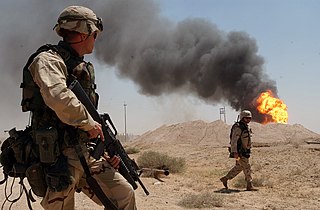
United States foreign policy in the Middle East has its roots in the early 19th-century Tripolitan War that occurred shortly after the 1776 establishment of the United States as an independent sovereign state, but became much more expansive in the aftermath of World War II. With the goal of preventing the Soviet Union from gaining influence in the region during the Cold War, American foreign policy saw the deliverance of extensive support in various forms to anti-communist and anti-Soviet regimes; among the top priorities for the U.S. with regards to this goal was its support for the State of Israel against its Soviet-backed neighbouring Arab countries during the peak of the Arab–Israeli conflict. The U.S. also came to replace the United Kingdom as the main security patron for Saudi Arabia as well as the other Arab states of the Persian Gulf in the 1960s and 1970s in order to ensure, among other goals, a stable flow of oil from the Persian Gulf. As of 2023, the U.S. has diplomatic relations with every country in the Middle East except for Iran, with whom relations were severed after the 1979 Islamic Revolution, and Syria, with whom relations were suspended in 2012 following the outbreak of the Syrian Civil War.

The Arab world consists of the 22 members of the Arab League. As of 2023, the combined population of all the Arab states was around 473 million people.
Mujahideen, or Mujahidin, is the plural form of mujahid, an Arabic term that broadly refers to people who engage in jihad, interpreted in a jurisprudence of Islam as the fight on behalf of God, religion or the community (ummah).

The Specially Designated Nationals and Blocked Persons List, also known as the SDN List, is a United States government sanctions/embargo measure targeting U.S.-designated terrorists, officials and beneficiaries of certain authoritarian regimes, and international criminals. The list is managed by the U.S. Treasury’s Office of Foreign Assets Control (OFAC). When individuals are added to the list of Specially Designated Nationals (SDN), their U.S. assets are blocked. Moreover, their names are added to automated screening systems used by banks in the United States and many foreign countries, making it difficult for them to open or hold accounts, transfer money, or transact properties internationally. Any individual or entity that provides support related to terrorism, drug trafficking or unauthorized military use to any person or entity appearing on the SDN list risks being penalized under the USA PATRIOT Act.

The history of Syria covers events which occurred on the territory of the present Syrian Arab Republic and events which occurred in the region of Syria. Throughout ancient times the territory of present Syrian Arab Republic was occupied and ruled by several empires, including the Sumerians, Mitanni, Assyrians, Babylonians, Egyptians, Hittites, Canaanites, Phoenicians, Arameans, Amorites, Persians, Greeks and Romans. Syria is considered to have emerged as an independent country for the first time on 24 October 1945, upon the signing of the United Nations Charter by the Syrian government, effectively ending France's mandate by the League of Nations to "render administrative advice and assistance to the population" of Syria, which came in effect in April 1946.
The Syrian coup d'état of 1961 was an uprising by disgruntled Syrian Army officers on 28 September 1961, that resulted in the break-up of the United Arab Republic and the restoration of an independent Syrian Republic.

The Armed Forces of the United Arab Republic was the official designation of the military of the United Arab Republic, a union made up of the territories of Egypt and Syria. After the union was announced on 22 February 1958, the Syrian Army was called the First Army, and the Egyptian Army was named the Second Army. It was dissolved after Syria withdrew from the union after a coup d'état took place on 28 September 1961. However, Egypt under Gamal Abdel Nasser continued using the designation.


