Related Research Articles

Garnet Walch, was an Australian writer, dramatist, journalist and publisher. The youngest son of Major J. W. H. Walch, of H.M. 54th Regiment, he went on to become the most popular, and arguably the most successful, writer for the Australian stage during the 1870s and 1880s, While many of his works were localised and updated adaptations, it was his ability to tap into the public's mood and desires by expressing sentiments and making satirical allusions that made his works so popular. Walch wrote a wide array of genres and forms, including "serious" dramatic works, comedies, pantomimes, burlesques, melodrama, and comediettas.
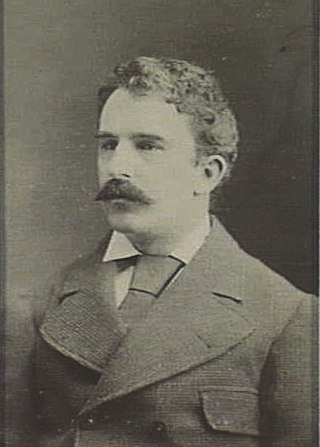
Alfred Dampier was an English-born actor-manager and playwright, active in Australia.

Alfred Rolfe, real name Alfred Roker, was an Australian stage and film director and actor, best known for being the son-in-law of the celebrated actor-manager Alfred Dampier, with whom he appeared frequently on stage, and for his prolific output as a director during Australia's silent era, including Captain Midnight, the Bush King (1911), Captain Starlight, or Gentleman of the Road (1911) and The Hero of the Dardanelles (1915). Only one of his films as director survives today.
The MacMahon brothers were entrepreneurs in Australian show business. Chief among them were James MacMahon and Charles MacMahon, who together and separately toured a large number of stage shows. Their younger brothers, Joseph and William, were involved in many of those activities.
The Lorgnette, subtitled "Theatrical Journal and Programme", was a weekly magazine in Melbourne, Australia, devoted to theatre, opera and the concert stage. The magazine was published Saturdays and sold for 2d at the major entertainment venues where it had exclusive rights, and elsewhere.

The first theatre on the site at 217-223 Bourke Street, Melbourne was the Victorian Academy of Music, built for Samuel Aarons, which opened with a performance by Ilma de Murska on 6 November 1876. Seating about 1600, it was designed by Reed & Barnes, and located on a deep site, with the theatre at the rear, located above a wide passageway running through the site, called the Victoria Arcade. The arcade featured billiard and refreshment rooms, and access to the theatre was from a grand stair off Bourke Street, as well as stairs running off the arcade.
Eduardo Majeroni was an actor who toured the world with Adelaide Ristori, playing popular Italian dramas in their original language. He and his wife Giulia, a niece of Ristori, left the company in Australia and carved out a career playing the same repertoire in English translations. Giulia was an actress, and their two sons Mario and George had acting careers in America.

Boothroyd Fairclough was an American actor, known for playing Shakespearean tragedies.
Frank Harvey was the nom de plume of John Ainsworth Hilton, born Jean François de Soissons de Latanac, actor and playwright, who was born and died in Manchester, England. His plays were popular in Australia.
The Haymarket Theatre, or Royal Haymarket Theatre was a live theatre built by George Coppin in the Haymarket district of Melbourne, Australia in 1862 and was destroyed by fire in 1871.
Frederick Charles Appleton was an Australian actor, noted as a Shakespearean character actor, a "painstaking studious aspirant for histrionic honours", praised for his "considerable ability and tact". In 1883 he earned an academic degree and became a university lecturer, an unusual conjugation of careers, shared with H. B. Irving.
William Hoskins was a Shakespearean actor from England whose later career was mostly in Australia and New Zealand, reputedly "one of the best actors who has ever trod our stage".
Robbery Under Arms is a 1890 play by Alfred Dampier and Garnet Walch based on the novel of the same name by Rolf Boldrewood.
George Leitch was an English actor-manager and dramatist who had a substantial career in Australia.
William Elton was an English comedian, actor and singer, who played in London and New York theatres and had a successful career in Australia, playing comic opera and pantomime.
Only a Fool, or Chico the Jester is a 1880 Australian play by F. R. C. Hopkins. It was produced by Alfred Dampier as a vehicle for Dampier and his daughters.
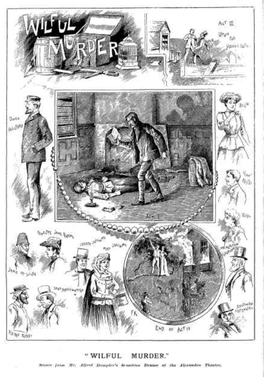
Wilful Murder is a 1892 Australian play by Alfred Dampier and Garnet Walch. The play adapted George Meredith's British play Drama of London Life, incorporating elements of the recent Windsor murder by Frederick Bailey Deeming.
Help One Another is a 1892 Australian stage play by Alfred Dampier and Garnet Walch. It was produced starring Dampier. It was adapted from an Irish drama.
Thou Shalt Not Steal is a 1896 Australian stage play by Alfred Dampier. It enabled Lily Dampier to play a dual role.
Marvellous Melbourne is a 1889 Australian stage play by Alfred Dampier and J.H. Wrangham. It was hugely popular in Melbourne and is one of Dampier's most iconic plays.
References
- ↑ "WHISPERS AT THE WINGS". Sportsman. No. 510. Victoria, Australia. 26 November 1890. p. 4. Retrieved 7 May 2024– via National Library of Australia.
- ↑ "The Mercury". Mercury And Weekly Courier . No. 801. Victoria, Australia. 27 November 1890. p. 2. Retrieved 7 May 2024– via National Library of Australia.
- ↑ "Advertising". The Argus (Melbourne) . No. 13, 864. Victoria, Australia. 29 November 1890. p. 16. Retrieved 7 May 2024– via National Library of Australia.
- ↑ "ALEXANDRA THEATRE". Table Talk . No. 285. Victoria, Australia. 5 December 1890. p. 14. Retrieved 7 May 2024– via National Library of Australia.
- ↑ "ALEXANDRA THEATRE". The Argus (Melbourne) . No. 13, 865. Victoria, Australia. 1 December 1890. p. 6. Retrieved 7 May 2024– via National Library of Australia.
- ↑ ""FOR LOVE AND LIFE."". The Lorgnette . No. 101. Victoria, Australia. 6 December 1890. p. 3. Retrieved 7 May 2024– via National Library of Australia.
- ↑ "The Dramatic Year, 1890". Table Talk . No. 289. Victoria, Australia. 2 January 1891. p. 4. Retrieved 7 May 2024– via National Library of Australia.