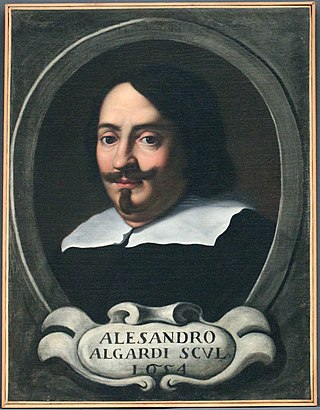
Alessandro Algardi was an Italian high-Baroque sculptor active almost exclusively in Rome. In the latter decades of his life, he was, along with Francesco Borromini and Pietro da Cortona, one of the major rivals of Gian Lorenzo Bernini, in Rome. He is now most admired for his portrait busts that have great vivacity and dignity.

Gian LorenzoBernini was an Italian sculptor and architect. While a major figure in the world of architecture, he was more prominently the leading sculptor of his age, credited with creating the Baroque style of sculpture.

The Galleria Borghese is an art gallery in Rome, Italy, housed in the former Villa Borghese Pinciana. At the outset, the gallery building was integrated with its gardens, but nowadays the Villa Borghese gardens are considered a separate tourist attraction. The Galleria Borghese houses a substantial part of the Borghese Collection of paintings, sculpture and antiquities, begun by Cardinal Scipione Borghese, the nephew of Pope Paul V. The building was constructed by the architect Flaminio Ponzio, developing sketches by Scipione Borghese himself, who used it as a villa suburbana, a country villa at the edge of Rome.
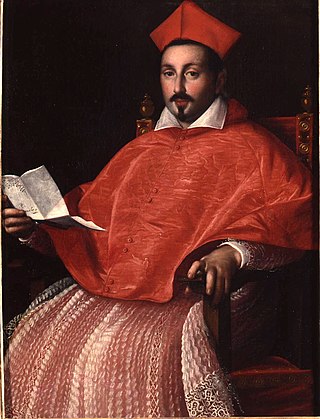
Scipione Borghese was an Italian cardinal, art collector and patron of the arts. A member of the Borghese family, he was the patron of the painter Caravaggio and the artist Bernini. His legacy is the establishment of the art collection at the Villa Borghese in Rome.

The life-size ancient but much restored marble statue known as the Barberini Faun, Fauno Barberini or Drunken Satyr is now in the Glyptothek in Munich, Germany. A faun is the Roman equivalent of a Greek satyr. In Greek mythology, satyrs were human-like male woodland spirits with several animal features, often a goat-like tail, hooves, ears, or horns. Satyrs attended Dionysus.
Ercole Ferrata was an Italian sculptor of the Roman Baroque.

The Palazzo Barberini is a 17th-century palace in Rome, facing the Piazza Barberini in Rione Trevi. Today, it houses the Galleria Nazionale d'Arte Antica, the main national collection of older paintings in Rome.
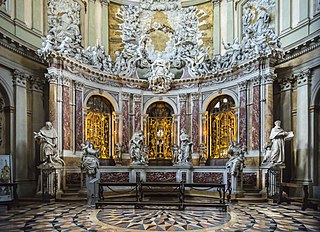
Filippo Parodi was an Italian sculptor of the Baroque period, "Genoa's first and greatest native Baroque sculptor".

The Borghese Collection is a collection of Roman sculptures, old masters and modern art collected by the Roman Borghese family, especially Cardinal Scipione Borghese, from the 17th century on. It includes major collections of Caravaggio, Raphael, and Titian, and of ancient Roman art. Cardinal Scipione Borghese also bought widely from leading painters and sculptors of his time, and Scipione Borghese's commissions include two portrait busts by Gian Lorenzo Bernini. Most of the collection remains intact and on display at the Galleria Borghese, although a significant sale of classical sculpture was made under duress to the Louvre in 1807.

The Sleeping Hermaphrodite is an ancient marble sculpture depicting Hermaphroditus life size. In 1620, Italian artist Gian Lorenzo Bernini sculpted the mattress upon which the statue now lies. The form is partly derived from ancient portrayals of Venus and other female nudes, and partly from contemporaneous feminised Hellenistic portrayals of Dionysus/Bacchus. It represents a subject that was much repeated in Hellenistic times and in ancient Rome, to judge from the number of versions that have survived. Discovered at Santa Maria della Vittoria, Rome, the Sleeping Hermaphrodite was immediately claimed by Cardinal Scipione Borghese and became part of the Borghese Collection. The "Borghese Hermaphrodite" was later sold to the occupying French and was moved to The Louvre, where it is on display.

The Rape of Proserpina, more accurately translated as The Abduction of Proserpina, is a large Baroque marble group sculpture by Italian artist Gian Lorenzo Bernini, executed between 1621 and 1622, when Bernini's career was in its early stage. The group, finished when Bernini was just 23 years old, depicts the abduction of Proserpina, who is seized and taken to the underworld by the god Pluto. It features Pluto holding Proserpina aloft, and a Cerberus to symbolize the border into the underworld that Pluto carries Proserpina into.
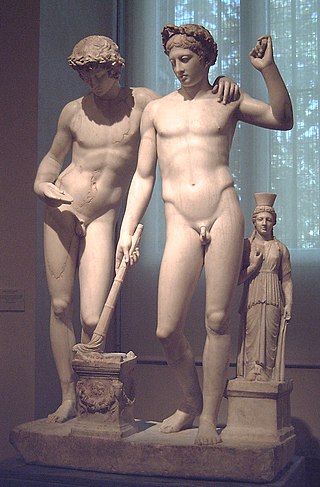
The Castor and Pollux group is an ancient Roman sculptural group of the 1st century AD, now in the Museo del Prado, Madrid.

Ippolito Buzzi (1562–1634) was an Italian sculptor from Viggiù, near Varese, in northernmost Lombardy, a member of a long-established dynasty of painters, sculptors and architects from the town, who passed his mature career in Rome. His personality as a sculptor is somewhat overshadowed by the two kinds of work he is known for: restorations to ancient Roman sculptures, some of them highly improvisatory by modern standards, and sculpture contributed to architectural projects and funeral monuments, where he was one among a team of craftsmen working under the general direction of an architect, like Giacomo della Porta - in projects for Pope Clement VIII, or Flaminio Ponzio - in projects for Pope Paul V - who would provide the designs from which the work was executed, always in consultation with the patron.

Bartolomeo Cavaceppi was an Italian sculptor who worked in Rome, where he trained in the studio of the acclimatized Frenchman, Pierre-Étienne Monnot, and then in the workshop of Carlo Antonio Napolioni, a restorer of sculptures for Cardinal Alessandro Albani, who was to become a major patron of Cavaceppi, and a purveyer of antiquities and copies on his own account. The two sculptors shared a studio. Much of his work was in restoring antique Roman sculptures, making casts, copies, and fakes of antiques, fields in which he was pre-eminent and which brought him into contact with all the virtuosi: he was a close friend of and informant for Johann Joachim Winckelmann. Winckelmann's influence and Cardinal Albani's own evolving taste may have contributed to Cavaceppi's increased self-consciousness of the appropriateness of restorations — a field in which earlier sculptors had improvised broadly — evinced in his introductory essay to his Raccolta d'antiche statue, busti, teste cognite ed altre sculture antiche restaurate da Cav. Bartolomeo Cavaceppi scultore romano. The baroque taste in ornate restorations of antiquities had favoured finely pumiced polished surfaces, coloured marbles and mixed media, and highly speculative restorations of sometimes incongruous fragments. Only in the nineteenth century, would collectors begin for the first time to appreciate fragments of sculpture: a headless torso was not easily sold in eighteenth-century Rome.
Orfeo Boselli, or Bosselli, (1597–1667) was an Italian sculptor working in Rome. As with most Roman sculptors of the sixteenth through the eighteenth centuries, a great part of his commissioned work was in restoring and completing fragmentary ancient Roman sculptures.
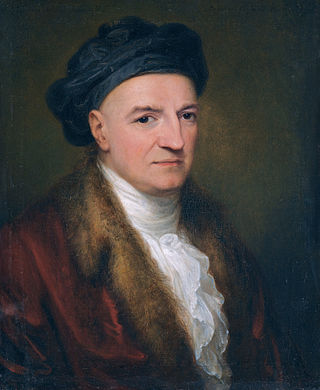
Giovanni Volpato (1735–1803) was an Italian engraver. He was also an excavator, dealer in antiquities and manufacturer of biscuit porcelain figurines.
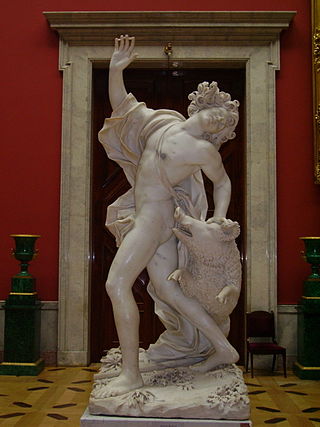
Giuseppe Mazzuoli was an Italian sculptor working in Rome in the Bernini-derived Baroque style. He produced many highly accomplished sculptures of up to monumental scale but was never a leading figure in the Roman art world.

Carlo Albacini was an Italian sculptor and restorer of Ancient Roman sculpture.

The statue of Jonah and the whale is an Italian Renaissance sculpture in marble by Lorenzetto in the niche to the left of the altar in the Chigi Chapel of the Basilica of Santa Maria del Popolo, Rome. The sculptor followed the original designs of his mentor, Raphael, who was the architect of the chapel. This is the only sculpture that Raphael himself designed and was executed according to his intentions.
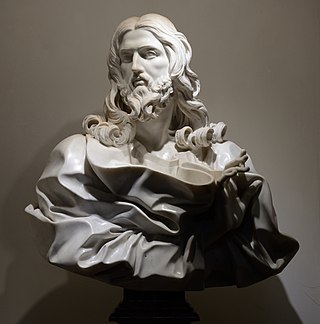
The Bust of the Saviour (Salvator Mundi) is the last sculpture created by baroque artist Gian Lorenzo Bernini, who died from the after-effects of a stroke, when the artist was 81 years old. He left the sculpture in his will to his friend and patron queen Christina of Sweden. Considered lost and "rediscovered" in 2001, by Francesco Petrucci, it is currently held in the basilica of San Sebastiano fuori le mura in Rome.
