Related Research Articles

Louis Comfort Tiffany was an American artist and designer who worked in the decorative arts and is best known for his work in stained glass. He is associated with the art nouveau and aesthetic art movements. He was affiliated with a prestigious collaborative of designers known as the Associated Artists, which included Lockwood de Forest, Candace Wheeler, and Samuel Colman. Tiffany designed stained glass windows and lamps, glass mosaics, blown glass, ceramics, jewellery, enamels, and metalwork. He was the first design director at his family company, Tiffany & Co., founded by his father Charles Lewis Tiffany.

Émile Gallé was a French artist and designer who worked in glass, and is considered to be one of the major innovators in the French Art Nouveau movement. He was noted for his designs of Art Nouveau glass art and Art Nouveau furniture, and was a founder of the École de Nancy or Nancy School, a movement of design in the city of Nancy, France.

Steuben Glass is an American art glass manufacturer, founded in the summer of 1903 by Frederick Carder and Thomas G. Hawkes in Corning, New York, which is in Steuben County, from which the company name was derived. Hawkes was the owner of the largest cut glass firm then operating in Corning. Carder was an Englishman who had many years' experience designing glass for Stevens & Williams in England. Hawkes purchased the glass blanks for his cutting shop from many sources and eventually wanted to start a factory to make the blanks himself. Hawkes convinced Carder to come to Corning and manage such a factory. Carder, who had been passed over for promotion at Stevens and Williams, consented to do so.
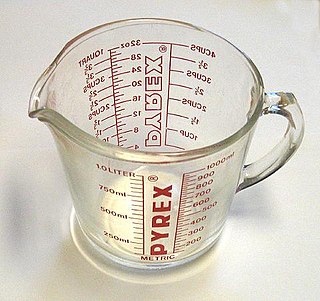
Pyrex is a brand introduced by Corning Inc. in 1915 for a line of clear, low-thermal-expansion borosilicate glass used for laboratory glassware and kitchenware. It was later expanded in the 1930s to include kitchenware products made of soda–lime glass and other materials.

Eva Striker Zeisel was a Hungarian-born American industrial designer known for her work with ceramics, primarily from the period after she immigrated to the United States. Her forms are often abstractions of the natural world and human relationships. Work from throughout her prodigious career is included in important museum collections across the world. Zeisel declared herself a "maker of useful things."

Aino Maria Marsio-Aalto was a Finnish architect and a pioneer of Scandinavian design. She is known as a co-founder of the design company Artek and as a collaborator on its most well-known designs. As Artek's first artistic director, her creative output spanned textiles, lamps, glassware, and buildings. It has been discovered that it was Aino who completed the first work commissioned through Artek which was the Viipuri Library in 1935. Her work is in the permanent collection of the Museum of Modern Art (MoMA) in New York, and MoMA has included her work in nine exhibitions. Aino Aalto’s first exhibition was Art in Progress: 15th Anniversary Exhibitions: Design for Use at MoMA in 1944. Other major exhibitions were at the Barbican Art Gallery in London and Chelsea Space in London. Aino Aalto has been exhibited with Pablo Picasso.

Vuokko Hillevi Lilian Eskolin-Nurmesniemi is a Finnish textile designer. She is best known for her work as one of the two leading designers of the Marimekko company. Her signature striped Jokapoika shirt helped to make the company's name.

Iittala, founded as a glassworks in 1881, is a Finnish design brand specialising in design objects, tableware and cookware. Iittala's official i-logo was designed by Timo Sarpaneva in 1956.
The firm of James Powell and Sons, also known as Whitefriars Glass, were London-based English glassmakers, leadlighters and stained-glass window manufacturers. As Whitefriars Glass, the company existed from the 17th century, but became well known as a result of the 19th-century Gothic Revival and the demand for stained glass windows.
Belle Kogan (1902–2000) was a Russian-American industrial designer and is regarded as the first prominent female in the profession in the United States as well as one of the founders of the profession itself. In 1994, she was recognized as a fellow of both the Industrial Designers Society of America (IDSA) and Industrial Designers Institute (IDI).
The Charles Reizenstein Company was an internationally acclaimed glassware and chinaware designer, importer, and manufacturer. The company's first store was established on Federal Street in Allegheny in 1865, making it America's oldest family-owned china and glassware concern as of 1947.
Early American molded glass refers to glass functional and decorative objects, such as bottles and dishware, that were manufactured in the United States in the 19th century. The objects were produced by blowing molten glass into a mold, thereby causing the glass to assume the shape and pattern design of the mold. When a plunger rather than blowing is used, as became usual later, the glass is technically called pressed glass. Common blown molded tableware items bearing designs include salt dishes, sugar bowls, creamers, celery stands, decanters, and drinking glasses.
Claus Josef Riedel was a Czech glassmaker, businessman, professor of chemistry, and chemical engineer. He was the 9th-generation owner of Riedel Crystal, an Austrian glassware manufacturer that was established in 1756. Riedel is best known for creating and producing grape variety-specific glassware designed to enhance types of wines based on specific properties of individual grape varieties. He was among the first glassware experts in history to recognize that the taste of wine is affected by the shape of the glass from which it is consumed, and is credited with first discovering the concept of variety-specificity in glassware, developing variety-specific glassware shapes and bringing these glasses to the consumer market. Riedel served as President and Chief Executive Officer of Riedel Crystal from 1957 until 1994.

Pairpoint Glass Company is an American glass manufacturer based in Sagamore, Massachusetts. It is currently the oldest operating glass company in the United States.

Gunnel Nyman was a Finnish glass and metal artist, and one of the founders of modern Finnish glass design. She was also a proponent of early mass-produced glassware. Nyman's glassware is exhibited in museums internationally.

Alice Carmen Gouvy was a designer at Tiffany Studios and worked closely with Clara Driscoll, the head of the Women's Glass Cutting Department.
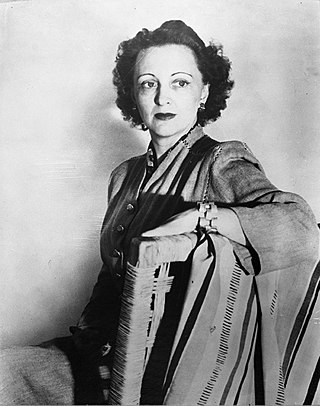
Eva-Lisa "Pipsan" Saarinen Swanson (March 31, 1905 – October 23, 1979) was a Finnish-American industrial, interior, and textile designer based in Michigan. She was known for her contemporary furniture, textile, and product designs.
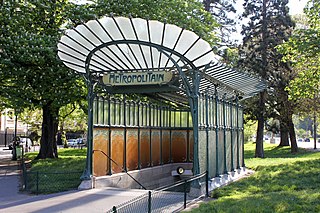
The Art Nouveau movement of architecture and design flourished in Paris from about 1895 to 1914, reaching its high point at the 1900 Paris International Exposition. with the Art Nouveau metro stations designed by Hector Guimard. It was characterized by a rejection of historicism and traditional architectural forms, and a flamboyant use of floral and vegetal designs, sinuous curving lines such as the whiplash line, and asymmetry. It was most prominent in architecture, appearing in department stores, apartment buildings, and churches; and in the decorative arts, particularly glassware, furniture, and jewelry. Besides Guimard, major artists included René Lalique in glassware, Louis Majorelle in furniture, and Alphonse Mucha in graphic arts, It spread quickly to other countries, but lost favor after 1910 and came to an end with the First World War.

Hellin Helena Tynell was a notable Finnish glass designer who has been described as a pioneer of Finnish glass art.

Ena Rottenberg was a Hungarian-Austrian craftswoman, draftswoman, ceramist and member of the artists' community of the Wiener Werkstätte.
References
- ↑ "Freda Diamond Collection · SOVA". sova.si.edu. Retrieved 2019-03-26.
- ↑ Avrich, Paul (2005). Anarchist Voices: An Oral History of Anarchism in America. AK Press. p. 52. ISBN 9781904859277.
- 1 2 Kirkham, Pat (2002). Women Designers in the USA, 1900-2000: Diversity and Difference. Yale University Press. p. 279. ISBN 9780300093315.
- 1 2 3 "Freda Diamond (1905-1998)" (PDF). Smithsonian. Archived from the original (PDF) on 2015-01-22. Retrieved 2019-03-26.
- ↑ "Women in Glasshouses: Communism in a Juice Glass – the designs of Freda Diamond". Corning Museum of Glass Blog. Retrieved 22 July 2022.
- ↑ "Women in Glasshouses: Communism in a Juice Glass – the designs of Freda Diamond". Corning Museum of Glass. Retrieved 23 July 2022.
| International | |
|---|---|
| National | |
| Artists | |
