Disruption, disruptive, or disrupted may refer to:
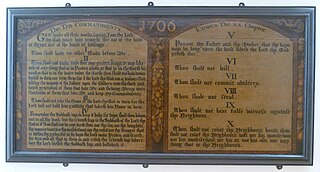
Kirk is a Scottish and former Northern English word meaning 'church'. The term the Kirk is often used informally to refer specifically to the Church of Scotland, the Scottish national church which developed from the 16th-century Reformation. Many place names and personal names are derived from kirk.

The Free Church of Scotland is a Scottish denomination which was formed in 1843 by a large withdrawal from the established Church of Scotland in a schism known as the Disruption of 1843. In 1900, the vast majority of the Free Church of Scotland joined with the United Presbyterian Church of Scotland to form the United Free Church of Scotland. In 1904, the House of Lords judged that the constitutional minority that did not enter the 1900 union were entitled to the whole of the church's patrimony, the Free Church of Scotland acquiesced in the division of those assets, between itself and those who had entered the union, by a Royal Commission in 1905. Despite the late founding date, Free Church of Scotland leadership claims an unbroken succession of leaders going all the way back to the Apostles.
The United Free Church of Scotland is a Scottish Presbyterian denomination formed in 1900 by the union of the United Presbyterian Church of Scotland and the majority of the 19th-century Free Church of Scotland. The majority of the United Free Church of Scotland united with the Church of Scotland in 1929.

The Free Presbyterian Church of Scotland was formed in 1893. The Church identifies itself as the spiritual descendant of the Scottish Reformation. The Church web-site states that it is 'the constitutional heir of the historic Church of Scotland'. Its adherents are occasionally referred to as Seceders or the Wee Wee Frees. Although small, the church has congregations on five continents.
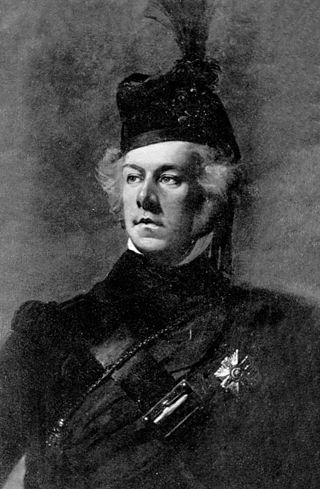
John Campbell, 2nd Marquess of Breadalbane,, styled Lord Glenorchy until 1831 and as Earl of Ormelie from 1831 to 1834, was a Scottish nobleman and Liberal politician.
Secession is the act of withdrawing from an organization, union, or political entity.
The Free Church of Scotland, an evangelical presbyterian church formed in 1843 when its founders withdrew from the Church of Scotland, also known as the Kirk. See:
Robert or Rob Harris may refer to:
The Anti-Burghers were opponents of the Burgher Oath on theological grounds.

Thomas M'Crie was a Presbyterian minister and church historian. He was a Scottish Secession minister who joined the Free Church of Scotland and served as the Moderator of the General Assembly to that church 1856/57.
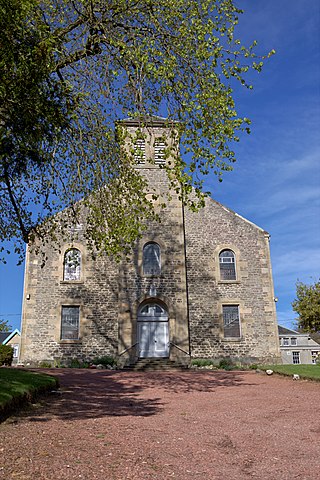
Abbeygreen Church is a congregation of the Free Church of Scotland in the small town of Lesmahagow, Lanarkshire. As a Christian congregation, it is presbyterian and reformed; holding the Word of God, the Holy Bible, as the supreme rule of life and doctrine and the Westminster Confession of Faith as a sub-ordinate standard, which helps explain the doctrines of the Christian faith. Being Presbyterian, it serves as part of the Free Church of Scotland Presbytery of Glasgow and seeks to faithfully serve God in Lesmahagow and the surrounding area. Having a missional outlook it is involved with a number of missionary organizations including, but not only, UFM Worldwide and Rose of Sharon Ministries, and helps with the organization and support of the Scottish Reformed Conference.

Peter Hately Waddell was a Scottish cleric and prolific writer. He founded a congregation he called the "Church of the Future". He also wrote widely on aspects of Scottish culture and ancient Celtic history, sometimes espousing distinctly non-mainstream views.

St Blane's is a Church of Scotland church located in Dunblane, Scotland. The evangelical congregation is within the Church of Scotland's Presbytery of Stirling. The Gothic Revival church building opened in 1854 as the Free Church and is now a category B listed building.

The First Secession was an exodus of ministers and members from the Church of Scotland in 1733. Those who took part formed the Associate Presbytery and later the United Secession Church. They were often referred to as Seceders.

The Reid Memorial Church is a church in Edinburgh. It is a congregation of the Church of Scotland and is located in the Blackford area on the south side of the city.
Free Church College may refer to:

The King's Hall is a church in Newington, Edinburgh, Scotland. Constructed as Newington Free Church in 1843, it is now used by Community Church Edinburgh: an independent evangelical congregation.

St Paul's Parish Church was a parish church of the Church of Scotland located in St Leonard's, Edinburgh, Scotland. Its building served as a church between 1836 and 1942 before being demolished in 1980.
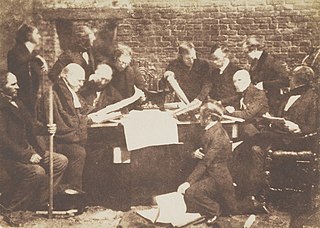
James Crawford was a Scottish lawyer and church elder from Edinburgh. After the Disruption of 1843 he sided with the Free Church and was elected Deputy Clerk of the General Assembly of the Free Church of Scotland - a post he held for 20 years. He was also involved in local government and publishing. He served on several Free Church committees and was photographed in this role by Hill & Adamson.
This page is based on this
Wikipedia article Text is available under the
CC BY-SA 4.0 license; additional terms may apply.
Images, videos and audio are available under their respective licenses.
