
The Volkssturm was a levée en masse national militia established by Nazi Germany during the last months of World War II. It was set up by the Nazi Party on the orders of Adolf Hitler and established on 25 September 1944. It was staffed by conscripting males between the ages of 16 and 60 years, who were not already serving in some military unit. The Volkssturm comprised one of the final components of the total war promulgated by Propaganda Minister Joseph Goebbels, part of a Nazi endeavor to overcome their enemies' military strength through force of will. Volkssturm units fought unsuccessful battles against Allied forces at the end of the war. On several occasions, its members participated in atrocities, accompanied by German civilians and the Hitler Youth, which were overseen by members of the SS or Gaue leaders.

Freikorps were irregular German and other European paramilitary volunteer units that existed from the 18th to the early 20th centuries. They effectively fought as mercenaries or private military companies, regardless of their own nationality. In German-speaking countries, the first so-called Freikorps were formed in the 18th century from native volunteers, enemy renegades, and deserters. These sometimes exotically equipped units served as infantry and cavalry ; sometimes in just company strength and sometimes in formations of up to several thousand strong. There were also various mixed formations or legions. The Prussian von Kleist Freikorps included infantry, jäger, dragoons and hussars. The French Volontaires de Saxe combined uhlans and dragoons.
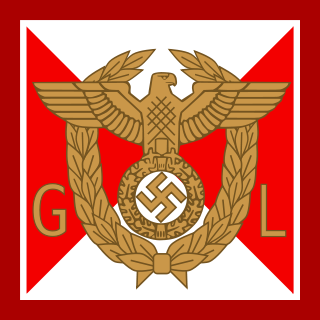
A Gauleiter was a regional leader of the Nazi Party (NSDAP) who served as the head of a Gau or Reichsgau. Gauleiter was the third-highest rank in the Nazi political leadership, subordinate only to Reichsleiter and to the Führer himself. The position was effectively abolished with the fall of the Nazi regime on 8 May 1945.

The Stahlhelm is a term used to refer to a series of German steel combat helmet designs intended to protect the wearer from common battlefield hazards such as shrapnel.

The Marinebrigade Ehrhardt, also known as the Ehrhardt Brigade, was a Freikorps unit of the early Weimar Republic. It was formed on 17 February 1919 as the Second Marine Brigade from members of the former Imperial German Navy under the leadership of Hermann Ehrhardt. The brigade was used primarily in the suppression of the Bavarian Soviet Republic and the First Silesian Uprising, both in the first half of 1919. In March 1920, faced with its imminent disbanding by orders of the government in Berlin, the Marine Brigade was one of the main supporters of the Kapp Putsch that tried to overthrow the Weimar Republic. After the putsch failed and the brigade was disbanded in May, many of the former members formed the secret Organisation Consul under Ehrhardt's leadership. Before it was banned in 1922, it carried out numerous assassinations and murders in a continuation of the attempts to overthrow the Republic.
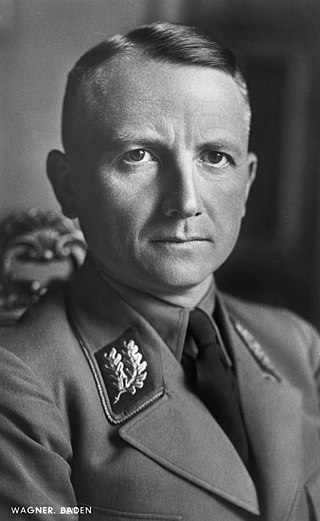
Robert Heinrich Wagner, born as Robert Heinrich Backfisch was a Nazi Party official and politician who served as Gauleiter and Reichsstatthalter of Baden, and Chief of Civil Administration for Alsace during the German occupation of France in World War II.
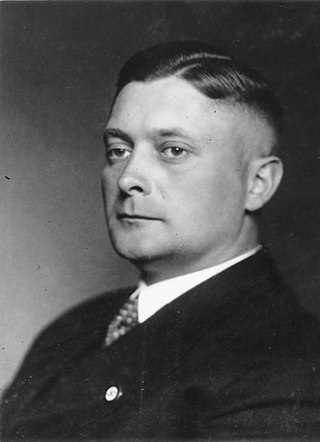
Karl Kaufmann was a German politician who served as a Nazi Party Gauleiter from 1925 to 1945 and as the Reichsstatthalter of Hamburg from 1933 to 1945.
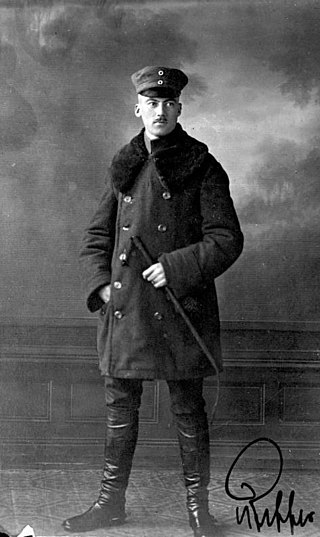
Franz Pfeffer von Salomon during the Nazi regime known as Franz von Pfeffer, was the first Supreme Leader of the Sturmabteilung (SA) after its re-establishment in 1925. Pfeffer resigned from his SA command in 1930 and was expelled from the Nazi Party in 1941. He died in 1968.

Friedrich Karl Florian was the Gauleiter of Gau Düsseldorf throughout its existence in Nazi Germany.
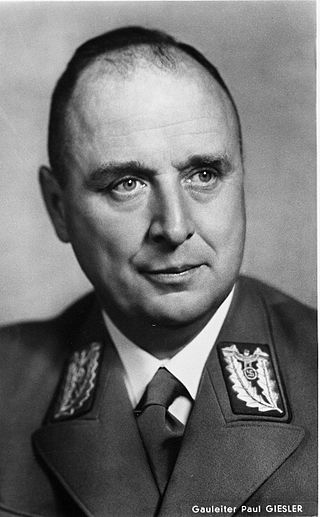
Paul Giesler was a German Nazi Party politician and SA-Obergruppenführer. From 1941, he was the Gauleiter of Westphalia-South, and he was appointed to the same position for the Gau Munich-Upper Bavaria in 1942. From 2 November 1942 to 28 April 1945, he was also Ministerpräsident of Bavaria. He was responsible for multiple acts of brutality, which included killing opponents of the regime in southern Germany. Giesler was also named in Hitler's Political Testament as Interior Minister, replacing Heinrich Himmler, in the short-lived Goebbels Cabinet. He committed suicide together with his wife in the closing days of the war in Europe.
Adolf Johann Albert Hoffmann was a German entrepreneur, who during the Third Reich served as the Nazi Gauleiter of Westphalia-South. He was also an SS-Gruppenführer. Tried for war crimes, he was acquitted for lack of evidence, but was sentenced to prison as a result of denazification proceedings.

The Province of Westphalia was a province of the Kingdom of Prussia and the Free State of Prussia from 1815 to 1946. In turn, Prussia was the largest component state of the German Empire from 1871 to 1918, of the Weimar Republic and from 1918 to 1933, and of Nazi Germany from 1933 until 1945.
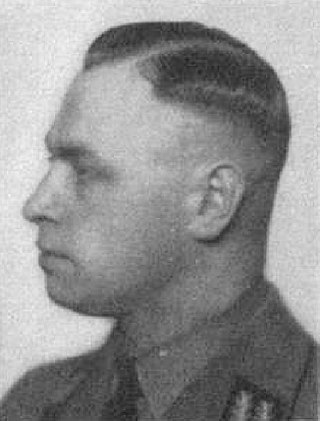
Josef Grohé was a German Nazi Party official. He was the long-serving Gauleiter of Gau Cologne-Aachen and Reichskommissar for Belgium and Northern France toward the end of the Second World War.
The Gau March of Brandenburg was formed in March 1933 initially under the name Gau Electoral March in Nazi Germany as a district within the Free State of Prussia. In January 1939, Kurmark was renamed March of Brandenburg. The Gau was dissolved in 1945, following Allied Soviet occupation of the area and Germany's formal surrender. After the war, the territory of the former Gau became part of the state of Brandenburg in East Germany except for areas beyond the Oder-Neisse line, which were given to the Polish People's Republic. Most of its territory is now divided between Germany's State of Brandenburg and Poland's Lubusz Voivodeship.
The Gau Westphalia-North was an administrative division of Nazi Germany encompassing the Free State of Lippe, the Free State of Schaumburg-Lippe and the northern half of the Prussian province of Westphalia between 1933 and 1945. From 1931 to 1933, it was the regional subdivision of the Nazi Party for these areas.
The Gau Pomerania formed on 22 March 1925, was an administrative division of Nazi Germany from 1933 to 1945 comprising the Prussian province of Pomerania. Before that, from 1925 to 1933, it was the regional subdivision of the Nazi Party in that area. Most of the Gau became part of Poland after the Second World War while the remainder became part of what would become East Germany.
The Gau Düsseldorf was an administrative division of Nazi Germany from 1933 to 1945 in the Düsseldorf region of the Prussian Rhine Province. Before that, from 1930 to 1933, it was the regional subdivision of the Nazi Party in that area.
The Gau Westphalia-South was an administrative division of Nazi Germany encompassing the Arnsberg Region in the southern part of the Prussian province of Westphalia between 1933 and 1945. From 1931 to 1933, it was the regional subdivision of the Nazi Party for these areas.
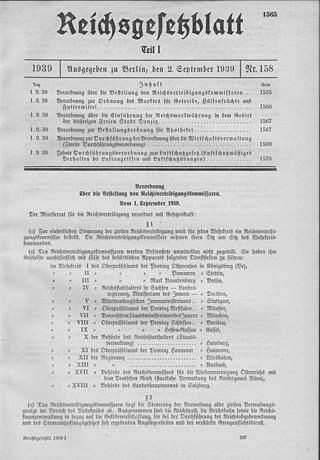
Reich Defense Commissioner was a governmental position created in Nazi Germany at the outbreak of World War II on 1 September 1939. Charged with overall defense of the territory of the German Reich, there was originally one Reich Defense Commissioner for each of 15 Wehrkreise. On 16 November 1942, the geographical scope was reduced to the Gau level, raising the number of Reich Defense Commissioners to 42.
Fritz Schlessmann, born Georg Friedrich Schlessmann was a Nazi Deputy Gauleiter of Gau Essen and served as Acting Gauleiter for most of the Second World War. He was also a prominent police official and SS-Obergruppenführer.

 Nazi Germany