| ||||||||||||||||||||||||||||
All 57 seats to the Assembly of French Polynesia | ||||||||||||||||||||||||||||
| ||||||||||||||||||||||||||||
| ||||||||||||||||||||||||||||
| This article is part of a series on the politics and government of French Polynesia |
|---|
|
An early legislative election to the Assembly of French Polynesia was held in French Polynesia in early 2008. The first round of the election was held on 27 January 2008, with the second round held on 10 February 2008. [1] [2] The early elections was the first one to be conducted under a reformed electoral system.
The Assembly of French Polynesia is the unicameral legislature of French Polynesia, an overseas country of the French Republic. It is located at Place Tarahoi in Papeete, Tahiti. It was established in its current form in 1996 although a Tahitian Assembly was first created in 1824. It consists of 57 members who are elected by popular vote for five years; the electoral system is based upon proportional representation in six multi-seat constituencies. Every constituency is represented by at least three representatives. Since 2001, the parity bill binds that the number of women matches the number of men elected to the Assembly.
French Polynesia is an overseas collectivity of the French Republic and the only overseas country of France. It is composed of 118 geographically dispersed islands and atolls stretching over an expanse of more than 2,000 kilometres (1,200 mi) in the South Pacific Ocean. Its total land area is 4,167 square kilometres (1,609 sq mi).
The new system, approved in France on 26 November 2007, was meant to stabilise the chaotic French Polynesian political scene. [3] [4] [5] Under the new system, a two-round election system was promulgated, [6] and candidates from any political party require at least 12.5% of the vote to enter the second round of voting, and a general electoral threshold of 5% was set. [7]
France, officially the French Republic, is a country whose territory consists of metropolitan France in Western Europe and several overseas regions and territories. The metropolitan area of France extends from the Mediterranean Sea to the English Channel and the North Sea, and from the Rhine to the Atlantic Ocean. It is bordered by Belgium, Luxembourg and Germany to the northeast, Switzerland and Italy to the east, and Andorra and Spain to the south. The overseas territories include French Guiana in South America and several islands in the Atlantic, Pacific and Indian oceans. The country's 18 integral regions span a combined area of 643,801 square kilometres (248,573 sq mi) and a total population of 67.3 million. France, a sovereign state, is a unitary semi-presidential republic with its capital in Paris, the country's largest city and main cultural and commercial centre. Other major urban areas include Lyon, Marseille, Toulouse, Bordeaux, Lille and Nice.
In July 2007, Former French Polynesian President Gaston Tong Sang was heavily criticized by Gaston Flosse, former President and the founder of Tong Sang's party, Tahoeraa Huiraatira. Flosse accused Tong Sang of caving in too easily to the demands of some of French Polynesia's minor coalition parties and ignoring the needs of Tahoeraa Huiraatira. [8] Critics of Flosse asserted that the attack was merely a move by Flosse to regain the presidency, an accusation bolstered by revelations that Flosse had "secret talks" with Oscar Temaru, former President and a leading pro-independence politician who has been Flosse's long time political opponent in the past. [8] According to reports, the talks were aimed at ousting Sang from office and setting up a unity platform between Flosse and Temaru's respective political parties. [8]
Gaston Flosse is a French politician who has been President of French Polynesia on five separate occasions. He is currently a member of the Senate of France and has been a French junior minister under Jacques Chirac. He received sentences for corruption, which are under appeal.
On 29 August 2007, a no confidence motion was introduced by Temaru's Union for Democracy (UPLD). [8] The UPLD said that the no cofidence motion against Tong Sang was based on the fact that he had only small support in the Assembly, thus losing his legitimacy to govern. Tong Sang's own Tahoeraa Huiraatira party asked him to resign ahead of the vote of no confidence against him. [8] Tong Sang refused the calls from his party to step down.
Tong Sang's government fell after the vote of no confidence was passed by French Polynesia's 57 member Assembly on August 31. The motion Sang was passed by a majority 35 members of the Assembly, including some members of the governing Tahoera'a Huiraatira party. [9] Tong Sang tried to save his government by offering Tahoer'a Huiraatira 7 ministerial posts. The deal was refused. [9]
The motion against Tong Sang was the first time that Oscar Temaru's Union for Democracy and Gaston Flosse's Tahoera'a Huiraatira party formed a de facto alliance to oust a sitting French Polynesian government. [9]
A political alliance, also referred to as a political coalition, political bloc, is an agreement for cooperation among different political parties on common political agenda, often for purposes of contesting an election to mutually benefit by collectively clearing election thresholds, or otherwise benefiting from characteristics of the electoral system or for government formation after elections. These may break up quickly, or hold together for decades becoming the de-facto norm, operating almost as a single unit.
After his ouster from government, Gaston Tong Sang left Tahoera'a Huiraatira and founded a new party, O Porinetia To Tatou Ai'a. [10] The new party, from the onset, had 6 members in the Assembly, all former members of Tahoera'a Huiraatira.
After Tong Sang's ouster, which was the third time a French Polynesian government was ousted from power via motions of no confidence since 2004, calls for electoral reform were heard. This culminated in an electoral reform package that was passed by France in November of the same year.
After elections were announced, President of French Polynesia Oscar Temaru stated that he would prefer to have elections after the French municipal elections in March 2008. [11]
| Party/Alliance | Votes | % | Seats | Total | |
|---|---|---|---|---|---|
| To Tatou Ai'a (Our Home) | 55,227 | 41.19 | 23 | 27 | |
| Te Niu Hau Manahune | 2,502 | 1.87 | 2 | ||
| Te Henua Enata a Tu† | 2,773 | 2.07 | 2 | ||
| Union for Democracy | 48,403 | 36.10 | 19 | 20 | |
| Tapura Amui No Te Faatereraa Manahune – Tuhaa Pae | 1,448 | 1.08 | 1 | ||
| Tahoera'a Huiraatira (Popular Rally) | 23,021 | 17.17 | 10 | ||
| Te Henua Enana Kotoa† | 497 | 0.37 | — | ||
| Te Ao Hou No Oe† | 171 | 0.13 | — | ||
| Te Ati o Te Henau Enana† | 44 | 0.03 | — | ||
| Total | 134,086 | 100.00 | 57 | ||
| Source: Haut-Commissariat de la République en Polynésie française † These parties only contested the election in the constituency of the Marquesas Islands; the Union for Democracy and Tahoera'a Huiraatira also contested the election in that constituency, and as a second round was not necessary there, the total numbers reflect the results of the first round in the Marquesas Islands and the results of the second round in all the other constituencies. To Tatou Ai'a did not contest the elections in Tuamotu Islands West and the Marquesas Islands; Te Niu Hau Manahune contested Tuamotu West for the alliance. The Union for Democracy did not contest the elections in the Austral Islands; Tapura Amui No Te Faatereraa Manahune – Tuhaa Pae contested the constituency for the alliance. | |||||
According to reports, the two pro-autonomy/anti-independence factions were likely to agree to form the government for the next five years, but coalition talks broke down on 20 February 2008. [12] The President of the Assembly was decided to be elected on 22 February 2008, with presidential elections in the Assembly to follow on 24 February 2008. [13]
In the election for the President of the Assembly, the incumbent Edouard Fritch was reelected [14] with 36 votes while the pro-independence candidate Antony Géros received 21 votes; one of the 37 pro-autonomy MPs had therefore evidently voted for Géros. [15]

Oscar Manutahi Temaru is a French politician. He has been President of French Polynesia, an overseas collectivity of France, on five occasions: in 2004, from 2005 to 2006, from 2007 to 2008, in 2009, and from 2011 to 2013 and mayor of Faa'a since 1983.

Elections for the Assembly of French Polynesia, the Territorial Assembly of French Polynesia, were held on May 23, 2004.
Elections in French Polynesia gives information on election and election results in French Polynesia.

Tāhōʻēraʻa Huiraʻatira is a political party in French Polynesia.
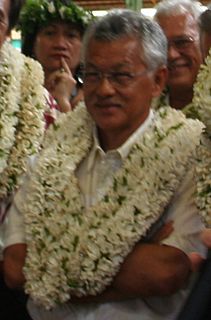
Gaston Tong Sang is a French politician and is the former President of French Polynesia. He served terms as President of French Polynesia from November 2009 until April 2011, from April 2008 until February 2009 and from December 2006 until September 2007; he is currently the Mayor of Bora-Bora. He is of Chinese descent, and is a founding member of French Polynesia's pro-French Tahoera'a Huiraatira political party.
Jean-Christophe Matahuira Bouissou is a French Polynesian politician and leader of the Rautahi political party.
Nelson Lévy was a leading figure in French Polynesia tourism and the founding head of Air Tahiti Nui, the national airline of French Polynesia.
‘O Pōrīnetia To Tātou ‘Ai‘a is a French Polynesian anti-independence political party founded by Gaston Tong Sang on 1 October 2007 after he split from his former party, the Tāhō‘ēra‘a Huira‘atira. It has six members in the French Polynesian assembly, all former Taheora'a Huiraatira members.
Indirect Senate elections were held for 114 of the 343 seats in the French Senate on 21 September 2008. With this election, the number of senators was increased from 331 to 343; Saint Barthélemy and Saint Martin elected two senators each for the first time. Furthermore, this election was the last to be held under the old system: prior to this election, senators were elected in three classes for nine-year terms. Under the new system instituted in 2011, senators are elected for six-year terms in two classes.
An indirect presidential election was held in French Polynesia on 24 February 2008 following the legislative election held on 27 January and 10 February 2008. It had originally been planned to be held in late February or early March, but was brought forward after an agreement by the three party groups in the Assembly.
Édouard Fritch is a French politician and has been President of French Polynesia since September 2014. Previously he has served as the Speaker of the Assembly of French Polynesia on three occasions: from April 2007 to February 2008, from February 2009 to April 2009 and from May 2013 to September 2014. Fritch was co-President of Tahoeraa Huiraatira, a pro-French political party, until 2016.
An indirect presidential election was held in French Polynesia on 11 February 2009, after defections from the ruling pro-autonomy faction and a scheduled constructive vote of no confidence planned for 12 February 2009 caused the incumbent Gaston Tong Sang to step down on 7 February 2009.
Alexandre Léontieff was a French politician and the President of French Polynesia from 1987 to 1991.
Jacques "Jacky" Teuira is a French politician and was the President of French Polynesia from February 12, 1987 to December 9, 1987.
Te Tiarama is a French Polynesian political party formed by former President of French Polynesia Alexandre Léontieff in January 1988. Léontieff created the new party on January 23, 1988 following his departure from Tahoera'a Huiraatira and a rift with Gaston Flosse.
An indirect presidential election was held in French Polynesia on Tuesday 24 November 2009, after the opposition, led by Gaston Tong Sang, won a vote of no confidence against the government of incumbent French Polynesia President Oscar Temaru.
Legislative elections were held in French Polynesia on 21 April and 5 May 2013. The result was a victory for the Tahoera'a Huiraatira party, which won 38 of the 57 seats in the Assembly.
Legislative elections were held in French Polynesia on 22 April and 6 May 2018. On 22 April 2018, voters cast their ballots in the first round of the election to the Assembly of French Polynesia. A second round was held on 6 May 2018 for the three political parties that exceeded 12.5 percent of the vote in the first round. The new Tapura Huiraatira party emerged as the largest in the Assembly, winning 38 of the 57 seats.