Related Research Articles

The demographics of Sudan include the Sudanese people and their characteristics, Sudan, including population density, ethnicity, education level, health, economic status, religious affiliations, and other aspects of the population.

The Kakwa people are a Nilotic ethnic group and part of the Karo people found in north-western Uganda, south-western South Sudan, and north-eastern Democratic Republic of the Congo, particularly to the west of the White Nile river.
The Masalit are an ethnic group inhabiting western Sudan and eastern Chad. They speak the Masalit language.
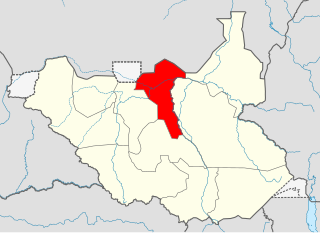
Unity State, also known as Western Upper Nile, is a state in South Sudan. Unity State is in the Greater Upper Nile region. Unity is inhabited predominantly by two ethnic groups: the Nuer majority, and the Dinka minority.

Western Bahr el Ghazal is a state in South Sudan. It has an area of 93,900 km2 (36,255 sq mi) and is the least populous state in South Sudan, according to the controversial Sudanese census conducted in 2008. It is part of the Bahr el Ghazal region. Its capital is Wau. The state shared international borders with Sudan to the north and the Central African Republic to the west. The portion now occupied by Raga County is the southern part of the historical region known as "Dar Fertit".
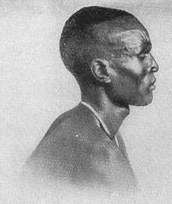
The Dinka tribe are a Nilotic ethnic group native to South Sudan. The Dinka mostly live along the Nile, from Bor to Renk, in the region of Bahr el Ghazal, Upper Nile, and the Abyei Area of the Ngok Dinka in South Sudan.

The Shilluk is a major Luo Nilotic ethnic group that resides in the northeastern state of the Upper Nile in South Sudan, living on both banks of the Nile River in Malakal. Before the Second Sudanese Civil War, the Shilluk also lived in settlements on the northern bank of the Sobat River, close to where the Sobat joins the Nile.
The Logo people or Logoa (plural) are an ethnic group of Nilotic origin who live predominantly in the north-east of the Democratic Republic of the Congo as well as parts of western Uganda and southern South Sudan. There are believed to be more than 200,000 people who identify as ethnically Logo of whom most live in the Congo's Faradje Territory, a remote region in Haut-Uélé Province, where they form the ethnic majority. Logo people also live in Watsa and Aba, both also in Haut-Uélé, and in Yei in South Sudan.
Ngulgule is an ethnic group of South Sudan living just north of the confluence of the Sopo and Boro rivers. They are one of seven distinct ethnicities comprising the Daju people. They speak Njalgulgule, a Nilo-Saharan language. Most of them are Muslims. The population of this group is 900.
Opo is an ethnic group of South Sudan and Ethiopia. They speak Opuuo, a Koman language. Most members of this ethnic group are not Muslims.
South Sudan, officially the Republic of South Sudan, is a landlocked country in eastern Central Africa. It is bordered by Ethiopia, Sudan, the Central African Republic, the Democratic Republic of the Congo, Uganda, and Kenya. Its population was estimated at 11,088,796 in 2023. Juba is the capital and largest city.
The culture of South Sudan encompasses the religions, languages, ethnic groups, foods, and other traditions of peoples of the modern state of South Sudan, as well as of the inhabitants of the historical regions of southern Sudan.

South Sudan is home to around 60 indigenous ethnic groups and 80 linguistic partitions among a 2021 population of around 11 million. Historically, most ethnic groups were lacking in formal Western political institutions, with land held by the community and elders acting as problem solvers and adjudicators. Today, most ethnic groups still embrace a cattle culture in which livestock is the main measure of wealth and used for bride wealth.

Christianity is the most widely professed religion in South Sudan, with significant minorities of the adherents of traditional faiths and Islam.

Human rights in South Sudan are a contentious issue, owing at least in part to the country's violent history.
Ethnic violence in South Sudan has a long history among South Sudan's varied ethnic groups. South Sudan has 64 tribes with the largest being the Dinka, who constitute about 35% of the population and predominate in government. The second largest are the Nuers. Conflict is often aggravated among nomadic groups over the issue of cattle and grazing land and is part of the wider Sudanese nomadic conflicts.
The Fungor language, Ko (Kau) or Nyaro, is a Niger–Congo language of the Heiban family spoken in Kordofan, Sudan.
South Sudanese Americans are an ethnic group of Americans of South Sudanese ancestry, or South Sudanese people who have American citizenship. South Sudanese Americans can include American descendants to South Sudanese ancestors or South Sudanese immigrants who obtained an American citizenship.

The South Sudanese Civil War was a multi-sided civil war in South Sudan between forces of the government and opposition forces. In December 2013, President Salva Kiir accused his former deputy Riek Machar and 10 others of attempting a coup d'état. Machar denied trying to start a coup and fled to lead the SPLM – in opposition (SPLM-IO). Fighting broke out between the Sudan People's Liberation Movement (SPLM) and SPLM-IO, igniting the civil war. Ugandan troops were deployed to fight alongside the South Sudanese government. The United Nations has peacekeepers in the country as part of the United Nations Mission in South Sudan (UNMISS).
Ethnic federalism, multi-ethnic or multi-national federalism, is a form of federal system in which the federated regional or state units are defined by ethnicity. Ethnic federal systems have been created in attempts to accommodate demands for ethnic autonomy and manage inter-ethnic tensions within a state. They have not always succeeded in this: problems inherent in the construction and maintenance of an ethnic federation have led to some states or sub-divisions of a state into either breaking up, resorting to authoritarian repression, or resorting to ethnocracy, ethnic segregation, population transfer, internal displacement, ethnic cleansing, and/or even ethnicity-based attacks and pogroms.
References
- 1 2 Olson, James Stuart; Meur, Charles (1996). The Peoples of Africa: An Ethnohistorical Dictionary. Greenwood Publishing Group. p. 182. ISBN 978-0-313-27918-8.
 | This article about a Sudanese ethnicity is a stub. You can help Wikipedia by expanding it. |