
The Gahadavala dynasty also Gahadavalas of Kannauj was a Rajput dynasty that ruled parts of the present-day Indian states of Uttar Pradesh and Bihar, during 11th and 12th centuries. Their capital was located at Banaras in the Gangetic plains, and for a brief period, they also controlled Kannauj.

Deoria district, one of the districts of eastern Uttar Pradesh, India has its headquarters located at Deoria and is a part of Gorakhpur division. It came into existence on 16 March 1946 from Gorakhpur district.
Iraqi Biradri is a Sunni Muslim caste found chiefly in Ghazipur, Azamgarh, Ballia, Deoria and Gorakhpur districts of the eastern Uttar Pradesh in India. Iraqi Biradri is also referred to as Iraqi Shaikh.
Fatehpur is a city in the state of Uttar Pradesh, India. The city is situated between the rivers Ganga and Yamuna. The city has been named after Babu Fateh Chandra who helped Rani Lakshmi Bai in freedom fight as well. It is located 120 km (75 mi) south of state capital Lucknow.
Baragaon is a census town in Varanasi district in the state of Uttar Pradesh, India.
Several Branches of the Rashtrakuta dynasty were created by the kings, commanders and relatives of the Rashtrakuta family during their expansion into central and northern India in the eighth to the tenth centuries. These kingdoms ruled during the reign of the parent empire or continued to rule for centuries after its fall or came to power much later. Well known among these were the Rashtrakutas of Gujarat (757-888), the Rattas of Saundatti (875-1230) in modern Karnataka, the Rashtrakutas of Rajasthan and ruling from Hastikundi or Hathundi (893-996), Dahal, the Rathores of Mandore and Dhanop, Reddy dynasty of Andhra Pradesh and Telangana, Rashtraudha dynasty of Mayuragiri in modern Maharashtra and Rashtrakutas of Kanauj.
Kharwar is a community found in the Indian states of Uttar Pradesh, Bihar, Jharkhand, Chhattisgarh, Orissa and West Bengal.

Sallakshana-Varman was a king of the Chandela dynasty of India. He succeeded his father Kirttivarman as the ruler of the Jejakabhukti region. The inscriptions of his descendants suggest that he achieved military successes against the Paramaras, the Kalachuris of Tripuri and the ruler of Kanyakubja.
Chandradeva, also known as Chandraditya, was an Indian king from the Gahadavala dynasty. He ruled the Antarvedi country in present-day Uttar Pradesh, including Kanyakubja and Varanasi.
Govindachandra was an Indian king from the Gahadavala dynasty. He ruled the Antarvedi country in present-day Uttar Pradesh, including the major cities of Kanyakubja and Varanasi.
Harishchandra was an Indian king from the Gahadavala dynasty. The last known king from the family's imperial branch, he probably ruled a part of his ancestral kingdom in present-day Uttar Pradesh.
Kundesar is a village in Ghazipur district, Uttar Pradesh. It has a population of 4602 per the 2011 Census. Having a history of five hundred years, this village has rich heritage of the Kinwar clan. Kundesar has got special mention in the gazetteers of Ghazipur since 1781. Kundesar is situated on the Ghazipur–Patna National Highway 19.
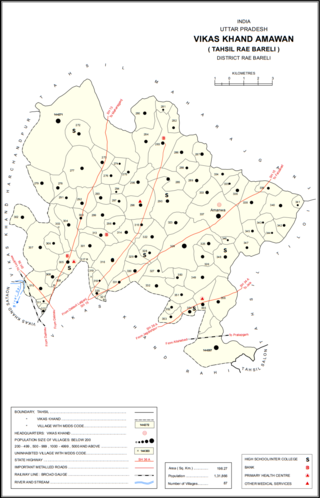
Hardaspur is a village in Amawan block of Rae Bareli district, Uttar Pradesh, India. As of 2011, its population is 2,974, in 570 households. It has 3 primary schools and one small clinic.

Korihar is a village located in Sataon block of Rae Bareli district, Uttar Pradesh, India. Located 20 km from Raebareli, the district headquarters, Korihar was historically the seat of a taluqdari estate held by a branch of the Bais Rajputs. On the northwest is Sataon, and to the south is the village of Hajipur, which has the ruins of an old Bais fort. As of 2011, the population of Korihar is 12,351, in 2,240 households. It has one primary school and no healthcare facilities. The village hosts markets twice per week, on Mondays and Fridays.
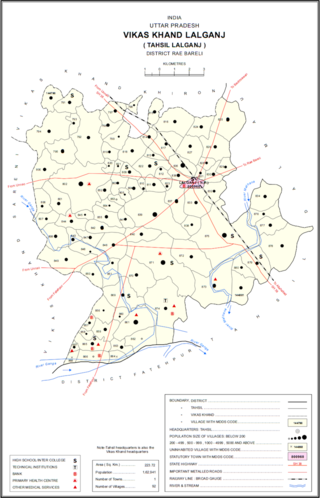
Simarpaha is a village in Lalganj block of Rae Bareli district, Uttar Pradesh, India. It is located 3 km southwest of Lalganj on the road to Ralpur on the Ganges. In addition to the main site, the village also includes several dispersed hamlets. Simarpaha was historically the seat of a taluqdari estate held by a branch of the Bais Rajputs. As of 2011, it has a population of 8,391 people, in 1,501 households. It has two primary schools and no healthcare facilities.

Jalalpur Dhai is a village in Deenshah Gaura block of Rae Bareli district, Uttar Pradesh, India. It is located a short distance north of the Ganges, on the road from Dalmau to Mustafabad. As of 2011, it has a population of 5,520 people, in 966 households. It has one primary school and no healthcare facilities. Jalalpur Dhai hosts markets twice per week, on Wednesdays and Sundays, with cloth and vegetables being the main items traded.

Paho, also spelled Pahu, is a village in Khiron block of Rae Bareli district, Uttar Pradesh, India. It is located near the road from Raebareli to Mauranwan and Unnao, close to the border with Unnao district. It is 18 km away from Lalganj, the tehsil headquarters. As of 2011, Paho has a population of 5,620 people, in 1,088 households. It has two primary schools and no healthcare facilities, and it hosts a weekly haat but not a permanent market. It is the seat of a nyaya panchayat which also includes 7 other villages.

Pilkha is a village in Dalmau block of Rae Bareli district, Uttar Pradesh, India. It is located 9 km from Lalganj, the nearest large town. As of 2011, it has a population of 2,122 people, in 375 households. It has one primary school and no healthcare facilities and does not host a permanent market or weekly haat.
Unwal, also called Sangrampur or Kasba Sangrampur and possibly also Unaula, is a large village in Bansgaon block of Gorakhpur district, Uttar Pradesh. It may also be identical with the Oṇavala mentioned in two Gāhaḍavāla-era copper plate grants from the early 1100s. The pargana of Unaula may be named after Unwal. As of 2011, it has a population of 17,377, in 2,460 households.
Unaula Khas, also just Unaula, is a village in Khajni block of Gorakhpur district, Uttar Pradesh. It may be identical with the Oṇavala mentioned in two Gāhaḍavāla-era copper plate grants from the early 1100s. As of 2011, it has a population of 1,078, in 136 households.


