Abstract expressionism in the United States emerged as a distinct art movement in the immediate aftermath of World War II and gained mainstream acceptance in the 1950s, a shift from the American social realism of the 1930s influenced by the Great Depression and Mexican muralists. The term was first applied to American art in 1946 by the art critic Robert Coates. Key figures in the New York School, which was the center of this movement, included such artists as Arshile Gorky, Jackson Pollock, Franz Kline, Mark Rothko, Norman Lewis, Willem de Kooning, Adolph Gottlieb, Clyfford Still, Robert Motherwell, Theodoros Stamos and Lee Krasner among others.

Visual art of the United States or American art is visual art made in the United States or by U.S. artists. Before colonization, there were many flourishing traditions of Native American art, and where the Spanish colonized Spanish Colonial architecture and the accompanying styles in other media were quickly in place. Early colonial art on the East Coast initially relied on artists from Europe, with John White the earliest example. In the late 18th and early 19th centuries, artists primarily painted portraits, and some landscapes in a style based mainly on English painting. Furniture-makers imitating English styles and similar craftsmen were also established in the major cities, but in the English colonies, locally made pottery remained resolutely utilitarian until the 19th century, with fancy products imported.
Action painting, sometimes called "gestural abstraction", is a style of painting in which paint is spontaneously dribbled, splashed or smeared onto the canvas, rather than being carefully applied. The resulting work often emphasizes the physical act of painting itself as an essential aspect of the finished work or concern of its artist.
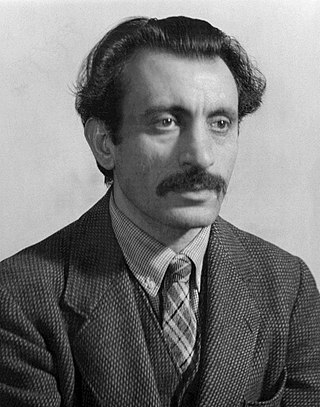
Arshile Gorky was an Armenian-American painter who had a seminal influence on Abstract Expressionism. He spent the last years of his life as a national of the United States. Along with Mark Rothko, Jackson Pollock and Willem de Kooning, Gorky has been hailed as one of the most powerful American painters of the 20th century. The suffering and loss he experienced in the Armenian genocide had crucial influence at Gorky's development as an artist.

Willem de Kooning was a Dutch-American abstract expressionist artist. Born in Rotterdam, in the Netherlands, he moved to the United States in 1926, becoming a US citizen in 1962. In 1943, he married painter Elaine Fried.

Jack Tworkov was an American abstract expressionist painter.
Abstract Imagists is a term derived from a 1961 exhibition in the Guggenheim Museum, New York called American Abstract Expressionists and Imagists. This exhibition was the first in the series of programs for the investigation of tendencies in American and European painting and sculpture.
Sidney Janis was a wealthy clothing manufacturer and art collector who opened an art gallery in New York in 1948. His gallery quickly gained prominence, for he not only exhibited work by the Abstract Expressionists, but also European artists such as Pierre Bonnard, Paul Klee, Joan Miró, and Piet Mondrian. As the critic Clement Greenberg explained in a 1958 tribute to Janis, the dealer's exhibition practices had helped to establish the legitimacy of the Americans, for his policy "not only implied, it declared, that Jackson Pollock, Willem de Kooning, Franz Kline, Phillip Guston, Mark Rothko, and Robert Motherwell were to be judged by the same standards as Matisse and Picasso, without condescension, without making allowances." Greenberg observed that in the late 1940s "the real issue was whether ambitious artists could live in this country by what they did ambitiously. Sidney Janis helped as much as anyone to see that it was decided affirmatively."
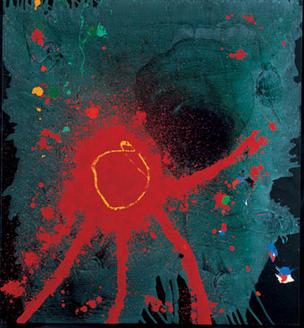
Lyrical abstraction is either of two related but distinct trends in Post-war Modernist painting:
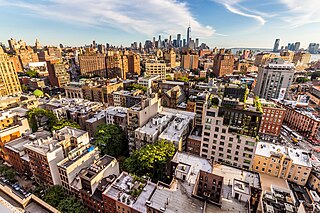
The 9th Street Art Exhibition of Paintings and Sculpture is the official title artist Franz Kline hand-lettered onto the poster he designed for the Ninth Street Show. Now considered historic, the artist-led exhibition marked the formal debut of Abstract Expressionism, and the first American art movement with international influence. The School of Paris, long the headquarters of the global art market, typically launched new movements, so there was both financial and cultural fall-out when all the excitement was suddenly emanating from New York. The postwar New York avant-garde, artists like Willem de Kooning and Jackson Pollock, would soon become "art stars," commanding large sums and international attention. The Ninth Street Show marked their "stepping-out," and that of nearly 75 other artists, including Harry Jackson, Helen Frankenthaler, Michael Goldberg, Joan Mitchell, Grace Hartigan, Robert De Niro Sr., John Ferren, Philip Guston, Elaine de Kooning, Lee Krasner, Franz Kline, Ad Reinhardt, David Smith, Milton Resnick, Joop Sanders, Robert Motherwell, Barnett Newman, and many others who were then mostly unknown to an art establishment that ignored experimental art without a ready market.

Theodoros Stamos was a Greek-American painter. He is one of the youngest painters of the original group of abstract expressionist painters, which included Jackson Pollock, Willem de Kooning and Mark Rothko. His later years were negatively affected by his involvement with the Rothko case.
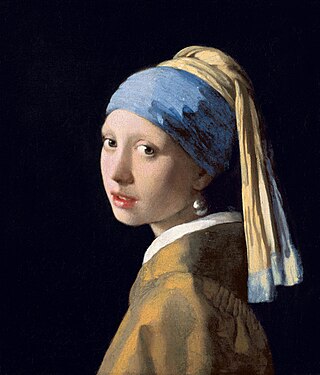
The history of Western painting represents a continuous, though disrupted, tradition from antiquity until the present time. Until the mid-19th century it was primarily concerned with representational and traditional modes of production, after which time more modern, abstract and conceptual forms gained favor.

John Levee was an American abstract expressionist painter who had worked in Paris since 1949. His father was M. C. Levee.

20th-century Western painting begins with the heritage of late-19th-century painters Vincent van Gogh, Paul Cézanne, Paul Gauguin, Georges Seurat, Henri de Toulouse-Lautrec, and others who were essential for the development of modern art. At the beginning of the 20th century, Henri Matisse and several other young artists including the pre-cubist Georges Braque, André Derain, Raoul Dufy and Maurice de Vlaminck, revolutionized the Paris art world with "wild", multi-colored, expressive landscapes and figure paintings that the critics called Fauvism. Matisse's second version of The Dance signified a key point in his career and in the development of modern painting. It reflected Matisse's incipient fascination with primitive art: the intense warm color of the figures against the cool blue-green background and the rhythmical succession of the dancing nudes convey the feelings of emotional liberation and hedonism.
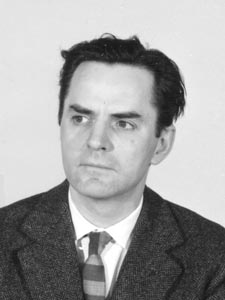
Alfred Russell was an artist who was a member of the early New York school of Abstract Expressionism. He exhibited in Paris and New York along with such well known painters as Willem de Kooning, Jackson Pollock, Ad Reinhardt and Mark Rothko. Later in life, Russell, disillusioned with abstraction, turned to figurative painting, with inspiration from the classical world.
Samuel M. Kootz was a New York City art dealer and author whose Kootz Gallery was one of the first to champion Abstract Expressionist painting.
The Irascibles or Irascible 18 were the labels given to a group of American abstract artists who put name to an open letter, written in 1950, to the president of the Metropolitan Museum of Art, rejecting the museum's exhibition American Painting Today - 1950 and boycotting the accompanying competition. The subsequent media coverage of the protest and a now iconic group photograph that appeared in Life magazine gave them notoriety, popularized the term Abstract Expressionist and established them as the so-called first generation of the putative movement.

Corinne Michelle West (1908–1991) was an American painter; she also used the names Mikael and Michael West. She was an Abstract Expressionist.
It is. A Magazine for Abstract Art was an influential limited edition fine arts magazine that only published six issues in its seven years of existence. Founded by the abstract expressionist sculptor Philip Pavia, the magazine's contributors included a who's who of some of the 20th century's most important artists. Although it primarily focused on painters and sculptors like Willem de Kooning, Franz Kline, Helen Frankenthaler, Jackson Pollock and Isamu Noguchi, it also published artists of other kinds, like musician John Cage and poet Allen Ginsberg. Collectively, the magazines served to catalyze, and catalogue, the contemporaneous life cycle of abstract expressionist thought, from creation to mature expression. Reference to the magazine appears in the archives of Picasso, Motherwell and André Breton, as well as collector Peggy Guggenheim, critic Clement Greenberg and nearly two dozen others.

David Anthony Neil Anfam was an English art historian, author and curator, best known for his voluminous writings on abstract expressionism. He was the senior consulting curator for The Clyfford Still Museum in Denver, Colorado, and the director of its research center.

