
The Teenage Mutant Ninja Turtles are four fictional teenaged superhero anthropomorphic mutant turtles. Named after Italian Renaissance artists, they were trained by their anthropomorphic rat sensei in the Japanese martial art of ninjutsu. From their home in the sewers of New York City, they battle petty criminals, evil overlords, mutated creatures, and alien invaders while attempting to remain hidden from society. They were created by Kevin Eastman and Peter Laird. The characters originated in comic books published by Mirage Studios and expanded into cartoon series, films, video games, toys, and other merchandise. During the peak of the franchise's popularity in the late 1980s and early 1990s, it gained worldwide success and fame.

Battle of the Planets is an American adaptation of the Japanese anime series Science Ninja Team Gatchaman (1972). Of the 105 original Gatchaman episodes, 85 were used in the Battle of the Planets adaptation, produced by Sandy Frank Entertainment. The adaptation was generally faithful to the plot and character development of the original Gatchaman series, but significant additions and reductions were made in order to increase appeal to the North American television market of the late 1970s, as well as avoid controversy from parents; these included the removal of elements of graphic violence and profanity.

Science Ninja Team Gatchaman is a Japanese animated franchise about a five-member superhero team created by Tatsuo Yoshida and produced by Tatsunoko Production. The original anime series, which debuted in 1972, was eponymously entitled Kagaku Ninja Tai Gatchaman and is best known in the English-speaking world as the adaptation entitled Battle of the Planets (1978). The series had additional English adaptations with G-Force: Guardians of Space (1986) and ADV Films' uncut 2005 release. Tatsunoko also uses the official translation Science Commando Gatchaman in related products and media.
Sandy Frank is an American television producer, distributor, and marketer of TV shows to US networks.
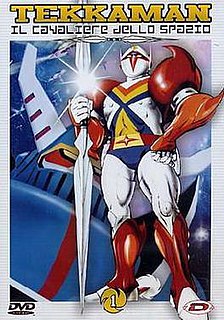
Tekkaman: The Space Knight is an anime produced by Tatsunoko Productions in 1975. A short-lived English adaptation aired in the US in 1984. The first 13 episodes streamed in Japanese with English subtitles on Anime Sols as of spring 2013 exclusively in North America, but the website is now defunct. All 26 episodes were streaming on Viewster in several countries until the website went defunct in 2019. In the 1990s, it was followed by the much more popular Tekkaman Blade, which was dubbed in the U.S. by Saban as Teknoman.

Kunio Okawara is a mechanical designer in the Japanese anime industry. Okawara was the first in the industry to be specifically credited as a mechanical designer. He designed mecha for the Gundam and Brave Series franchises, as well as those of numerous Super Robot and Real Robot shows.
Superheroes have been portrayed in animation since the early 1940s. Up until the late '90s animated cartoons have been the most common venue, right after comics, to depict superheroic adventures. Contrary to live action productions, they do not require expensive sets and special effects, although animation production standards can vary widely in cost. As a result, cartoon shows featuring superheroes became a staple of children's entertainment with a few shows reaching adult audiences.
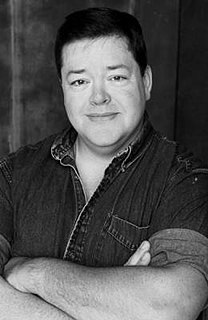
George Edmond Manley is an American voice actor, novelist and screenplay writer. He attended San Jose State University, majoring in theatre arts, University of Nevada, Reno, majoring in journalism and holds his associate of science degree in Computer Information Systems and trained at San Francisco's Voice One Studio and with Braintracks Audio's Nancy Wolfson in commercial and character voiceover.

G-Force: Guardians of Space (1986) is the second American animated television adaptation of the Japanese anime series Science Ninja Team Gatchaman (1972), following Sandy Frank Entertainment's initial 1978 effort Battle of the Planets and preceding ADV Films' 2005 attempt, known merely as Gatchaman. With G-Force, Sandy Frank Entertainment collaborated with Turner Broadcasting to create a newer, more faithful translation of Science Ninja Team Gatchaman for a new audience, and such a translation was made possible with the relaxed television standards of the 1980s, a luxury that the more Star Wars-themed Battle of the Planets did not enjoy.
Kevin Andrew Munroe is a Canadian filmmaker, director, screenwriter, producer, animator and artist, now an American citizen. His best-known work is that of writer and director of TMNT (2007), where he also had a cameo appearance as a diner patron.
Isao Sasaki is a Japanese actor, voice actor, and singer. He has had voice roles in anime such as Legend of the Galactic Heroes, Space Battleship Yamato, and Gatchaman. He has also performed the opening themes for anime such as Yamato, Star of the Giants, Getter Robo, Casshern, Grendizer, Gaiking and tokusatsu series such as Himitsu Sentai Gorenger, J.A.K.Q. Dengekitai, Choujinki Metalder, and most recently Tokusou Sentai Dekaranger. He has also had an acting role in the tokusatsu film Kamen Rider ZO, OOO, Den-O, All Riders: Let's Go Kamen Riders and in the series Kyojuu Tokusou Juspion. He is the official dub voice of Sylvester Stallone, and Clark Kent and Superman in the film series, until he was replaced by Hiroki Tōchi for Superman Returns.
Eagle Riders is an American animated television adaptation of the Japanese anime series Gatchaman II and Gatchaman Fighter, which have been combined together. It was produced by Saban Entertainment. All 65 episodes aired in Australia on Network Ten from August 14, 1997, to December 4, 1997. In the United States, 13 episodes had previously aired in first-run syndication during the fall of 1996 and 1997.

Gatchaman (ガッチャマン) is a three-part original video animation (OVA) based on the popular 1970s anime Science Ninja Team Gatchaman. It was released in Japan and the United States during the mid-1990s. This version of Gatchaman is set in the year 2066 where the evil leader of the nation of Hontwall is threatening to take over the planet. Scientists from the International Science Organization are disappearing and only five teenage heroes, the Science Ninja team, can stop the disaster. The OVAs were licensed by Urban Vision through Harmony Gold USA and were released on VHS and DVD. At Anime Boston 2013, Sentai Filmworks had announced that they have rescued the OVA series along with the original 1970's series for a DVD re-release in October. The series was made available for streaming through Crunchyroll.
Gatchaman Fighter or Gatchaman F is the direct sequel to Gatchaman II. In the continuing saga, a surviving fragment of Leader X mutates into Leader Z, and recruits megalomaniac Count Egobossler to create an army to conquer the world. In order to defeat this new enemy, the Science Ninja Team Gatchaman return with stronger weapons.
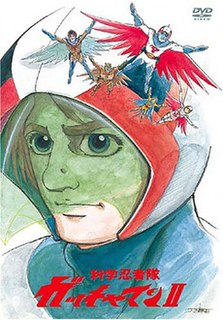
Gatchaman II is the direct sequel to Science Ninja Team Gatchaman, set two years after the first television series. After the defeat of Leader X, he exacts his revenge by mutating a young girl into Gel Sadra, making her the new leader of Galactor. While Galactor returns, Dr. Nambu and the International Science Organization bring the Science Ninja Team Gatchaman back into active duty. This series and Gatchaman F would be the basis of the English-language version named Eagle Riders. Sentai Filmworks has licensed the series and released the complete series on DVD on April 18, 2017.
Science Ninja Team Gatchaman: The Movie is a 1978 Japanese anime superhero science fiction film and a version of the anime series of the same name.
Hisayuki Toriumi, sometimes credited as Eiko Toriumi, was a Japanese director, screenwriter, and novelist. He is best known for having directed the television program Science Ninja Team Gatchaman and its ancillary projects. He is also credited for contributing to several other anime series and authored nearly two dozen novels.
