
Thebes, known to the ancient Egyptians as Waset, was an ancient Egyptian city located along the Nile about 800 kilometers (500 mi) south of the Mediterranean. Its ruins lie within the modern Egyptian city of Luxor. Thebes was the main city of the fourth Upper Egyptian nome and was the capital of Egypt for long periods during the Middle Kingdom and New Kingdom eras. It was close to Nubia and the Eastern Desert, with its valuable mineral resources and trade routes. It was a religious center and the most venerated city during many periods of ancient Egyptian history. The site of Thebes includes areas on both the eastern bank of the Nile, where the temples of Karnak and Luxor stand and where the city was situated; and the western bank, where a necropolis of large private and royal cemeteries and funerary complexes can be found. In 1979, the ruins of ancient Thebes were classified by UNESCO as a World Heritage Site.

Taharqa, also spelled Taharka or Taharqo, was a pharaoh of the Twenty-fifth Dynasty of Egypt and qore (king) of the Kingdom of Kush from 690 to 664 BC. He was one of the "Black Pharaohs" who ruled over Egypt for nearly a century, or one of the Nubian Pharaohs of Egypt, since the traditional representation of the 25th dynasty as "Black Pharaohs" has drawn criticism from scholars, specifically because the term suggests that other dynasties did not share similar southern origins.. They also argue that the term ignores the genetic continuum that linked ancient Nubians and Egyptians.

Amenemhat III, also known as Amenemhet III, was a pharaoh of ancient Egypt and the sixth king of the Twelfth Dynasty of the Middle Kingdom. He was elevated to throne as co-regent by his father Senusret III, with whom he shared the throne as the active king for twenty years. During his reign, Egypt attained its cultural and economic zenith of the Middle Kingdom.

The Ny Carlsberg Glyptotek, commonly known simply as Glyptoteket, is an art museum in Copenhagen, Denmark. The collection represents the private art collection of Carl Jacobsen (1842–1914), the son of the founder of the Carlsberg Breweries.

The Middle Kingdom of Egypt is the period in the history of ancient Egypt following a period of political division known as the First Intermediate Period. The Middle Kingdom lasted from approximately 2040 to 1782 BC, stretching from the reunification of Egypt under the reign of Mentuhotep II in the Eleventh Dynasty to the end of the Twelfth Dynasty. The kings of the Eleventh Dynasty ruled from Thebes and the kings of the Twelfth Dynasty ruled from el-Lisht.

Mentuhotep II, also known under his prenomen Nebhepetre, was an ancient Egyptian pharaoh, the sixth ruler of the Eleventh Dynasty. He is credited with reuniting Egypt, thus ending the turbulent First Intermediate Period and becoming the first pharaoh of the Middle Kingdom. He reigned for 51 years, according to the Turin King List. Mentuhotep II succeeded his father Intef III on the throne and was in turn succeeded by his son Mentuhotep III.

Senusret I also anglicized as Sesostris I and Senwosret I, was the second pharaoh of the Twelfth Dynasty of Egypt. He ruled from 1971 BC to 1926 BC, and was one of the most powerful kings of this Dynasty. He was the son of Amenemhat I. Senusret I was known by his prenomen, Kheperkare, which means "the Ka of Re is created." He expanded the territory of Egypt allowing him to rule over an age of prosperity.
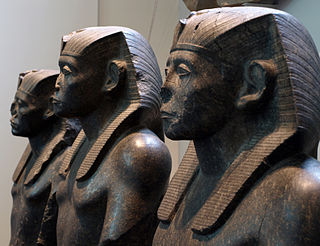
Khakaure Senusret III was a pharaoh of Egypt. He ruled from 1878 BC to 1839 BC during a time of great power and prosperity, and was the fifth king of the Twelfth Dynasty of the Middle Kingdom. He was a great pharaoh of the Twelfth Dynasty and is considered to rule at the height of the Middle Kingdom. Consequently, he is regarded as one of the sources for the legend about Sesostris. His military campaigns gave rise to an era of peace and economic prosperity that reduced the power of regional rulers and led to a revival in craftwork, trade, and urban development. Senusret III was among the few Egyptian kings who were deified and honored with a cult during their own lifetime.

The necropolis of Draʻ Abu el-Naga' is located on the West Bank of the Nile at Thebes, Egypt, just by the entrance of the dry bay that leads up to Deir el-Bahari and north of the necropolis of el-Assasif. The necropolis is located near the Valley of the Kings.

Khutawyre Wegaf was a pharaoh of the early Thirteenth Dynasty of Egypt in the late Middle Kingdom/Second Intermediate Period. He is known from several sources, including a stele and statues. In the Turin King List he is the first ruler of this dynasty with a reign of 2 regnal years.

Khaneferre Sobekhotep IV was one of the more powerful Egyptian kings of the 13th Dynasty, who reigned at least eight years. His brothers, Neferhotep I and Sihathor, were his predecessors on the throne, the latter having only ruled as coregent for a few months.
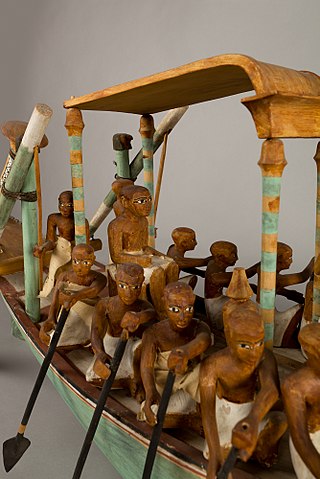
The ancient Egyptian official Meketre was chancellor and high steward during the reign of Mentuhotep II, Mentuhotep III and perhaps Amenemhat I, during the Middle Kingdom.

The mortuary temple of Hatshepsut is a mortuary temple built during the reign of Pharaoh Hatshepsut of the Eighteenth Dynasty of Egypt. Located opposite the city of Luxor, it is considered to be a masterpiece of ancient architecture. Its three massive terraces rise above the desert floor and into the cliffs of Deir el-Bahari. Hatshepsut's tomb, KV20, lies inside the same massif capped by El Qurn, a pyramid for her mortuary complex. At the edge of the desert, 1 km (0.62 mi) east, connected to the complex by a causeway, lies the accompanying valley temple. Across the river Nile, the whole structure points towards the monumental Eighth Pylon, Hatshepsut's most recognizable addition to the Temple of Karnak and the site from which the procession of the Beautiful Festival of the Valley departed. Its axes identify the temple's twin functions: its central east-west axis served to receive the barque of Amun-Re at the climax of the festival, while its north-south axis represented the life cycle of the pharaoh from coronation to rebirth.

The Sphinx of Taharqo is a granite gneiss statue of a sphinx with the face of Taharqo. He was a Nubian king, who was one of the 25th Egyptian Dynasty rulers of the Kingdom of Kush. It is now in the British Museum in London.
Intef (Antef) was an Ancient Egyptian general of the 11th Dynasty, around 2000 BC, under king Mentuhotep II. His main title was overseer of troops often translated as general. Other titles include royal sealer and sole friend.
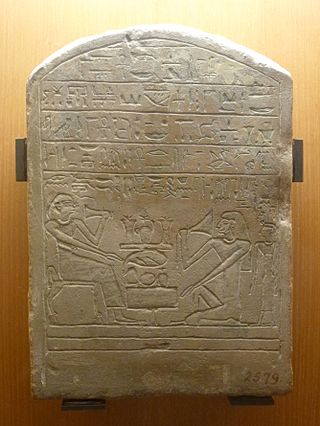
Senewosret-Ankh {s-n-wsrt-ꜥnḫ/snfrw} was an ancient Egyptian vizier of the Middle Kingdom, dating to the end of the Twelfth or to the beginning of the Thirteenth Dynasty.
This page list topics related to ancient Egypt.

Gemniemhat was an ancient Egyptian official who is known from his well preserved burial excavated at Saqqara. Gemniemhat dates to the end of the First Intermediate Period or early Middle Kingdom. His burial was found by Cecil Mallaby Firth in 1921, who excavated part of the cemeteries around the pyramid of Teti. The burial of Gemniemhat was found at the bottom of a shaft and contained two decorated coffins. The head of the deceased was covered with a mummy mask. Around the coffins were found many wooden models showing the production of food, two female offering bearers and a small wooden statue of Gemniemhat. The objects are today in the Ny Carlsberg Glyptotek, although only the inner coffin could be preserved. Above ground there was a small mud brick mastaba decorated with a false door. Here, Gemniemhat bears several titles, including royal sealer, steward, overseer of the granaries. He was also funerary priest at the pyramid of king Merikare.

Amanimalel was a Kushite queen of the Napatan kingdom of Nubia, likely a spouse of king Senkamanisken living in the second half of the 7th century BC. She is mostly known from one or possibly two statues of her of very high quality.
Dedusobek Bebi was a high official of the late Thirteenth Dynasty of ancient Egypt. He became the "Great Scribe of the Vizier". This position was directly under the Vizier acting as a deputy.


