
A generalist is a person with a wide array of knowledge on a variety of subjects, useful or not. It may also refer to:
A generalist is a person with a wide array of knowledge on a variety of subjects, useful or not. It may also refer to:


Medicine is the science and practice of caring for a patient, managing the diagnosis, prognosis, prevention, treatment, palliation of their injury or disease, and promoting their health. Medicine encompasses a variety of health care practices evolved to maintain and restore health by the prevention and treatment of illness. Contemporary medicine applies biomedical sciences, biomedical research, genetics, and medical technology to diagnose, treat, and prevent injury and disease, typically through pharmaceuticals or surgery, but also through therapies as diverse as psychotherapy, external splints and traction, medical devices, biologics, and ionizing radiation, amongst others.

A polymath is an individual whose knowledge spans a substantial number of subjects, known to draw on complex bodies of knowledge to solve specific problems.
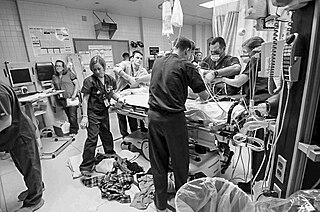
Emergency medicine is the medical speciality concerned with the care of illnesses or injuries requiring immediate medical attention. Emergency physicians continuously learn to care for unscheduled and undifferentiated patients of all ages. As first-line providers, in coordination with Emergency Medical Services, they are primarily responsible for initiating resuscitation and stabilization and performing the initial investigations and interventions necessary to diagnose and treat illnesses or injuries in the acute phase. Emergency physicians generally practise in hospital emergency departments, pre-hospital settings via emergency medical services, and intensive care units. Still, they may also work in primary care settings such as urgent care clinics.
In the medical profession, a general practitioner (GP) is a physician who treats acute and chronic illnesses and provides preventive care and health education to patients of all ages. Their duties are not confined to specific fields of medicine, and they have particular skills in treating people with multiple health issues. They are trained to treat patients to levels of complexity that vary between countries.
Internal medicine or general internal medicine is the medical specialty dealing with the prevention, diagnosis, and treatment of internal diseases. Doctors specializing in internal medicine are called internists, or physicians in Commonwealth nations. Internists are medical specialists that are skilled in the management of patients who have undifferentiated or multi-system disease processes. Internists care for hospitalized (inpatient) and ambulatory (outpatient) patients and may play a major role in teaching and research. Internists are qualified physicians with postgraduate training in internal medicine and should not be confused with "interns", a term for doctors in their first year of residency training.

Health care or healthcare is the improvement of health via the prevention, diagnosis, treatment, amelioration or cure of disease, illness, injury, and other physical and mental impairments in people. Health care is delivered by health professionals and allied health fields. Medicine, dentistry, pharmacy, midwifery, nursing, optometry, audiology, psychology, occupational therapy, physical therapy, athletic training, and other health professions all constitute health care. It includes work done in providing primary care, secondary care, and tertiary care, as well as in public health.

Primary care is the day-to-day healthcare given by a health care provider. Typically this provider acts as the first contact and principal point of continuing care for patients within a healthcare system, and coordinates other specialist care that the patient may need. Patients commonly receive primary care from professionals such as a primary care physician, a physician assistant, or a nurse practitioner. In some localities, such a professional may be a registered nurse, a pharmacist, a clinical officer, or an Ayurvedic or other traditional medicine professional. Depending on the nature of the health condition, patients may then be referred for secondary or tertiary care.

A primary care physician (PCP) is a physician who provides both the first contact for a person with an undiagnosed health concern as well as continuing care of varied medical conditions, not limited by cause, organ system, or diagnosis. The term is primarily used in the United States. In the past, the equivalent term was 'general practitioner' in the US; however in the United Kingdom and other countries the term general practitioner is still used.

Medical education is education related to the practice of being a medical practitioner, including the initial training to become a physician and additional training thereafter.

Medical education in Australia includes the educational activities involved in the initial and ongoing training of Medical Practitioners. In Australia, medical education begins in Medical School; upon graduation it is followed by a period of pre-vocational training including Internship and Residency; thereafter, enrolment into a specialist-vocational training program as a Registrar eventually leads to fellowship qualification and recognition as a fully qualified Specialist Medical Practitioner. Medical education in Australia is facilitated by Medical Schools and the Medical Specialty Colleges, and is regulated by the Australian Medical Council (AMC) and Australian Health Practitioner Regulation Agency (AHPRA) of which includes the Medical Board of Australia where medical practitioners are registered nationally.

A medical laboratory scientist (MLS) or clinical laboratory scientist (CLS) or medical technologist (MT) performs diagnostic testing of blood and body fluids in clinical laboratories. The scope of a medical laboratory scientist's work begins with the receipt of patient or client specimens and terminates with the delivery of test results to physicians and other healthcare providers. The utility of clinical diagnostic testing relies squarely on the validity of test methodology. To this end, much of the work done by medical laboratory scientists involves ensuring specimen quality, interpreting test results, data-logging, testing control products, performing calibration, maintenance, validation, and troubleshooting of instrumentation as well as performing statistical analyses to verify the accuracy and repeatability of testing. Medical laboratory scientists may also assist healthcare providers with test selection and specimen collection and are responsible for prompt verbal delivery of critical lab results. Medical Laboratory Scientist in health settings also play an important role in the diagnosis of diseses conditions. An estimated 70% of medical decisions are based on laboratory test results and MLS contributions affect 95% of a health system's costs.
Infomed is the Cuban health portal and the network of people and institutions that share the purpose of facilitating the access to the health information in Cuba.
Multipotentiality is an educational and psychological term referring to the ability and preference of a person, particularly one of strong intellectual or artistic curiosity, to excel in two or more different fields.
The BTEC Level 3 diploma is a Further Education qualification and vocational qualification taken in England, Wales and Northern Ireland. The qualification is organised and awarded by Pearson within the BTEC brand and it is equivalent to A-Levels. It is equivalent to the GCE A Levels, more specifically to three A2 awards and the AVCE.
Specialization or Specialized may refer to:
The Australian College of Rural and Remote Medicine (ACRRM) is one of the two Australian Medical Council (AMC) accredited general practice colleges in Australia. The College sets and upholds standards for best practice provision of rural and remote medical care. It provides training and certification, and professional development for rural general practice. It also provides advocacy and support for current and prospective rural doctors.
Technologist may refer to:

Veterinary medicine in the United States is the performance of veterinary medicine in the United States, normally performed by licensed professionals, and subject to provisions of statute law which vary by state. Veterinary medicine is normally led by veterinary physicians, termed veterinarians or vets.
An information technology generalist is a technology professional proficient in many facets of information technology without any specific specialty. Furthermore, an IT generalist is generally considered to possess general business knowledge and soft skills allowing them to be adaptable in a wide array of work environments. The IT Generalist is often able to fulfill many different roles within a company depending on specific technology needs. In a small business environment, budgets often delegate many different facets of technology to a single individual, especially considering a small business will often require an individual proficient in desktop support, web page design, databases, phone systems, and even server administration. The role of the IT Generalist within a larger company, however, often becomes more of a project leader or integrations specialist due to a project team consisting of a varying degree of IT specialists and interfacing with end-users requiring soft-skills.
BMJ Best Practice is an online decision-support tool for use at the point of care. It was created in 2009 by The BMJ.