
The economy of Hong Kong is a highly developed free-market economy characterised by low taxation, almost free port trade and well-established international financial market. Its currency, called the Hong Kong dollar, is legally issued by three major international commercial banks, and is pegged to the US dollar. Interest rates are determined by the individual banks in Hong Kong to ensure they are market driven. There is no officially recognised central banking system, although the Hong Kong Monetary Authority functions as a financial regulatory authority.
Baby boomers are the demographic cohort following the Silent Generation and preceding Generation X. The Baby Boom generation is most often defined as those individuals born between 1946 and 1964.
Millennials, also known as Generation Y, are the demographic cohort following Generation X and preceding Generation Z. Researchers and popular media use the early 1980s as starting birth years and the mid-1990s to early 2000s as ending birth years, with 1981 to 1996 a widely accepted definition. Millennials are sometimes referred to as "echo boomers" due to a major surge in birth rates in the 1980s and 1990s, and because millennials are often the children of the baby boomers. The characteristics of millennials vary by region and by individual, and the group experiences a variety of social and economic conditions, but they are generally marked by their coming of age in the Information Age, and are comfortable in their usage of digital technologies and social media.
The welfare state is a form of government in which the state protects and promotes the economic and social well-being of the citizens, based upon the principles of equal opportunity, equitable distribution of wealth, and public responsibility for citizens unable to avail themselves of the minimal provisions for a good life. Sociologist T. H. Marshall described the modern welfare state as a distinctive combination of democracy, welfare, and capitalism.

Welfare is a type of government support for the citizens of that society. Welfare may be provided to people of any income level, as with social security, but it is usually intended to ensure that people can meet their basic human needs such as food and shelter. Welfare attempts to provide a minimal level of well-being, usually either a free- or a subsidized-supply of certain goods and social services, such as healthcare, education, and vocational training.
The balance of payments, also known as balance of international payments and abbreviated B.O.P. or BoP, of a country is the record of all economic transactions between the residents of the country and the rest of the world in a particular period of time. These transactions are made by individuals, firms and government bodies. Thus the balance of payments includes all external visible and non-visible transactions of a country. It is an important issue to be studied, especially in international financial management field, for a few reasons.
Welfare reforms are changes in the operation of a given welfare system, with the goals of reducing the number of individuals dependent on government assistance, keeping the welfare systems affordable, and assisting recipients to become self-sufficient. Classical liberals and conservatives generally argue that welfare and other tax-funded services reduce incentives to work, exacerbate the free-rider problem, and intensify poverty. On the other hand, socialists generally criticize welfare reform because it usually minimizes the public safety net and strengthens the capitalist economic system. Welfare reform is constantly debated because of the varying opinions on the government's determined balance of providing guaranteed welfare benefits and promoting self-sufficiency.

The crude birth rate in a year or other period is the total number of live births per 1,000 population. The number of live births is normally taken from a universal registration system for births; population counts from a census, and estimation through specialized demographic techniques. The birth rate is used to calculate population growth. The estimated average population may be taken as the mid-year population.
A currency crisis is a situation in which serious doubt exists as to whether a country's central bank has sufficient foreign exchange reserves to maintain the country's fixed exchange rate. The crisis is often accompanied by a speculative attack in the foreign exchange market. A currency crisis results from chronic balance of payments deficits, and thus is also called a balance of payments crisis. Often such a crisis culminates in a devaluation of the currency.
A social issue is a problem that influences many individuals within a society. A social issue has many categories in depth as well as light. It's a common problem we see happening in our society. A social issue can be considered as a problem that influences many people and many peoples strive to solve the issue. It is often the consequence of factors extending beyond an individual's control, and is the source of a conflicting opinion on the grounds of what is perceived as morally correct or incorrect personal life or Interpersonal social life. Social issues are distinguished from economic issues; however, some issues have both social and economic aspects. There are also issues that don't fall into either category, such as warfare.
Social welfare, assistance for the ill or otherwise disabled and the old, has long been provided in Japan by both the government and private companies. Beginning in the 1920s, the Japanese government enacted a series of welfare programs, based mainly on European models, to provide medical care and financial support. During the post-war period, a comprehensive system of social security was gradually established.
Generation Z, or Gen Z for short, is the demographic cohort succeeding the Millennials. Demographers and researchers typically use the mid- to late-1990s as starting birth years, while consensus has not been reached on the ending birth years. Children of Generation X and sometimes Millennials, members of Generation Z have used digital technology since a young age and are comfortable with the Internet and social media, but are not necessarily digitally literate.

Immigration is the international movement of people to a destination country of which they are not natives or where they do not possess citizenship in order to settle or reside there, especially as permanent residents or naturalized citizens, or to take up employment as a migrant worker or temporarily as a foreign worker.
The Nordic model comprises the economic and social policies as well as typical cultural practices common to the Nordic countries. This includes a comprehensive welfare state and multi-level collective bargaining, with a high percentage of the workforce unionised and a large percentage of the population employed by the public sector. The Nordic model began to gain attention after World War II.
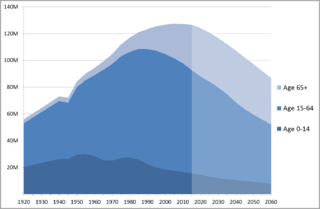
The aging of Japan is thought to outweigh all other nations, with Japan being purported to have the highest proportion of elderly citizens. Japan is experiencing a "super-aging" society both in rural and urban areas. According to 2014 estimates, 33.0% of the Japanese population is above the age of 60, 25.9% are aged 65 or above, and 12.5% are aged 75 or above. People aged 65 and older in Japan make up a quarter of its total population, estimated to reach a third by 2050.
Generational accounting is a method of measuring the fiscal burdens facing today's and tomorrow's children. Laurence Kotlikoff's individual and co-authored work on the relativity of fiscal language demonstrates that conventional fiscal measures, including the government's deficit, are not well defined from the perspective of economic theory. Instead, their measurement reflects economically arbitrary fiscal labeling conventions. "Economics labeling problem," as Kotlikoff calls it, has led to gross misreadings of the fiscal positions of different countries, starting with the United States, which has a relatively small debt-to-GDP ratio, but is, arguably, in worse fiscal shape than any developed country. Kotlikoff's identification of economics labeling problem, beginning with his 1984 Deficit Delusion article in The Public Interest led him to push for generational accounting, a term he coined and that provides the title for his 1993 book, Generational Accounting.
In India, the child sex ratio is defined as the number of females per thousand males in the age group 0–6 years in a human population. Thus it is equal to 1000 x the reciprocal of the sex ratio in the same age group, i.e. under age seven. An imbalance in this age group will extend to older age groups in future years. Currently, the ratio of males to females is generally significantly greater than 1, i.e. there are more boys than girls.

Basic income, also called universal basic income (UBI), citizen's income, citizen's basic income in the United Kingdom, basic income guarantee or freedom dividend in the United States and Canada, or basic living stipend or universal demogrant, is a periodic payment delivered to all on an individual basis without means test or work requirement. The incomes would be:
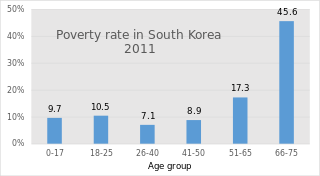
South Korea's pension scheme was introduced relatively recently, compared to other democratic nations. Half of the country's population aged 65 and over lives in relative poverty, or nearly four times the 13% average for member countries of the Organisation for Economic Co-operation and Development (OECD). This makes old age poverty an urgent social problem. Public social spending by general government is half the OECD average, and is the lowest as a percentage of GDP among OECD member countries.

Public pensions in Greece are designed to provide incomes to Greek pensioners upon reaching retirement. For decades pensions in Greece were known to be among the most generous in the European Union, allowing many pensioners to retire earlier than pensioners in other European countries. This placed a heavy burden on Greece's public finances which made the Greek state increasingly vulnerable to external economic shocks, culminating in a recession due to the 2008 financial crisis and subsequent European debt crisis. This series of crises has forced the Greek government to implement economic reforms aimed at restructuring the pension system and eliminating inefficiencies within it. Measures in the Greek austerity packages imposed upon Greek citizens by the European Central Bank have achieved some success at reforming the pension system despite having stark ramifications for standards of living in Greece, which have seen a sharp decline since the beginning of the crisis.