
Georg Bydlinski (born 30 May 1956 in Graz) is an Austrian writer.
Georg Bydlinski (born 30 May 1956 in Graz) is an Austrian writer.
After studying English literature and religious instruction, Bydlinski has lived as a freelance writer in Mödling since 1982. In 1990, he participated at the Festival of German-Language Literature in Klagenfurt.
He has written many novels, children's books and poems, co-founded a small publishing house, and is an editor of anthologies as well as a translator. [1]
Georg Bydlinski is a member of "IG Autorinnen Autoren", Grazer Autorenversammlung, Österreichischer Schriftstellerverband, "Literaturkreis Podium" and "Friedrich-Bödecker-Kreis Hannover".
Since 2013, he has been working together with the producer Thomas Raber.
Carl Wilhelm, was a prolific German film director, film producer and screenwriter of the silent film era, at the end of which his career apparently entirely faded away and he vanished into obscurity.

Paul Alfred Kleinert is a German writer, editor and translator.

Willy Puchner is an Austrian photographer, artist, painter, and author.

Heinrich Maier was an Austrian Roman Catholic priest, pedagogue, philosopher and a member of the Austrian resistance, who was executed as the last victim of Hitler's regime in Vienna.
August Everding was a German opera director and administrator.
Marcel Rubin was an Austrian composer.

The Carltheater was a theatre in Vienna. It was in the suburbs in Leopoldstadt at Praterstraße 31.
The "Urgent Call for Unity" was an appeal by the Internationaler Sozialistischer Kampfbund (ISK) to defeat the National Socialist German Workers Party. It was signed by nearly three dozen well-known German scientists, authors and artists in advance of the German federal election in July 1932.

Josef Haslinger is an Austrian writer.
The Bremen Literature Prize is a German literary award. The prize money is €25,000.

Sabine Derflinger is an Austrian film director, screenwriter, producer and dramaturgical consultant. She lives and works in Vienna and Berlin. Many of her films have won several awards, notably Geraubte Kindheit, Vollgas, Kleine Schwester, 42plus and Tag und Nacht. She is also well known for directing a number of films in the cult series Tatort.
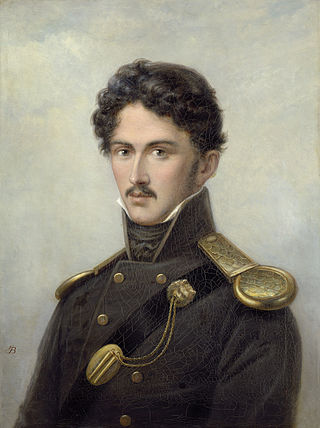
Leyer und Schwert is a patriotic opera in five acts composed by Wendelin Weißheimer to a libretto by Louise Otto-Peters. Also known as Theodor Körner, the opera was composed in 1863/64 and premiered in Munich in 1872. The libretto is based on an episode in the life of the German poet and soldier Theodor Körner.
Peter Minich was an Austrian stage actor who became a tenor performing in operas, operettas and musical films. He was for decades the lead tenor of the Volksoper in Vienna, focused on Viennese operetta.
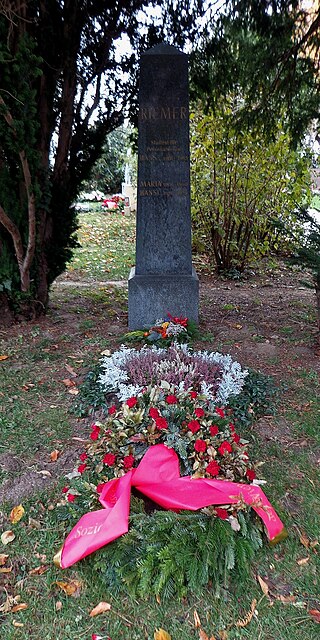
Hans Riemer was an Austrian politician of the Social Democratic Party of Austria (SPÖ). From 1949 to 1956 he was a member of the Bundesrat and from 1956 to 1963 a member of the city council of Vienna.
Herta Talmar was an Austrian operetta singer (soprano) as well as an actress.
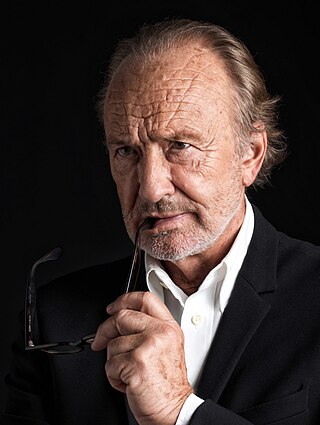
Miguel Herz-Kestranek is an Austrian actor and author.

Robert Schindel is an Austrian lyricist, director and author.
György Sebestyén was a Hungarian-Austrian writer, radio dramatist and screenwriter.

Wolfgang Schoor was a German composer, who wrote orchestral works, song cycles and chamber music and the music for numerous children's and documentary films and radio plays.
Heinz Janisch is an Austrian radio journalist and writer. In 2024, he won the Hans Christian Andersen Award for Writing.
| International | |
|---|---|
| National | |
| People | |
| Other | |
