
Georg Heinrich Tischbein (1753/55, Marburg - 4 March 1848, Bremen) was a German engraver, etcher, cartographer and engineer from the Tischbein family of artists.
Georg Heinrich Tischbein (1753/55, Marburg - 4 March 1848, Bremen) was a German engraver, etcher, cartographer and engineer from the Tischbein family of artists.
His father, Johann (1717-1757), was an engineering professor at the University of Marburg. The painter and set designer, Johann Valentin Tischbein, was his uncle. Christian Wilhelm (1751-1824), his older brother, was a painter, architect and gallery director.
In 1785, he went to Bremen and, from 1789 to 1791, engraved the tables and illustrations for the Schrötersche Mondwerk by Johann Hieronymus Schröter. In 1796, together with the cartographer, Carl Ludwig Murtfeldt , he helped create the Murtfeldtsche Karte; the first map of Bremen produced by using triangulation. In 1804, he did a copper engraved map of the Duchy of Oldenburg, based on drawings by the surveyor, Christoph Friedrich Mentz (1765-1832).
In addition to maps, he produced portraits, cityscapes and landscapes.
 Media related to Georg Heinrich Tischbein at Wikimedia Commons
| International | |
|---|---|
| National | |
| Artists | |
| People | |
| Other | |
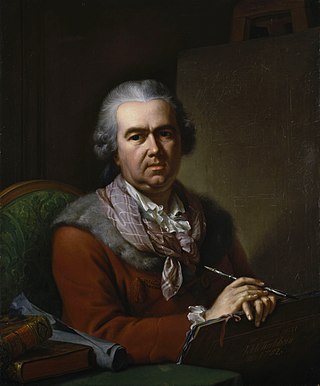
Johann Heinrich Tischbein was a German painter. He was one of the most respected European painters in the 18th century and an important member of the Tischbein family of German painters, which spanned three generations. His work consisted primarily of portraits of the nobility, mythological scenes, and historical paintings. For his mythology paintings his models were mostly members of the upper nobility.

Johann Heinrich Wilhelm Tischbein, known as the Goethe Tischbein, was a German painter from the Tischbein family of artists.
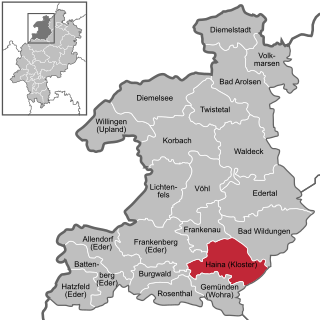
Haina (Kloster) is a municipality in Waldeck-Frankenberg in northwest Hesse, Germany.
Events from the year 1753 in art.
Events from the year 1722 in art.

Georg Melchior Kraus was a German painter. He was a co-founder of the Weimar Princely Free Drawing School, together with Friedrich Justin Bertuch, in 1776.

Friedrich Georg Weitsch was a German painter and etcher.

Friedrich (Fritz) Bury was Court painter to the royal courts of Kassel and Brussels, a German painter born in Hanau. He studied first under his father Jean Jacques Bury, who was a goldsmith and professor in the Academy of Design in Hanau, and with Anton Wilhelm Tischbein. In 1780 he visited for two years the Kunstakademie Düsseldorf, where he met Johann Heinrich Lips, with whom he returned to Hanau at the age of 19 and two month later they traveled to Rome. From November 1782 to July 1785 he lived with a nephew of Tischbein, Johann Heinrich Wilhelm Tischbein, Johann Georg Schütz and Lips in a rear building of the Palazzo Piombino in Via del Babuino 51. Later they followed their landlord to Via del Corso no. 18, now known as the Casa di Goethe, as Johann Wolfgang von Goethe also lived and worked there for over a year.

Johann Friedrich August Tischbein, known as the Leipziger Tischbein was a German portrait painter from the Tischbein family of artists.
The Tischbein family was a German family of artists, originating in Hesse and spanning three generations. The family patriarch, Johann Heinrich Tischbein (1682–1764), was a master baker at the State Hospital in Haina. The Tischbeins also produced a number of master carpenters..

Johann Jacob Tischbein, known as the Lübecker Tischbein, was a German painter from the Tischbein family of artists.

Johann Valentin Tischbein was a German painter from the Tischbein family of artists.

The Casa di Goethe is a museum in Rome, in Via del Corso 18, dedicated to Johann Wolfgang von Goethe, his Italian Journey and his life at Rome in the years from 1786 through 1788. During his journey Goethe wrote a journal and also many letters which would be published in 1816-17 as the Italian Journey.

Goethe in the Roman Campagna is a 1787 painting by Johann Heinrich Wilhelm Tischbein, a German Neoclassical painter, depicting Johann Wolfgang von Goethe when the writer was travelling in Italy. Goethe's book on his travels to Italy from 1786 to 1788, called Italian Journey, was published in 1816–17; the book is based on his diaries. Since 1887, the painting has been in the possession of the Städel Museum in Goethe's hometown Frankfurt.
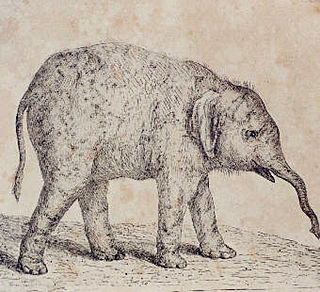
Johann Heinrich Tischbein, known as The Younger was a German painter and engraver from the Tischbein family of artists.
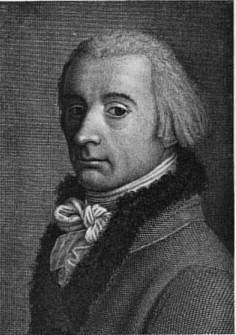
Johann Heinrich Lips was a Swiss copper engraver; mostly of portraits.

The Collegium Carolinum was a scientific institution in Kassel, Germany. It was founded in 1709 by Charles I, Landgrave of Hesse-Kassel and closed after the 1785 death of Frederick II, Landgrave of Hesse-Kassel. The Ottoneum housed most of its activities. However, a new anatomical theatre, the first in Germany, was used by Samuel Thomas von Sömmerring.
Friedrich Ludwig Heinrich Waagen also Christian Friedrich Ludwig Heinrich Waagen, Wagen or Wage) was a German portrait, history and landscape painter born in the Holy Roman Empire. Hardly anything is known about his works. However, he had acquired extensive knowledge of art, amassed a collection of paintings in Hamburg and was known to friends with or in-laws of many important personalities of his time. Gustav Friedrich Waagen (1794-1868) and Carl Waagen (1800-1873) are his sons.
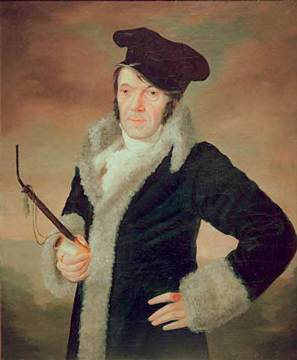
Conrad Westermayr was a German painter and engraver.
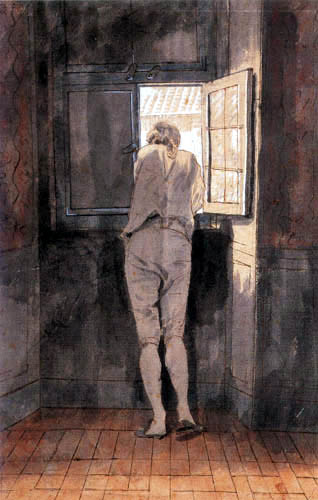
Goethe at the Window is a 1786/7 watercolour by German painter Johann Heinrich Wilhelm Tischbein. It depicts the poet Johann Wolfgang von Goethe looking out of the window of the apartment in Rome he shared with the artist.
